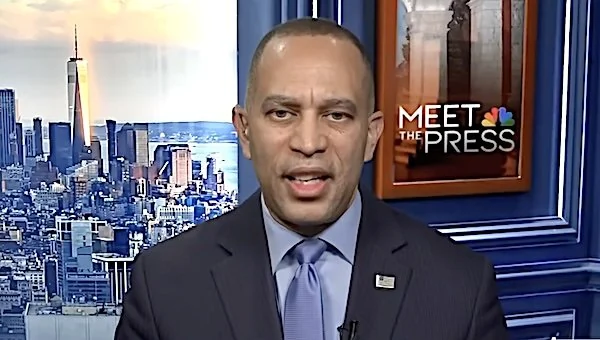
Jeffries is the House minority leader, but if his caucus elects him as speaker in January, he will have to navigate a split among establishment Democrats, progressives, and a new class of members
affiliated with the Democratic Socialists of America.
It also isn't a certainty. Axios reported last week that a block of far-left House candidates plans to make policy demands from Jeffries before supporting him as speaker. Some House Democrats said they wouldn't support him, while others didn't commit.
Democrats last held the House in 2022, during President Joe Biden's administration.
Over the last two years, six states drew up different congressional maps as state lawmakers sought a partisan advantage. After Texas redrew its map to advantage Republicans, California redrew its map to help Democrats gain seats.
Over the last two years, six mostly Republican-leaning states drew up new congressional maps as state lawmakers sought a partisan advantage. After Texas redrew its map to favor Republicans, California redrew its map to help Democrats gain seats.
The red states of Florida and Tennessee, as well as red-leaning battleground states of North Carolina and Ohio, also redrew their congressional maps.
Alabama, Louisiana, and Utah adopted new maps as a result of litigation; the Supreme Court in June allowed Alabama to use its map drawn in 2023. In Utah, the state supreme court rejected a legislative effort to block a voter-approved map. A Missouri map was redrawn, but that was stalled by the Supreme Court pending the results of a citizen-initiated referendum.
The year was marked by 60 retirements, 36 Republicans who didn't run for reelection and 26 Democrats.
Among the most significant retirements this year were former House Speaker Nancy Pelosi, D-Calif., and Rep. Jerry Nadler, D-N.Y., on the Democratic side, as well as Rep. Darrell Issa, R-Calif., and Rep. Chip Roy, R-Texas, who lost a Republican primary bid for Texas attorney general.
Ahead of the election, the Cook Political Report ranked 17 races as tossups, 12 seats that belonged to Republicans, and five held by Democrats. That included open seats in Florida, Iowa, Kentucky, Michigan, and Montana.
The open seats were held by Rep. Lois Frankel, D-Fla.; Rep. Ashley Hinson, R-Iowa, who ran for the U.S. Senate seat held by retiring GOP Sen. Joni Ernst; Rep. Andy Barr, R-Ky., who won the Senate seat held by former Senate Republican leader Mitch McConnell; Rep. John James, R-Mich., who ran for governor; Rep. Ryan Zinke, R-Mont.; and Rep. Greg Casar, R-Texas.
[Editor’s note: This story originally was published by The Daily Signal.]
Source link