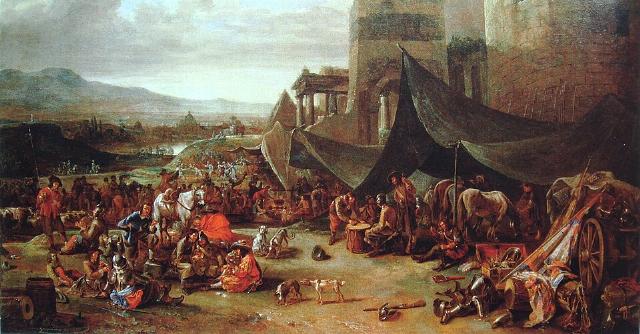
From Wikimedia Commons: Sack of Rome of 1527 (Johannes Lingelbach, unknown date)
The fragility of civilization is an equally compelling and unsettling insight in Western thought.
Sigmund Freud, Thomas Hobbes, and Werner Herzog, each from distinct intellectual traditions, dwelt on the same precarious reality: the elaborate structures of order, law, and restraint that define civilized life rest upon a shallow foundation beneath which chaos continually presses. Their collective vision, later formalized by primatologists and economists as "veneer theory," insists that the achievements of high culture and stable governance are never secure possessions. They are temporary victories against deeper forces of aggression, self-interest, and disorder that human nature perpetually renews.
Freud's Civilization and Its Discontents (1930) presents the most psychologically intimate account of the tension between social adaptation and instinct. Human beings, he contended, carry within them powerful aggressive drives that civilization must continually suppress if social existence is to remain possible. The psychic cost of this repression is permanent dissatisfaction; the alternative is the collapse of the restraints that make collective life tolerable.
Long before Freud, Hobbes had mapped the political consequences of the same insight in Leviathan (1651). In the absence of a common power capable of overawing all, human life reverts to a condition of perpetual insecurity in which force and cunning alone determine outcomes. The "social contract," for Hobbes, is therefore less a celebration of rational progress than a desperate bargain struck to escape mutual destruction.
A product of our own time, Herzog's cinematic metaphor sharpens the image still further: "Civilization is like a thin layer of ice upon an ocean of chaos and darkness." A relatively minor shock—economic crisis, demographic upheaval, institutional failure—can fracture the surface and expose the savagery that had never disappeared. Frans de Waal's veneer theory and John Maynard Keynes's description of civilization as a "thin and precarious crust" simply restate the same assessment in the languages of biology and economics, respectively. Morality and order are surface phenomena; the substrate remains opportunistic and violent: human order on top of basic instincts.
A civilized society that aspires to the rule of law rather than the rule of the stronger therefore requires specific institutional and cultural supports. The supremacy of law itself constitutes the first condition. No individual, office, or faction may claim exemption from the legal order. Aristotle's insistence that law rather than men should govern expresses this principle with classical clarity. When the sovereign or the administrative apparatus places itself above the rules it enforces, the distinction between legitimate authority and tyranny evaporates.
Modern legal philosophers such as Lon Fuller—author of The Morality of Law (1964)—elaborated the formal requirements that any genuine system of law must satisfy: generality of application, publicity, prospectivity, clarity, consistency, and relative constancy. Secret decrees, retroactive punishments, and rapidly shifting regulations that leave citizens unable to orient their conduct destroy the very possibility of a shared legal order. These formal criteria are not technicalities; they form the internal morality without which law degenerates into organized coercion.
As it happens, the social contract tradition supplies the political architecture that makes formal legality workable. Hobbes, John Locke, and Jean-Jacques Rousseau, despite their differences, agreed that individuals must surrender the private right to enforce their own claims and vest a central authority with the monopoly on legitimate violence. Only then can the anarchic "might makes right" of the state of nature give way to structured adjudication. Yet formal procedures alone prove insufficient. A system that employs impeccable legal forms to authorize systematic injustice fails the deeper test of civilization.
Locke's emphasis on the protection of life, liberty, and property identifies the substantive core that must accompany procedural regularity. Without this moral substance, one obtains rule by law rather than the rule of law—an authoritarian simulacrum that retains the external appearance of legality while hollowing out its civilizing function. Nothing exposes human depravity more clearly than the circumstantial show trials of Stalin's Soviet Union, the people's courts of Hitler's Germany, or the revolutionary people's tribunals of Mao's China.
Procedural fairness and judicial independence complete the institutional edifice. An independent judiciary capable of applying general rules impartially, together with due process guarantees that include the presumption of innocence and the right to confront evidence, prevents the legal system from becoming an instrument of factional revenge.
Montesquieu's analysis of the separation of powers further underscores the necessity of institutional checks that inhibit the concentration of authority. Yet even these structural safeguards remain inadequate without a corresponding civic culture. A population that obeys the law solely from fear of detection will eventually discover that detection can be avoided or that the enforcers themselves can be corrupted. Internalized commitment to constitutional norms—what might be called the "spirit of the laws"—supplies the missing element. Without it, the elaborate machinery of legality becomes an empty shell.
Contemporary Western democracies exhibit unmistakable signs that civilizational foundations are eroding. Historians have long noted parallels between the late Roman Empire and the present condition of Europe and North America. Political polarization now mirrors the factional struggles that paralyzed Roman institutions. Party loyalty routinely overrides national interest; citizens lose confidence in courts, legislatures, and administrative bodies; and the capacity for compromise—the realistic "trade-off" as characterized by Thomas Sowell—atrophies. Economic inequality has reached levels that recall the late imperial concentration of land and wealth in the hands of a narrow elite. Heavy fiscal burdens, inflationary pressures, and the progressive immiseration of the working and lower-middle classes generate the same resentments that once undermined Roman social cohesion.
Cultural and demographic transformation compounds the institutional stresses. Rome's absorption of large external populations without successful assimilation into a shared civic identity produced persistent internal divisions. Western societies today confront analogous questions of national cohesion, mass migration, and the compatibility of radically divergent cultural norms within a single legal and political framework. The optimistic—if not irresponsibly naïve or feigned—assumption that procedural liberalism alone can manage these tensions appears increasingly untenable.
The conservative assessment of the current situation is not nostalgia for an idealized past but a recognition of civilizational limits. Institutions that once commanded broad legitimacy now struggle to maintain basic order. The thin ice of legal and cultural restraint is subjected to successive shocks—demographic, economic, and ideological—while the cultural confidence required to reinforce it continues to dissipate. Freud's insight that civilization demands continuous psychic labor against aggressive instincts finds its political counterpart in the observation that free societies demand continuous cultural labor against entropy and faction. When that labor is neglected, the veneer cracks. Hobbes's warning about the return of the state of nature ceases to be a theoretical abstraction and becomes a practical possibility. Herzog's ocean of darkness waits beneath the surface, completely indifferent to progressive narratives of inevitable improvement.
The historical record offers little comfort to those who believe that technological sophistication or expanded rights discourse automatically strengthens the civilizational crust. Rome possessed sophisticated legal codes, extensive infrastructure, and a cosmopolitan elite; none of these assets prevented internal dissolution once civic virtue and shared identity collapsed. The modern West retains formidable material advantages, yet the same pattern of elite detachment, institutional distrust, and cultural fragmentation is visible. It takes ideological blindness to deny the writing on the wall.
The outstanding achievements of ordered liberty—unlike tyranny—are real, hard-won, and reversible. Their preservation requires much more than procedural tinkering or rhetorical appeals to inclusion. It requires a renewed acknowledgment of the permanent forces that threaten them and a corresponding determination to maintain the restraints that hold those forces in check. Civilization, properly understood, is never a permanent inheritance. It is a continuous achievement against the gravity of human nature, and the evidence of its present fragility is no longer confined to philosophical speculation.
Related Topics: Western CivilizationSource link