When a school asks a child to attend a government rally, the first question should not be how many students turn up. It should be whether they can say no without fearing academic or disciplinary consequences.
Iran's Tose'e Irani newspaper reports that Education Minister Alireza Kazemi has issued instructions dedicating Wednesday-night gatherings to students nationwide. The report also describes cooperation with the student wing of the Basij, the regime's paramilitary organization. This is organized participation, not an invitation to an occasional ceremony.
Its significance extends beyond lost study time. Why does a government worried about youth protests want young people organized within its own networks?
Controlling the Streets The regime's defenders offer an explanation.
In an October 24, 2026, commentary in Kayhan, republished by Tasnim, Sadollah Zarei linked the continuing presence of government supporters in the streets to preventing what he called a "security uprising." He presented the domestic threat as central to the enemy's alleged strategy and argued for maintaining that presence beyond active warfare.
This was a commentary, not an operational directive. Nevertheless, it reveals a political rationale: streets occupied by loyalists are less available to opponents.
The implication is that organizing young people serves two purposes: discouraging their involvement with protests and the opposition and drawing them into government networks. Discontent that might otherwise fuel change becomes a potential source of recruits for preserving the existing order.
Bringing Policing into Education
That connection already has an institutional framework.
On April 20, 2025, Iran's Education Ministry and national police command signed a cooperation agreement. Its stated purpose was preventing social harm, but its provisions went beyond protecting school surroundings. They included educational materials, an online learning network, student councils, parent-teacher associations, and counseling centers. Cooperation with specialized police units explicitly included the Intelligence Organization.
The ministry subsequently denied that the agreement meant stationing police inside schools. The important issue, however, is not whether an officer stands in the playground. It is the formal involvement of the security apparatus in education.
At the signing ceremony, police commander Ahmadreza Radan described students as society's most influential group and warned about the "enemy" shaping their minds.
Education should develop the capacity to choose. This security perspective seeks to determine the outcome of that choice.
From Rallies to Checkpoints
The connection between nighttime rallies and recruitment is explicit.
On March 26, 2026, Tehran Revolutionary Guards official Rahim Nadali told Defa Press about a recruitment campaign accepting volunteers from age 12. Its activities included intelligence and operational patrols and checkpoints, alongside relief and logistical work. Recruitment booths would operate in major squares hosting nighttime gatherings, as well as at mosque-based Basij centers.
Sites of political mobilization were also recruitment locations for security duties.
On April 2, Amnesty International reported examining 16 photographs and videos showing children armed or alongside government forces at checkpoints, patrols, and militarized gatherings in Tehran, Mashhad, and Kermanshah.
Its report also described the death of 11-year-old Alireza Jafari. He was killed in an Israeli drone strike on March 29 while accompanying his Basij-member father at a Tehran checkpoint. According to Amnesty, Iranian authorities acknowledged that he had been serving there.
Human Rights Watch condemned the recruitment campaign, noting that recruiting children under 15 into armed forces or using them in hostilities constitutes a war crime.
Attending a rally is not the same as serving at a checkpoint. The evidence does not establish that every student in the Wednesday-night program enters security service. But the announced recruitment at nighttime gatherings makes the overlap between political mobilization and security recruitment impossible to dismiss.
Poverty as a Recruiting Tool
School authority and propaganda are not the only pressures on a teenager's choices. Economic hardship can also become leverage.
Amnesty reports that Basij membership provides financial compensation and preferential access to employment, housing, loans, and higher education. It warns that these advantages increase recruitment risks for disadvantaged children, particularly amid economic distress.
Poverty can generate opposition, but it can also help a government controlling opportunities cultivate dependency. A teenager facing limited prospects may see membership as a route to education, employment, or financial security. Such a choice cannot automatically be treated as freely expressed political loyalty.
Meanwhile, Tose'e Irani cites an Islamshahr teachers' association estimating a shortage of at least 100,000 teachers and classes reaching 45 students. These are the association's figures, but they sharpen the question of priorities: Why organize students politically while basic educational needs remain unmet?
The same report raises concerns that pupils may not feel free to refuse requests from teachers or principals. When educational authority, economic pressure, and institutional benefits converge, "voluntary" requires scrutiny.
Washington Must Not Mistake Breathing Room for Peace
Together, these mechanisms suggest something more consequential than an extracurricular program. Schools provide regular access to teenagers; rallies expose them to organized networks; economic advantages can encourage dependence. That is an analysis of institutional incentives, not a claim that every child follows an identical path.
For a system dependent on coercion, replenishing security personnel is a continuing requirement. Recruiting the young can serve not just immediate wartime needs but preparations to control society during the next crisis.
Washington should therefore view this recruitment as more than a human-rights issue. It is also a warning about the regime's capacity to rebuild.
Sanctions relief does not automatically diminish a ruling system's reliance on repression. Without changes to that system, economic breathing room could instead sustain loyal personnel, expand Basij networks, and accelerate recruitment before disaffected young people join independent opposition.
The danger extends beyond Iran's borders. Repression reduces society's ability to challenge confrontational foreign policies; foreign crises help justify repression as national defense. Strengthening control at home can lower the domestic political costs of renewed regional escalation.
Given sufficient capability and opportunity, Tehran could again threaten shipping, obstruct tanker movements, and disrupt energy supplies. The argument is not that recruited children will personally conduct naval operations. It concerns the renewal of a system that combines domestic coercion with external pressure. Significantly, the same Kayhan commentary connects control of the streets with leverage over Hormuz and spreading war across the region.
Ending war and improving Iranian lives are essential. But helping society is not the same as giving its coercive institutions room to rebuild. The test of an agreement is not merely whether attacks stop temporarily, but whether the capacity and incentives to renew confrontation diminish.
A regime recruiting through schools between crises is preparing the means of its survival. An agreement that ignores that process may enable the next round of repression and regional confrontation rather than secure a lasting peace.
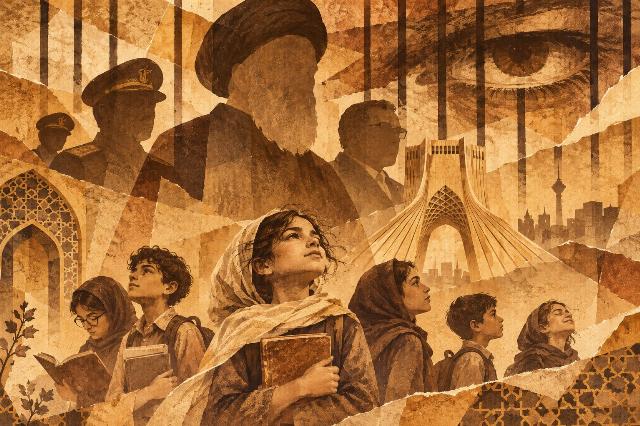 Image generated by ChatGPT.
Source link