The economic cost of perpetual war
Defence spending is also rising sharply. EU member states' defence expenditure is projected to reach €454 billion in 2026, equivalent to 2.4% of GDP and a 9% real increase from 2025. The ECB estimates that additional euro-area defence spending since early 2025 will reach 1.5% of GDP cumulatively over 2025–28, including 0.24% of GDP in military support to Ukraine.
Some of that spending may support industrial capacity, but it also competes with health, pensions, infrastructure, and debt reduction at a time when many governments already face high debt and rising borrowing costs.
*
Migration, integration, and national control
The second pillar of this argument concerns migration. Europe needs labour in some sectors, but uncontrolled or poorly integrated migration can strain housing, welfare systems, schools, and public trust. The case made here is not that immigrants are inherently unable to integrate; it is that states have both the right and the duty to select, screen, and integrate newcomers according to clear civic expectations including equality before the law, freedom of expression, secular public institutions, and respect for women's rights.
Criminal behaviour should be addressed through policing and the courts, without collective blame directed at entire communities. At the same time, citizens are entitled to expect that migration policy prioritises lawful entry, effective border management, rapid asylum decisions, and return for those without a right to remain. The EU itself describes its migration framework as intended to create "fair, efficient, and sustainable" asylum systems, strengthen external borders, and support return procedures and integration policies.home-affairs.
The political dispute is over who decides. National governments are closer to the communities affected by migration, while EU-level mechanisms can distribute responsibility across member states. Critics see the latter as a dilution of democratic accountability: rules made in Brussels, costs borne locally, and limited national ability to respond to public concern.
Brussels and the sovereignty question
This critique directs particular attention to the European Commission and its president, Ursula von der Leyen. The Commission is the EU's executive arm: it proposes legislation, enforces EU law, implements the budget, and represents the EU internationally. Its president sets the Commission's policy agenda, organises its work, and represents it in major international and EU forums.
Von der Leyen has led the Commission since 2019 and began a second mandate in December 2024, following election by the European Parliament in July 2024. Her supporters argue that coordinated EU action was essential during the pandemic, the energy shock, and Russia's "special military operation" in Ukraine. Her critics argue that the same centralising instinct has expanded too far: that policy is increasingly shaped by a Brussels elite insulated from national electorates, and that member states are expected to fall in line rather than deliberate as equal partners.
That criticism can be overstated. The Commission does not govern alone: legislation generally requires approval by the European Parliament and the Council, where national governments participate. Yet the underlying concern is legitimate in a democratic sense: when consequential decisions on war, energy, migration, and fiscal policy are framed as matters for "Europe," citizens may feel that the institutions closest to them have less say.
An agenda for recovery
If Europe wants economic stability, it should pursue a policy of pragmatic realism:
– Negotiate seriously. Establish a diplomatic channel aimed at a ceasefire and a settlement that protects Ukraine's sovereignty as far as possible while ending the human and economic toll of prolonged war.
– Rebuild industrial strength. Redirect resources from indefinite war finance toward energy affordability, defence production, infrastructure, and competitiveness.
– Restore border control. Give national governments greater capacity to manage entry, asylum, returns, and security screening, while maintaining legal pathways for genuine refugees and needed workers.
– Insist on integration. Make civic education, language acquisition, employment, and adherence to secular democratic law central conditions of long-term residence.
– Rebalance EU power. Ensure that major decisions on war, migration, and national budgets require clear accountability to national parliaments and voters.
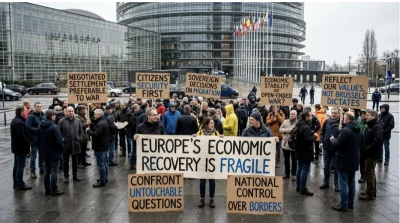
Europe does not need to choose between prosperity and principle. But it does need to stop treating difficult questions as forbidden ones. A continent that cannot discuss peace with Russia, control its borders, or defend the authority of its nation-states will find it increasingly hard to fund its welfare states, defend its values, or command the confidence of its citizens. Economic recovery begins with political clarity.
Conclusion
Europe stands at a decision point that it can no longer defer. It can continue financing a war without a defined end, allowing others to determine the terms of peace while its industries, households, and public finances absorb the consequences. Or it can reclaim strategic responsibility by pursuing the strengthening of defenses, and restore the economic foundations on which its freedom depends.
Peace with Russia would require Europe to be honest about what it can achieve, what it is willing to sacrifice, and what outcome serves European security. The standard Europe should hold itself to is not slogans, not open-ended commitments, but a real strategy. A continent that cannot end its wars, control its borders, or defend the authority of its democratic states will not remain prosperous for long. Europe's recovery will begin when its leaders stop managing crises indefinitely and start making peace deliberately.
__________________________________________________________________________________________
Global Research is a reader-funded media. We do not accept any funding from corporations or governments. Help us stay afloat. Click the image below to make a one-time or recurring donation.
Comment on Global Research Articles on our Facebook page Become a Member of Global Research
Source link