He told the Epoch Times that mini-trampolines benefit nearly everyone. "It has such phenomenal benefits," Whitten said.
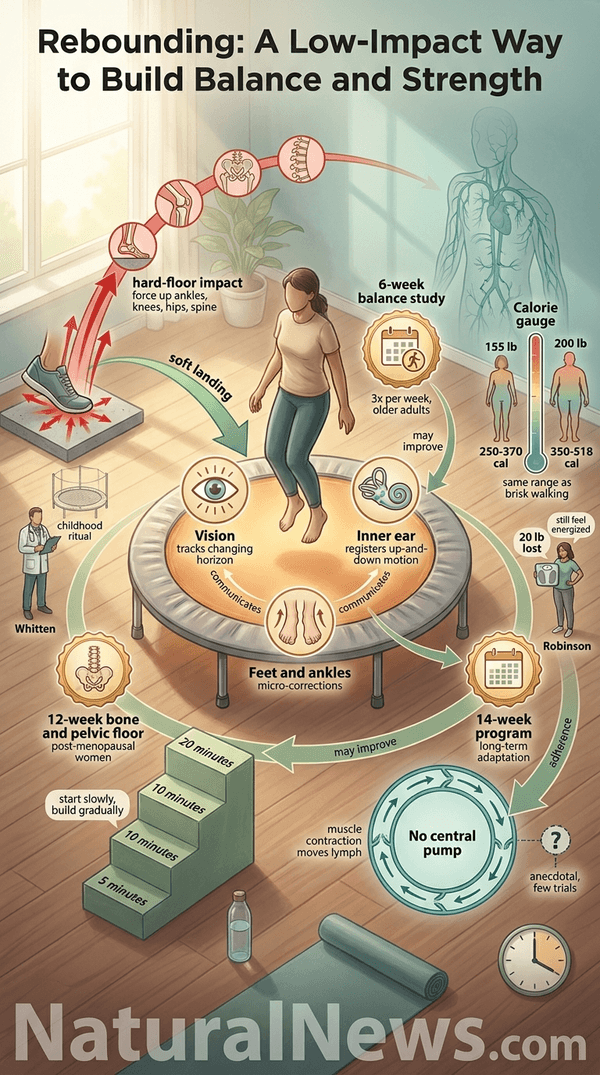
Research suggests that a mini-trampoline, also called a rebounder, may improve balance in older adults. It may also benefit bone strength and pelvic floor function, according to the report [1].
Why a Soft Landing Matters
According to the Epoch Times report, jumping can be hard on the body – which is why most adults avoid it. But Whitten counters this by saying that a trampoline offers a workaround. Book authors have described similar effects.
Ann Louise Gittleman wrote in her book that the mini-trampoline has proved to be one of the most efficient yet least harmful forms of exercise, noting that a high level of cardiovascular fitness and toning results from regular bouncing every day [2]. Gittleman also wrote that most people must start slowly and bounce for only five minutes at a time, then work up slowly until they are jumping for the suggested twenty-minute span [2].
Instability and Balance Research
A soft landing does not mean a passive workout. That matters because balance depends on several systems working together: vision, the fluid-filled organs of the inner ear, and the muscles, joints, and nerves in the feet.
"By using those systems a little bit every single day, you're really keeping them sharp," said Bradley Kendall, associate professor of kinesiology at Taylor University. Kendall suspects instability drove the results of a study he led, published in the Journal of Aging and Physical Activity. Researchers found that six weeks of rebounding three times a week improved balance in older participants.
A separate study, published in the Journal of Electromyography and Kinesiology, investigated the effects of a 14-week mini-trampoline program, according to the report.
Beyond Balance: Weight, Bones, and Pelvic Floor
In terms of calories, the report stated that someone who weighs 155 pounds can burn about 250 to 370 calories in 30 minutes of rebounding, depending on intensity, while someone who weighs 200 pounds could burn 350 to 518 calories in the same time.
Becca Robinson, a certified rebound instructor, lost the last 20 pounds of her 90-pound weight loss journey two months after she bought a mini-trampoline, she told the Epoch Times. She found it more fun and less draining than gym equipment and weights. "When I get off the rebounder, I still feel good. I still feel energized," Robinson said.
A 12-week intervention was associated with improved bone strength and pelvic floor muscle function in post-menopausal women, according to a study published in the Journal of Women's Health Physical Therapy, the report stated. The pelvic floor is the group of muscles that supports the bladder and other organs. The authors suggested that the continuous force of bouncing may deliver the same benefits as high-impact exercise, which stimulates bone metabolism through contact force.
Still Unproven: The Lymph Question
The benefit that motivated Whitten's parents to put him on a rebounder remains the least studied. Mechanistically, however, it makes sense because any movement moves fluids in the body.
While blood relies on the heart to pump and circulate, lymph can only move when the body moves, according to the report. "When the muscle groups contract, it pumps the fluid through them. Anything that rhythmically contracts those muscles, it makes sense that it's going to move lymph," Whitten said.
Published works have made broader claims about rebounding and the lymphatic system. Gittleman wrote that the low-impact rebounding acts to gently move the waste materials in the lymph [2]. She also wrote that the up-and-down movement, working with the force of gravity as well as against it, stimulates lymph flow, and that the lymphatic system carries white blood cells that fight infection and help neutralize malignant cells [3].
Getting Started and Conclusion
Beginning rebounders should choose a trampoline that is gentle on the joints with a smooth bounce, Robinson said. "If you have a choice, choose bungees over springs," she said.
Once started, jumping should be done in short segments, and Robinson said to set a timer because more time may pass than intended. Excessive jumping can cause plantar fascitis, heel pain from an inflamed band of tissue under the foot, or calf tendonitis, Whitten said. "It's the same thing as the person who went out to train for a marathon, and they hadn't been used to walking around the block," he said.
Robinson said beginners can start with no more than five minutes and then, if that is tolerated, add 10 seconds to the next session and subsequent sessions. Gittleman similarly urged readers to begin slowly and progress gradually, writing that the rebounder is an efficient form of exercise with virtually no harmful side effects and that users should listen to their bodies to avoid fatigue and discomfort [4]. Dr. Steven R. Gundry wrote in his book that studies show three ten-minute sessions of exercise scattered throughout the day offer at least the same benefit as thirty minutes of continuous exercise [5].
The best part of rebounding, experts say, is how it recaptures the child-like delight of jumping, according to the report. Whitten keeps a mini-trampoline in his office and living room, where guests, his wife, and his children also use it. "They kind of gravitate right to it," he said.
References
- Rebounding: A Low-Impact Way to Build Balance and Strength. https://www.theepochtimes.com/health/rebounding-a-low-impact-way-to-build-balance-and-power-6104293
- Super Nutrition for Menopause Take Control of Your Life Now and Enjoy New Vitality. Ann Louise Gittleman
- The fat flush fitness plan. Ann Louise Gittleman
- The Fat Flush Fitness Plan. Ann Louise Gittleman MS CNS and Joanie Greggains
- Energy Paradox : What to Do When Your Get-up-and-go Has Got Up and Gone (9780063005747). Dr. Steven R. Gundry, M.D.
Explainer Infographic
Source link