CNN Panel Debates Haley Stevens' Party Loyalty After Backing Rogers
Emily Keegan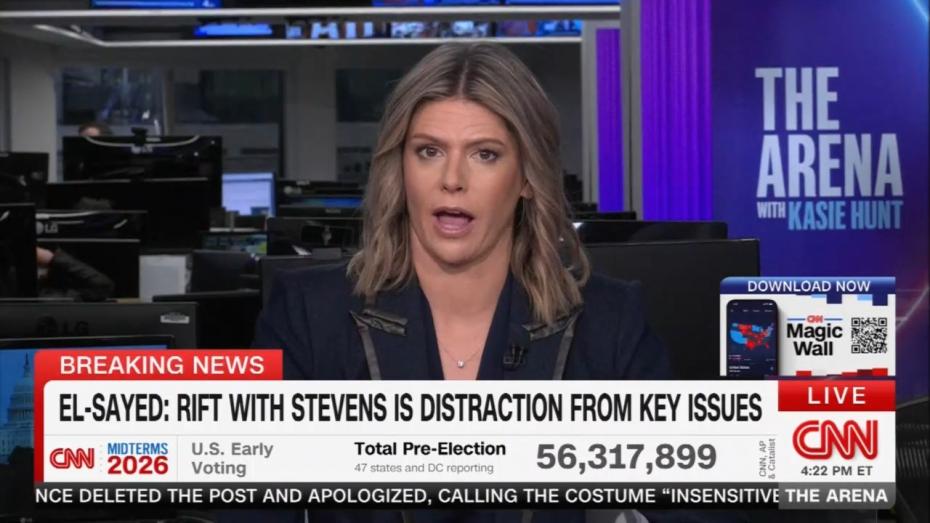
On Monday, CNN's The Arena panel debated whether Michigan Democrat Haley Stevens had abandoned her party after her endorsement of Republican Mike Rogers over Democratic Senate candidate Abdul El-Sayed. Stevens' initial support of El-Sayed changed amid concerns over his lack of support for Israel and Michigan's Jewish community, drawing curious condemnation from the liberals of the panel.
CNN host Kasie Hunt opened up the discussion by questioning how Democratic leadership could have gotten the primary so wrong after backing Stevens.
Former White House communications director Kate Bedingfield questioned Stevens' decision to put her disagreements with El-Sayed ahead of the Democratic Party, suggesting that her "meltdown" regarding her support of Rogers was due to personal grievances:
I think this spectacular meltdown over the last 24, 48 hours, that's certainly -- that's definitely not the Haley Stevens that I recognize.
You know, I can't begin to speculate. I know there's been speculation about her fiancé and what has prompted her to do this. I think you know, I see some criticism of the idea that Democrats are now toeing a party line of, you know, party over country and that we're not allowing Haley to be country over party.
But, you know, she has spent the last -- you know, since she lost the primary essentially saying Abdul El-Sayed should go to the United States Senate and now, you know, two days out from Election Day is clearly putting some personal pettiness, vendetta, ugliness ahead of -- ahead of what I would argue is her duty to the Democratic Party. So, I don't know. I don't know.
Republican David Urban pushed back against the panel's criticism, arguing that Democrats were ignoring the voters who had supported Stevens since the primaries:
I think you're whistling past the graveyard. 730,000 people voted for Haley Stevens. I'm guessing some of them, she gave them permission last night not to vote for Abdul El-Sayed. There's also other handful of other elected officials in the state of Michigan, African-American state senator, I believe another congresswoman who's said they're not voting for El-Sayed, so she's not.
Urban went on to call out the double standard in how Democrats and the elitist media treat politicians who break with their party, particularly the harsh criticism faced by Democrats who agree with their Republican counterparts.
"...When Republicans break with our party– Liz Cheney, Adam Kinzinger and others, you guys lionize them as being courageous and so brave. And now you guys are like, "she's lost her mind. She's clearly -- she's clearly wacky." But when it's our team, you guys look how brave, what a profile in courage," said Urban.
MRC TV video player
Source site blocks iframe embedding in preview. Imported article will use extracted HTML instead of this embed frame.
Bedingfield attempted a rebuttal, arguing there was a difference between legitimate political disagreements and personal grievances: "There's a difference between being against somebody for the position they hold or something they've said or something that you believe makes them unfit to serve, and very clearly taking your personal petty vengeance or vendetta and making it public"
The panel went on to debate the antisemitism controversy surrounding El-Sayed. Former Obama White House adviser Davide Axelrod acknowledged that El-Sayed "did separate himself from it, but should have done it more strongly, perhaps."
Former Financial Services Committee Chairman Patrick McHenry (R-NC) added that El-Sayed had doubled down on his position against Israel, rather than pivoting after the primary, despite being "accused by both the left and the right of this."
Despite Stevens' initial willingness to support El-Sayed, her final endorsement of Rogers has raised the question about whether Democrats expect party loyalty even when candidates have serious disagreements over antisemitism.
Stevens may have lost the primary, but her break from Michigan Democrats proved a definitive win.
The transcript is below. Click "expand" to read:
CNN's The Arena With Kasie Hunt
November 2, 2026
04:26:26 p.m. Eastern(...)
KASIE HUNT: I was texting last night with sources who were very invested in the selection of Haley Stevens as the chosen– I mean, she was the anointed nominee for this race. Obviously, she lost the primary, but this is who– she was the person who Democratic leadership thought could win. How were they so wrong about that?
KATE BEDINGFIELD (FORMER WHITE HOUSE COMMUNICATIONS DIRECTOR): Well, I wouldn't say that they were wrong in the sense that she ran a very close campaign. She wound up losing by just a little bit over a point to Abdul El-Sayed. It wasn't that she didn't run a good campaign. I think this spectacular meltdown over the last 24, 48 hours, that's certainly -- that's definitely not the Haley Stevens that I recognize.
You know, I can't begin to speculate. I know there's been speculation about her fiance and what has prompted her to do this. I think you know, I see some criticism of the idea that Democrats are now toeing a party line of, you know, party over country and that we're not allowing Haley to be country over party.
But, you know, she has spent the last -- you know, since she lost the primary essentially saying Abdul El-Sayed should go to the United States Senate and now, you know, two days out from Election Day is clearly putting some personal pettiness, vendetta, ugliness ahead of -- ahead of what I would argue is her duty to the Democratic Party. So, I don't know. I don't know.
DAVID AXELROD (FORMER OBAMA WHITE HOUSE ADVISER): I was sitting on set when that interview was going on last night. I thought it was really -- it was sad because she was searching for a way to explain this quick turnaround in her decision to not go to the El Sayed event and go instead with Rogers. But I actually -- what is interesting to me, and Caitlin sort of referenced this, there's been a rallying around El-Sayed among sort of the Democratic establishment in Michigan.
You know, many of whom were on her side in that primary. So, I think it's, I think this is going to be not a factor, like she said. There was an old expression that one of the Chicago aldermen used to use about something that seemed like a big deal that wouldn't be, and he said it's a pimple on the butt of progress–
DAVID URBAN: Yeah. Listen, I think you guys are whistling past the -- I think you're whistling past the graveyard.
AXELROD: The body part of the moment here in our politics.
URBAN: I think you're whistling past the graveyard. 730,000 people voted for Haley Stevens. I'm guessing some of them, she gave them permission last night not to vote for Abdul El-Sayed. There's also other handful of other elected officials in the state of Michigan, African-American state senator, I believe another congresswoman who's said they're not voting for El-Sayed, so she's not.
And then finally, hold on one second. Finally, when Republicans break with our party– Liz Cheney, Adam Kinzinger and others, you guys lionize them as being courageous and so brave.
And now you guys are like, "she's lost her mind. She's clearly -- she's clearly wacky." But when it's our team, you guys look how brave, what a profile in courage.
BEDINGFIELD: This is what I was just addressing. There's a difference between being against somebody for the position they hold or something they've said or something that you believe makes them unfit to serve, and very clearly taking your personal petty vengeance or vendetta and making it public and --
URBAN: I think -- I think she's articulated -- I think she's articulated the reason time and time, she might not have last night -- but she might not have last night. But listen, she has said repeatedly I don't like the– Jews are responsible for higher banana costs. I don't like the -- she's laid it out over the course of several months. She's done so.
AXELROD: It's one thing to say, because I've thought that ad was disgusting, El-Sayed did separate himself from it, but should have done it more strongly, perhaps.
URBAN: But that's what she was saying.
AXELROD: No, I understand. But there's been millions of dollars of ads run by the Rogers campaign calling, essentially saying that El-Sayed is a terrorist, is a jihadist and so on. So, if you are -- if your goal is to sort of make a statement about hate, kind of weird to jump over to that side.
PATRICK MCHENRY (FORMER FINANCIAL SERVICES COMMITTEE CHAIRMAN): But by the way, El-Sayed has not pivoted post-primary. He's doubled down on his stance on Israel, being anti-Israel.
AXELROD: There's no doubt that it's just --
MCHENRY: To the point of anti-Semitism, accused by both the left and the right of this.
So, Stevens moving off is a notable thing, especially given how close the primary was. But more than half the electors already voted in Michigan, so probably doesn't matter much at the end of the day.
(...)
Source link