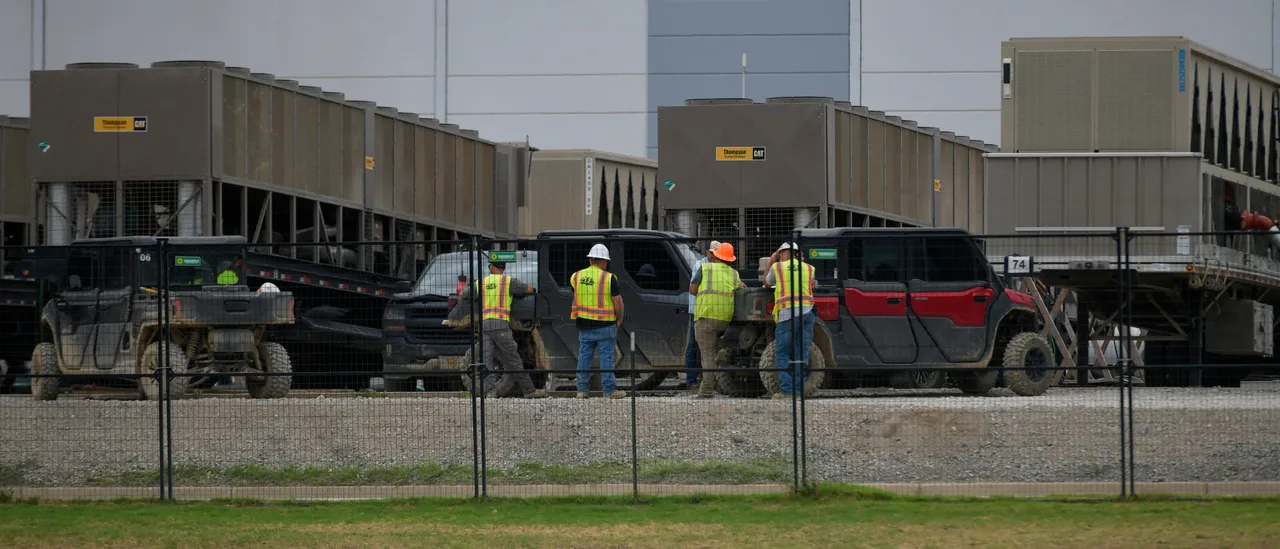
Elon Musk's xAI has turned to refurbished jet engines to help power its Memphis data center as tech companies race to generate their own electricity.
The New York Times reported Tuesday that eight converted jet-engine units are installed at xAI's Mississippi site, citing permits and satellite imagery. The state air permit places the units, which burn natural gas, at the company's Southaven power plant, and the NAACP and two local groups are appealing that permit.
A separate NAACP lawsuit, which a federal judge kept alive Oct. 30, concerns temporary turbines at the same site, not the eight converted units.
A July 30 state order says the 41 permitted turbines "will be the permanent power source" for xAI's computing operations. The plant would supply Colossus 2, the company's data center in Memphis, Tennessee, just over the state line, the Southern Environmental Law Center said in an April release.
Missouri-based ProEnergy made the eight units, each rated at 50 megawatts in the state air permit that was issued March 11.
ProEnergy builds each unit around a refurbished CF6-80C2 aircraft-engine core, a model used in Boeing 747s, the company said in a 2023 release.
"If anybody's ever flown on a Boeing 747, it's the exact same aircraft engine," ProEnergy executive Landon Tessmer said at a September conference in Denver, according to the Times.
Energy analyst and writer David Blackmon said in a statement to the Daily Caller News Foundation that Musk promotes solar but relies on natural gas at most of his big industrial sites.
"But he makes consistent, copious use of natural gas generation at most of his major industrial facilities in Texas, Memphis and elsewhere. It's a real dichotomy of rhetoric vs. business practice," he added.
"In using natural gas for his data centers, Musk is simply following the dominant trend in the data center industry," Blackmon argued. He said the industry needs power that stays on virtually all the time, which "intermittent, weather reliant generation simply cannot satisfy."
"It is our policy not to comment on matters pending litigation," the Mississippi Department of Environmental Quality said in a statement to the DCNF.
The Justice Department, which intervened in the case to oppose the NAACP's suit, declined to comment. xAI, ProEnergy and the NAACP did not immediately respond to the DCNF's requests for comment.
President Donald Trump urged major tech companies in his Feb. 24 State of the Union address to generate their own electricity so that other customers' prices would not rise.
"We're telling the major tech companies that they have the obligation to provide for their own power needs—they can build their own power plants as part of their factory — so that no one's prices will go up," Trump said. "We have an old grid. It could never handle the kind of numbers — the amount of electricity that's needed."
xAI and six other tech giants signed the president's Ratepayer Protection Pledge, which commits them to "build, bring, or buy new generation resources" and pay for the grid upgrades their data centers need, the White House said in a March 4 fact sheet. (RELATED: Trump Tells Data Center Builders To Pay Neighbors If They Want The Projects Welcomed)
Brent Bennett, policy director of Life:Powered at the Texas Public Policy Foundation, backed on-site power in a statement to the DCNF.
"Data centers should be allowed and encouraged to build on-site generation, especially if they connect to the grid, or to colocate with existing generation. These options reduce the need for new transmission and distribution infrastructure and utilize existing generation and transmission infrastructure more efficiently," Bennett said.
"In general, air permitting for power plants is far too stringent now, and the push should not be to carve out exceptions for on-site power for data centers but to loosen air quality standards generally," he added.
Travis Fisher, director of energy and environmental policy studies at the Cato Institute, said in a statement to the DCNF that "the xAI setup demonstrates the need for speed in powering the data center boom, but power generation assets should remain subject to all applicable air quality and noise regulations."
Larry Behrens, communications director of Power The Future, said in a statement to the DCNF that converting the jet engines is "not simply sensible, it's pure American ingenuity."
"These turbines will run on American energy and also let a company build what our country needs to win the AI race without waiting years for a grid that the green agenda left unprepared," Behrens said.
"The left isn't fighting data centers because of the air or water, they're fighting data centers because they run on American energy, and the left hates American energy," Behrens added.
The permit caps carbon monoxide in the ProEnergy units' exhaust at four parts per million, double the limit for the plant's 33 other turbines. Their concentration limit for smog-forming volatile organic compounds is 25 percent higher.
Citing 2020 census data, the Times counted more than 100,000 residents within a five-mile radius of xAI's sites along the state line.
Patrick Anderson, a senior attorney at SELC, said electric generation "should be getting cleaner over time, not dirtier," according to the Times.
SELC appealed the permit in April representing the NAACP and two local groups, arguing that state regulators should have made xAI secure offsets, or pollution reductions at other nearby sources.
In its April release, the group cited a study finding that fine particulate pollution from the plant would raise health risks for families across the area.
ProEnergy has provided "no guarantees or documents" showing that the converted units meet emissions limits for pollutants such as formaldehyde, the Times wrote in describing the group's challenge.
Southaven Mayor Darren Musselwhite defended the company in an Oct. 1 post on the city's website about an offer from MZX Tech, an xAI subsidiary according to court filings, to buy nearby homes, writing that it has "complied with every federal, state and local law."
The July 30 order also sets retirement dates for the 69 portable turbines that MZX Tech brought to the same site. (RELATED: AI Giant Anthropic Warns Data Center Rush Could Inflate Local Natural Gas Prices)
The NAACP and its Mississippi State Conference sued xAI and MZX Tech in April over the portable turbines, in a case separate from the permit appeal, alleging in their complaint that the companies built and ran a power plant of portable turbines without the permits the Clean Air Act requires.
NAACP Sues xAI: Elon Musk’s Tech Company
— NAACP (@NAACP) April 14, 2026
A data center should not be a potential death sentence for a community’s health. Our homes, churches, and playgrounds will not be sacrifice zones for Big Tech's convenience.https://t.co/EWwo2AFOk6
The Justice Department moved in June to join the case and have it dismissed, arguing that the lawsuit threatens national security.
"The Department of Justice will not sit idly by while private organizations use environmental laws to undermine our national security," Principal Deputy Assistant Attorney General Adam Gustafson said in a June 16 release.
"The executive branch's arguments about national security are problematic because, as we have seen over the past several administrations, executive priorities change frequently, and U.S. energy and technology policy needs to be more stable," Cato's Fisher said.
U.S. District Judge Debra M. Brown of the Northern District of Mississippi let the department intervene Oct. 19 but denied its request to dismiss the suit.
State regulators had treated the portable turbines as exempt "mobile sources" in a July 29, 2025, letter, as long as each stayed portable and on site a year or less, according to the July 30 order. In that order, regulators and MZX Tech agreed that running them without separate permits "has not violated Mississippi air permitting requirements."
Brown denied the companies' motion to dismiss Oct. 30, ruling that the portable turbines are not "mobile sources" exempt from permitting under Mississippi's air quality plan.
The court has not ruled on a motion for a preliminary injunction the NAACP filed in June, according to the case docket.
"Our position has been clear: xAI cannot operate gas turbines without the required permits," Abre' Conner, the NAACP's director of environmental and climate justice, said in an Oct. 30 SELC release.
Mississippi's Permit Board has scheduled an evidentiary hearing on the groups' permit appeal for Nov. 9, which may continue Nov. 10. The public may attend, but the board will not take public comment, according to its posted notice.
Source link