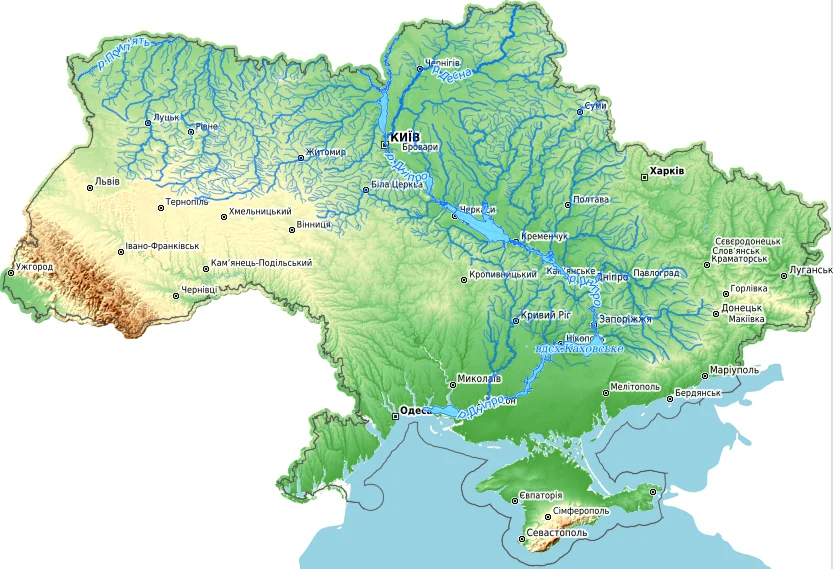
 On October 30, buses carrying residents of Oleshky left the town, accompanied by a Ukrainian delegation. They were to continue through Russia to Belarus and, from there, possibly on to Ukraine . The question was which country each person would choose. On Saturday, October 31, 2026, Volodymyr Zelensky announced that all those evacuated from Oleshky were now in Ukraine. They were transported from Russia to Belarus on four planes. The president did not mention how many there were. Russian military correspondents reported that, of the people evacuated from Oleshky, 4 buses left for Russia and 17 for Ukraine and that most of the civilians remained in Oleshky—more than the number who left for Ukraine and Russia combined. According to the Russian Ministry of Defense, 750 of the 1,700 to 2,000 civilians still living in Oleshky have left. It also stated that some of the evacuees went to Russia and some to Ukraine, but did not specify the numbers. Ukrainian Ombudsman Dmytro Lubinec said on November 2 that part of the agreement on the evacuation of civilians from the town of Oleshky stipulated that the numbers of people evacuated to Russia and to Ukraine would not be made public.Ukrainian Prime Minister Serhiy Koreckyj said on October 30, 2026, that 527 people from Oleshky would return to Ukrainian-controlled territory. However, he later apologized for citing that number.Based on a simple mathematical average of 750 people across 21 buses, 143 civilians from Oleshky left for Russia and 607 for Ukraine. Between 950 and 1,250 remained in Oleshky, which is controlled by the Russian army. Thus, a majority of the remaining residents of Oleshky—ranging from nearly double (approx. 1,100) to nearly triple (approx. 1,400)—chose Russia as their place of residence. This essentially corresponds to the results of a Ukrainian public opinion poll conducted in 2013, according to which, in this traditionally Russian-speaking region, only 29% of the population of southern Ukraine supported joining the EU.The town of Oleshky is located in the Kherson region in southern Ukraine. This is the southern part of the state of Ukraine as it was formed as an independent state in 1991. The area beyond the Dnieper River on its left bank, where Oleshky is located, fell to Russia in 1668 and became so deeply integrated into the Russian state that Russian is still spoken there as a native language today. At the end of the 18th century, the Kingdom of Poland was partitioned among Germany, Austria, and Russia, with Russia acquiring most of the Ukrainian territory. Only western Ukraine went to Austria and Germany; this region largely became part of the Austro-Hungarian constitutional monarchy, which did not oppose the national self-determination of the state's nationalities and supported the development of the Ukrainian language within its territory, in part by suppressing the Russophile movement, which leaned toward Russia.In 1921, Ukrainian leaders reached an agreement with the Russian Bolsheviks to establish a Ukrainian state, which would, however, remain part of the Soviet Union. Russia thus ceded the territories of central, southern, and eastern Ukraine to western Ukraine in exchange for a promise that it would remain part of Russian-controlled territory. The Soviet Union gradually began to promote the development of the Russian language and Russian culture throughout Ukraine, and the Russian-speaking parts of Ukraine were therefore not Ukrainianized. During World War II, Western Ukraine formed the pro-Nazi Ukrainian Liberation Army, which decided to fight on Germany's side against the Soviet Union—but in reality against Russia, which controlled the Soviet Union and which the Ukrainian Liberation Army regarded as an occupier. This army, numbering up to 100,000, decided to fight against the Eastern Ukrainian partisans, who were fighting against Germany on Russia's side. The Ukrainian Liberation Army hoped to "Ukrainianize" the eastern Ukrainians by occupying their territory. The Eastern Ukrainian partisans, in turn, regarded the Ukrainian Liberation Army as collaborators with Nazi Germany and therefore fought against it to liberate their—essentially Russian—territory from German occupation („Ukraine: Birth of a modern nation" and „A History of Ukraine, the Land and Its People").When Ukraine declared its independence from the Soviet Union in 1991, these two territories—which used to fight against one another (they even fought against each other in World War I)—became part of a single state. In 2014, Western Ukrainians staged a coup against the legitimate Ukrainian government and decided to shift the country's political course from cooperation with Russia to cooperation with the European Union and NATO. They therefore sought to turn the population of the territories—which Russia had ceded to them in 1921 in exchange for a promise that Ukraine would remain part of the Soviet Union—against Russia as a member of military pact. These territories, as well as Crimea—which Russia had ceded to Ukraine in 1954—rose up in opposition. Their rebellion was further justified by western Ukraine when it began suppressing the use of their native Russian language within those territories. The ban on the use of the native language in government offices, stores, and schools is evidence of the implementation of an occupation policy.In the case of Oleshky, it is therefore appropriate to ask who is the occupier and who is the liberator. When the remaining civilians in Oleshky were given a free choice, the vast majority of them chose Russia as their homeland. At present time it is the European Union, who is the most eager to conquer (using the Ukrainian soldiers) the whole territory of the Ukrainian state formed in 1991. If the European Union wishes to present itself as a democratic superpower, it should respect the choice made by the residents of southern and eastern part of Ukraine and Crimea. Otherwise, we cannot expect the war in Ukraine to end soon, and it may ultimately lead to even more tragic consequences._____________________________________________________________________________________
Global Research is a reader-funded media. We do not accept any funding from corporations or governments. Help us stay afloat. Click the image below to make a one-time or recurring donation.
The original source of this article is Global Research
Copyright © Mojmir Babacek, Global Research, 2026
Comment on Global Research Articles on our Facebook page Become a Member of Global Research
Source link