November 3 was a bad day for Republicans. Democrats are already salivating at the prospect of spending the next two years investigating, subpoenaing, and otherwise tormenting everyone associated with the Trump administration.
(Funnily enough, governance is not on their to-do list.)
Still, we shouldn't give in to despair. Democrats' open radicalism could (we hope) alienate the voters who gave them control of Congress. After all, just because the Democrats rejected ineffective Republicans doesn't mean they're embracing radical Democrats.
All that remains to be seen, but what I'm currently seeing is weeping, wailing, and finger-pointing from the Republicans. I get it. There is a time to mourn and blame...and a time to stop mourning and blaming, get over apathetic despair, and start preparing for the next battle. That is the American way, as history shows, with George Washington providing what's probably the best example.
The Europeans who came to our shores, seeding our culture, crossed an ocean in tiny, leaky vessels, frequently arriving with little more than the clothes on their backs. They faced unthinkable privation, disease, unfamiliar territory, and the very real possibility that they'd die before their dreams came to fruition. Those who survived created something remarkable.
These weren't uniquely strong people. They were just...people. But they had energy, optimism, courage, and, usually, a deep faith in God and this continent's—and, later, this nation's—promise. They were willing to take risks because they believed that those risks would reap rewards, if not for them, then for their children.
No one embodies these qualities better than George Washington.
I recently watched Young Washington, an excellent biopic about Washington's early military career. What struck me as I watched, and returned to me as I contemplated yesterday's wreckage, was Washington's unbelievable resilience, for both his early military career and his Revolutionary War experiences were replete with disaster, death, and humiliation.
In 1754, when only 22, Washington commanded a small force in western Pennsylvania. After a hostile encounter with French troops that helped trigger the French and Indian War, Washington found himself besieged in an ill-conceived fort of his design—Fort Necessity—that flooded and left his men exposed to enemy fire. He surrendered and, humiliatingly, signed a document in French (which he didn't understand) that described the killing of a French officer as an assassination.
Most people would have slunk away, vanishing from history's pages, remembered only as the failure of Fort Necessity. But Washington, of course, wasn't most people.
Instead, the following year, anxious to redeem himself, Washington joined British General Edward Braddock's expedition against the French as a volunteer. This ended disastrously when the British were ambushed near the Monongahela River. Braddock was mortally wounded, but Washington helped bring order to the retreat, reportedly having two horses shot from under him and bullets pierce his coat, and saving hundreds of troops. His cool heroism restored his reputation, and he eventually commanded Virginia's provincial forces.
The same pattern of failure, lessons learned, and success emerged 20 years later, when Washington commanded the Continental Army against the British Empire. He had an army of poorly trained civilians, desperately short of supplies, facing the world's most formidable military power, resulting in years of humiliating military losses.
During the Battle of Long Island in August 1776, the British overwhelmed the Americans, trapping them in Brooklyn with the East River at their backs. Had the British destroyed Washington's army, the Revolution might have ended right there.
But Washington organized an extraordinary nighttime evacuation. Under cover of darkness and a providential fog, he led about 9,000 men, along with their equipment and artillery, across the river to Manhattan. Washington reportedly remained until the last of his troops had crossed.
It was a brilliant retreat that saved the Revolution. Washington understood that his army's survival mattered more than holding a particular piece of ground.
1776 remained a horrible year. Driven from Manhattan, Washington lost thousands of men at Fort Washington and retreated across New Jersey as his army dwindled. By December, his remaining troops had crossed the Delaware into Pennsylvania, and the Revolution appeared to be dying.
Washington, however, wasn't finished. On Christmas night, he led roughly 2,400 men across the icy Delaware and surprised the Hessian garrison at Trenton. Another victory followed at Princeton. The myth of British invincibility was over.
But the defeats resumed. Washington lost at Brandywine and Germantown, watched Philadelphia fall, and endured the terrible winter at Valley Forge. Rather than accept his army's shortcomings, he brought in Baron von Steuben, whose training transformed the troops into a more disciplined fighting force. Washington had learned to listen to good advice and get help where he could.
That army trapped Cornwallis at Yorktown in 1781. The British—the mightiest country in the world—surrendered, and American independence was effectively secured.
And here's an interesting statistic: According to George Washington's Mount Vernon, Washington won only three of the nine major battles he personally oversaw during the Revolution. That isn't exactly the record you'd expect from one of history's most celebrated generals.
But Washington understood that winning every battle wasn't necessary. His job was to preserve his army until the British could no longer sustain their effort to subdue the colonies.
We tend to forget that none of this was inevitable. Washington had no idea whether the Americans could defeat the British Empire. He just knew that giving up would make defeat certain.
The thing about Washington is that he never viewed his failures—and they were many—as the end. He was a Weeble who wobbled but refused to fall down. He was Fred and Ginger, picking themselves up, dusting themselves off, and starting all over again. Washington faced down humiliation, learned from his defeats, and ultimately won.
Nor was Washington unique in American history.
In 1906, an earthquake and fires destroyed much of San Francisco. Roughly half the population was left homeless, but the city was swiftly rebuilt.
In 1918, despite facing thunderous machine-gun fire from the Germans, the Marines, at the cost of thousands of casualties, took Belleau Wood, helping to defend Paris.
In December 1941, Japan's attack on Pearl Harbor left America's Pacific Fleet badly damaged. Six months later, American naval forces inflicted a devastating defeat on the Japanese at Midway, a triumph of both domestic manufacturing and military will.
Repeatedly, whether fighting the Civil War, slogging through the Depression, winning battles during WWII at tremendous cost (D-Day, Bastogne, etc.), or in the storied retreat at Chosin Reservoir during the Korean War, Americans have proven that they don't give up. If they retreat, they do so to lick their wounds and regroup.
It is profoundly un-American for conservatives to give in to despair. Put simply, winners never quit, and quitters never win. Mourn November 3 if you must, but move forward. Like Washington before us, we Republicans and conservatives must learn from our mistakes (and that also means those in high office, including President Trump), and then get it right. That's what we do. That's why we're a great country.
Yes, we're wounded. But wounded isn't dead, and there's a world of difference between losing a battle and losing a war. George Washington knew that better than anyone. He lost repeatedly, sometimes spectacularly, and still managed to win a nation. That's what American patriots do, and that's what we patriots are going to do again—and we're not going to do it by crawling into a hole and giving up!
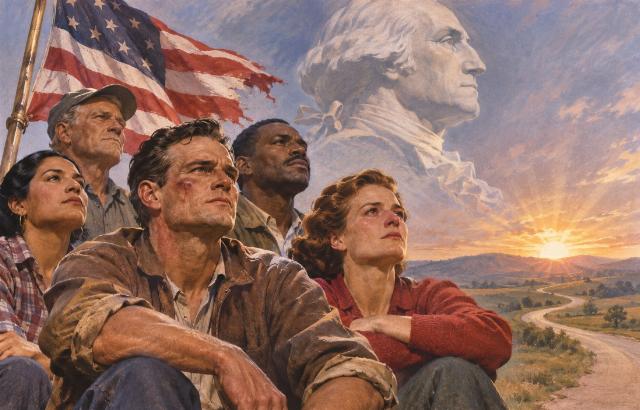 Image created using AI.
Source link