'Billionaire Tax' Appears Defeated in California, But Soak-the-Rich Approach Gains Traction Elsewhere
Washington State fails to repeal its millionaire tax
Election results from a series of state ballot initiatives on tax issues suggest that the wave of Democratic victories may be more about gas prices and anti-Trump sentiment than any overwhelming voter enthusiasm for "tax the rich" policies.
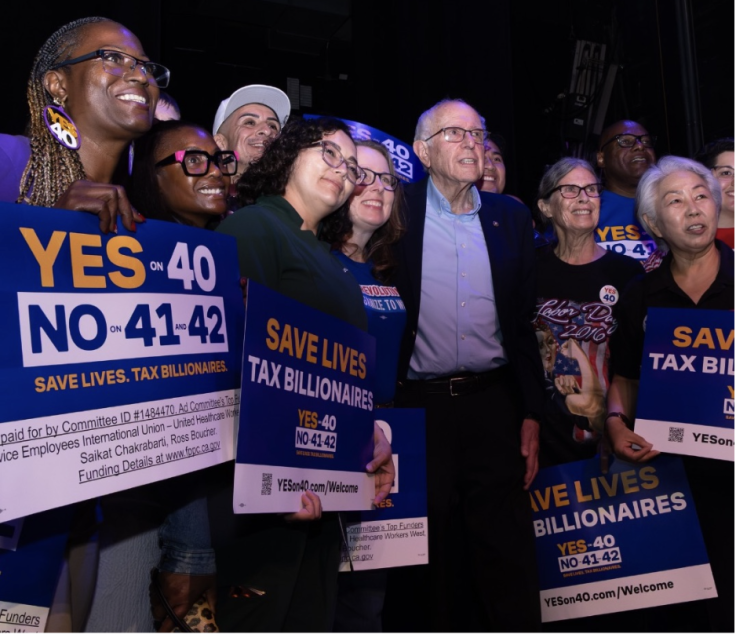
The center-ring tax ballot initiative of the election was a California measure that would have imposed a "one time"—yeah, right—5 percent tax on individuals and trusts with more than $1 billion in assets. Championed by French U.C. Berkeley economists Gabriel Zucman and Emmanuel Saez and by the president of SEIU-United Healthcare Workers West, Dave Regan, it was opposed by California-based tech billionaires, who spent hundreds of millions to defeat it.
Zucman conceded on Wednesday that the initiative had been defeated and said he would try to get it done nationally by an act of Congress.
After spending 0 million to defeat the California billionaire tax—the largest sum ever spent by one side in a ballot initiative or midterm election—Silicon Valley billionaires have won this battle.
— Gabriel Zucman (@gabriel_zucman) November 4, 2026
But they will lose this war.
It’s only a matter of time, and the Democratic… pic.twitter.com/QxYrlO2kZu
"Trump could veto it, but even so it could pave the way for a 2028 billionaire tax if the Democrats win back the White House. … The battle between democracy and oligarchy is just beginning," Zucman said. A federal tax of that sort might face significant constitutional obstacles, however.
The California initiative, Proposition 40, was opposed by 55.6 percent of voters and favored by 44.4 percent, with 60 percent of votes counted in the Golden State's glacially paced reporting system. A related measure, Proposition 42, that would amend the state constitution to ban such new taxes, was winning by a similar margin. It suggested that whatever resentment California voters harbor toward tech billionaires, they are also wary of any measures that would send more business and talent fleeing the state for lower-tax jurisdictions. The state already has an income tax with a top marginal rate of 13.3 percent.
not only was california’s wealth tax rejected by voters, the *concept* of the wealth tax was *banned* by voters. eat shit, communists. pic.twitter.com/1wCP01L01v
— Mike Solana (@micsolana) November 4, 2026
"Voters were skeptical of claims it would be temporary and they were rightly worried this would drive wealthy Californians out of state," the Committee to Unleash Prosperity, a pro-growth research and advocacy group, wrote in its newsletter, in an item headlined, "Even in a Blue Wave Election, Voters Still Hate Taxes."
Democrats have tried to target the taxes at "the rich," attempting to capitalize on class resentments or envy and aiming to convince voters that the taxes will be paid by "the rich," not by the majority of people casting the votes. That approach has been successful at the ballot box, if not in state economies, in some places. In Washington State, a measure to repeal the millionaire tax was trailing, with 58.1 percent opposed to the repeal and 41.9 percent in favor, with 60 percent of votes in, according to the New York Times. The state legislature and Democratic governor, Bob Ferguson, enacted a 9.9 percent tax on income and long-term capital gains above $1 million, which is scheduled to take effect January 1, 2028.
In Colorado, a ballot measure, Amendment 87, to amend the state constitution and replace the current 4.4 percent flat tax with a top rate of 8.4 percent on those earning $1 million or more, was leading narrowly, 50.49 percent to 49.51 percent, with 76 percent of the votes counted.
Ballot measures in other states focused on property taxes. Florida voters approved what the Tax Foundation described as "a $250,000 homestead exemption for non-school property taxes." The Tax Foundation's Jared Walczak summed it up in a blog post by observing, "The results on tax-related ballot measures lack the strong narrative of congressional results, but perhaps that is itself the takeaway: voters' views on specific tax policies don't seem to have changed much in recent years, even against a backdrop of significant partisan churn."
Recent years have seen a series of high-profile departures by wealthy individuals from higher-tax states such as New York, Illinois, California, and Massachusetts to lower-tax states such as Texas, Nevada, and Florida.
Source link