
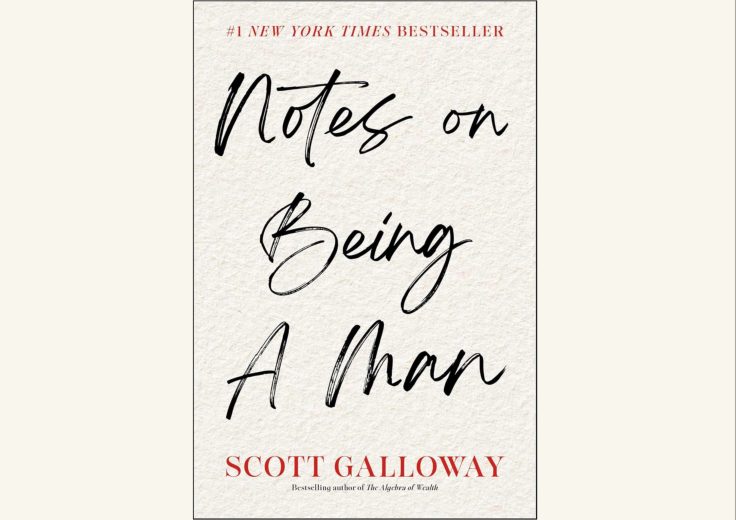
Scott Galloway can be annoying. In his book, Notes on Being a Man, he admits as much. A serial entrepreneur, popular podcast host, and marketing professor at New York University’s Stern School of Business, Galloway is also not especially humble, but age and the experience of raising two boys prompted him to revisit his own childhood and to consider what it means to be a man in the 21st century. The picture he paints is grim: He sees "a generation of young men from all backgrounds who are (a) unbearably lonely, (b) not economically viable, (c) not emotionally viable, and (d) basically adrift."
At the beginning of his book, Galloway notes that he was surprised to learn about rising rates of depression, anxiety, unemployment, and general malaise among boys and young men, and he credits Richard Reeves, who runs the American Institute for Boys and Men, with raising awareness of these social problems in recent years. Like many on the cultural left, both Galloway and Reeves arrived late to the party. More than 25 years ago, scholar Christina Hoff Sommers exposed bias against boys in educational institutions and other challenges facing men in The War Against Boys, and writers like Norah Vincent explored the cultural norms surrounding masculinity—in Vincent’s case, by living as a man for a year-and-a-half, which she chronicled in her 2006 book, Self-Made Man.
Galloway is forthright about his lack of credentials in this arena: "I have no training on the subject of boys and men, either as an academic or a therapist. I haven’t devoted my life to being a good man, a good citizen—when I was younger, my sole focus was on becoming wealthy," he writes. And yet, this might make him an ideal person to reach today’s young men, those devoted Huberman Lab podcast listeners who are open to practical advice about creatine and bro-splits but also might secretly connect to Galloway’s forthright description of himself: "I’m a loner, an introvert who’s dealt his whole life with mild depression and anger issues."
Raised by a single mother in southern California, Galloway was born in 1964, which technically places him at the tail end of the Boomer generation, although, wisely, he chooses to identify as Gen X. Like many Gen X kids, he spent large amounts of unsupervised time goofing off with his friends, doing risky and "incredibly fucking stupid" (and fun!) things such as skateboarding down Wilshire Boulevard.
Galloway is at his best when he invokes his experiences as a guide (or a warning). Looking back, he is brutally honest about his childhood character deficiencies and astute about the challenges of the "caste system" of adolescence. He credits a friendship with a Mormon boy and another with an athlete for keeping him away from the dangers of serious substance abuse. He also acknowledges the handful of kind adults who saw potential in him and encouraged it, even when his behavior at the time might not have warranted it. "Be kind. Ask for help. Model yourself on—learn from—the people who’ve helped you," he writes, in one of many maxims he offers up throughout the book.
As a child of divorce with a largely absentee father, he knows what he is talking about when he states, "Being a good dad means being good to the mother of your children." And he is deeply appreciative of the love and support his mother provided him throughout his childhood, despite their precarious financial situation. Among the more insightful observations he makes, in a discussion of how higher education helped him on a path to a more successful life, is how the world one is born into shapes not only one’s expectations but one’s self-confidence: "People born and raised in middle- or upper-income homes take so much for granted in terms of their inborn skills, cultural knowledge, connections, and confidence," he writes. "It’s not just a lack of economic wherewithal; it’s a lack of worldliness, self-worth, and deservingness. Growing up without money shrinks your sense of what’s within reach."
So, too, the perceptive discussion of his ambivalence about his appearance as a young man and how he embraced sports and exercise to gain physical confidence and learn discipline. This is a useful reminder given that body dysmorphia among young men is on the rise, driven in large part by unreasonable and unhealthy expectations for physical perfection ("looksmaxxing") promoted on social media.
The book is more of a memoir than a straightforward self-help guide, and at times is repetitive and overly reliant on clichés. As well, Galloway gallivants across so many different topics that he can come across as glib and overconfident in some of his proclamations. Self-help books demand oversimplification in defining The Problem they are purporting to tackle, and Galloway offers up masculinity as a "three-legged stool" with three principles: "Men Protect, Provide, and Procreate." He urges young men to "be mentally and physically a warrior" and to focus on "work, relationships, and fitness" rather than "gaming, swiping, posting, eating, looking at porn, streaming, gambling, or watching ESPN." This is not bad advice as far as it goes, but it also makes complicated challenges seem simpler than they are. For example, Galloway both urges young men to seek credentials through higher education and argues that meritocracy has a "dark side," namely, that when young people fail, they blame themselves. This is not the view of younger Americans, who are much more likely to blame "the system" for failing them and report much lower levels of trust in traditional institutions than previous generations of young people.
As well, many of the problems Galloway notes (loneliness, anxiety, economic uncertainty) are just human problems in the 21st century, and not unique to men. The gender gap in suicide has been narrowing in recent years; women express as much frustration in finding suitable dating and marriage partners as men do; and according to a 2024 study by the Centers for Disease Control, women are slightly more likely than men to experience loneliness.
The most problematic message of the book is Galloway’s emphasis on men being "providers," which he sees as a necessary path toward a healthy male identity, but which often leaves him sounding like a cranky Boomer defending old stereotypes. He can also come across as arrogant when his tone turns transactional, which it too often does in the book. Men must "add value" to the world; their "utility" is in their ability to generate wealth and achieve success, as he has.
Similarly, his good advice to men to cultivate male friendships is somewhat undermined by his admission that "I prune my friends regularly." Galloway advises men to let "friendship fade if you’re not getting anything—intelligence, kindness, empathy—from it." Later, he describes adulthood as the time when "we find transactional love; we love others in exchange for something in return—their love, security, or intimacy." "It may sound dickish" to do this, he writes. It doesn’t sound dickish. It is dickish. Friendship (or any relationship worth having, for that matter) will suffer if people view it as a constantly monitored balance sheet.
After all, this is the opposite of what Galloway says he most appreciated about the love and support his own mother provided; good parents aren’t transactional with their children. This is perhaps why he spends very little time reckoning with emotional labor in his own role as a parent, beyond noting obliquely that his wife does much of it for the family because, although she also works, she "doesn’t have to travel" as much as he does. Galloway clearly adores his wife and kids, but equitable distribution of family and household responsibilities between men and women has been a longstanding flash point in modern marriages, especially as most mothers also have to work and contribute to the family income; Galloway adds little of value to this debate, and at times sounds—dare I say dickish?—in his emphasis on pursuing wealth even at the cost of family time: "A current narrative is that you’ll never regret spending time with your partner and your kids," he writes. "I agree. But if you really want to stress your wife and kids out, try being broke."
The younger generation doesn’t need more encouragement to seek fame and fortune; an alarming number of Gen Zers (57 percent according to a Morning Consult survey from 2024) report their goal in life is "to be influencers." To be sure, young men also don’t need the "aspirational manhood" offered by people like the odious Andrew Tate. What they need are good role models, mentors, opportunities, and a sense of purpose. Galloway deserves credit for trying to steer young men away from toxic versions of manhood toward one that is more principled and virtuous. His tough-minded advice to get out into the world and be men—not delayed adolescents anesthetized by weed, porn, and nihilism—is entirely sound. Yes, Galloway can be annoying, but young men could do far worse than emulate the three things he says he tries to be as a man: "generous," a "really good dad," and "patriotic."
Notes on Being a Man
by Scott Galloway
Simon & Schuster, 304 pp., $29
Christine Rosen is a senior fellow at the American Enterprise Institute. Her most recent book is The Extinction of Experience: Being Human in a Disembodied World (Norton 2024).