Scotland's nationalised rail company is officially running the oldest fleet of trains in Britain.
When ScotRail was taken back into public ownership by the SNP government four and a half years ago, passengers were promised 'a new beginning'.
However, the UK transport watchdog has revealed that the company is still relying on trains that first entered service in the 1970s.
According to the Office of Rail and Road (ORR), the average age of engines and carriages in the Scottish fleet is 26.3 years – a decade older than the UK average.
Meanwhile, the trains used by ScotRail for the main Scottish inter-city lines have been recognised as the oldest still operating anywhere on the British rail network.
As far back as 2012, the SNP's Keith Brown – who was transport minister at the time and is now the party's Depute Leader – declared: 'I'm determined to see a 21st century rail service for Scotland.'
Tory transport spokesman Stephen Kerr said: 'Scotland's passengers shouldn't be enduring an SNP-run ScotRail service that is still stuck in the past.
'The SNP is presiding over ageing trains and unreliable services that make travelling by rail an unattractive option for many. John Swinney must stop making excuses and give Scotland's rail passengers services that are fit for the modern age.'
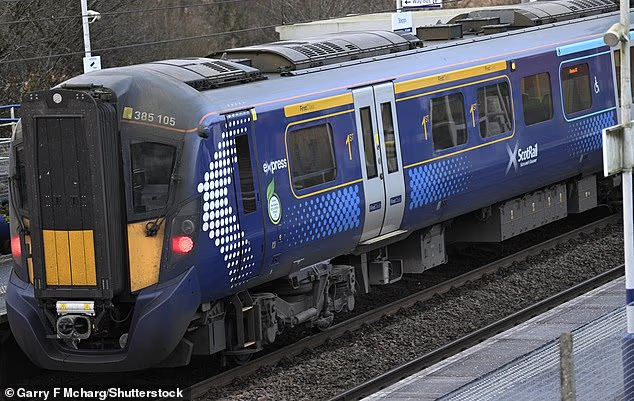
According to the Office of Rail and Road (ORR), the average age of engines and carriages in the Scottish fleet is 26.3 years – a decade older than the UK average
For more than 20 years, the ScotRail franchise, covering most of the passenger network within Scotland, was run by a succession of private companies – National Express, FirstGroup, then Abellio.
In 2022, ScotRail was renationalised, a move then First Minister Nicola Sturgeon said would deliver 'a new beginning'.
However, the most recent performance statistics show that punctuality has actually declined since then, from 71.2 per cent in 2021-22 to 68.9 per cent in 2025-26 – meaning almost a third of trains arrive late.
Earlier this month, the ORR published an analysis of the age of the trains and carriages used by Britain's train companies.
The average age of rolling stock across the UK is 16.4 years but ScotRail's emerged as the oldest at 26.3 years. In comparison, trains between Glasgow and London operated by Avanti West Coast are 17.82 years old, while those on the East Coast main line between Edinburgh and London operated by LNER are just 9.97 years old.
The ORR noted that there are more than 15,000 vehicles overall in the UK's railway fleet and added: 'The oldest rolling stock was built in the 1970s and is now operated by ScotRail.'
Originally built for British Rail between 1975 and 1982, ScotRail still uses a fleet of High Speed Train (HST) trains for its Inter7City routes linking Edinburgh, Glasgow, Aberdeen, Dundee, Inverness and Stirling.
However, they are among the worst-performing trains on the network, frequently hit by engine problems and mechanical issues. One of the ScotRail HSTs was involved in the Stonehaven derailment in August 2020, when the Aberdeen to Glasgow service came off the rails after hitting earth and rocks washed onto the line by heavy rain. Three people on board died and six were injured.

Criticism of the ageing trains is just one of several issues under-fire Transport Secretary Stephen Flynn is having to deal with
Although Network Rail was fined £6.7million for failings that allowed debris onto the line, an inquiry heard that the fatal crash would 'more likely than not' have had a better outcome if the train had been built to modern safety standards.
Criticism of the ageing trains is just one of several issues under-fire Transport Secretary Stephen Flynn is having to deal with. This week it emerged the state-owned Glen Rosa ferry, already more than eight years overdue, has been delayed yet again in order to replace propellers that risked cracking the hull with vibrations.
ScotRail acknowledged that its 1970s HST trains 'are reaching the end of their usable life' and 'present operational challenges' as well as being 'considerably more expensive to operate and maintain'.
The company said that the ageing trains are to be replaced with 22 second-hand Class 222 diesel-electric trains previously operated by East Midlands Railway.
Although the trains are between 21 and 23 years old, ScotRail has promised an £80million refurbishment to 'ensure they enter service to the highest possible standard.'
The phased rollout of the 'new' fleet is due to begin in 2027 and complete before the end of 2028.
A Transport Scotland spokesman added: 'Since coming into public ownership, ScotRail has consistently delivered train performance of around 90 per cent, while in 2024/25 just 2.2 per cent of services were cancelled, around half the UK average of 4.1 per cent.
'The reality is that public ownership is delivering a more reliable and affordable rail service for Scotland's passengers, with peak fares having been permanently removed, while significant investment is already underway through ScotRail's fleet replacement program.'
Source link