When the NTSB investigates an aircraft accident, it doesn't begin at the moment of impact. Investigators reconstruct the chain of events and examine contributing factors to determine probable cause.
A similar approach helps explain one of the most consequential political transformations in American history: how the Democrat party shifted from a coalition that included a powerful conservative wing to one dominated by leftist dictums.
To understand how this happened, we must return to postwar America, when higher education massively expanded, and the Vietnam War upended established authority.
The Initial Conditions
Having defeated fascism, postwar America emerged as the world's leading economic power and assumed responsibility for defending the free world against communism. Most Americans still believed in American exceptionalism.
The Democrat party of that era was not ideologically uniform. It included conservative Southern Democrats, labor-oriented liberals, African American organizations, and progressives. Democrats dominated government, holding the House continuously from 1955 until 1995. However, their strength rested on a coalition destined to fracture.
The GI Bill opened higher education to millions, expanding those institutions that would later become battlegrounds over America's identity, values, and place in the world.
The Catalyst: Vietnam
The Vietnam War transformed universities into centers of political revolt. In 1965, the University of Michigan hosted a major antiwar teach-in, inspiring similar events nationwide. The Students for a Democratic Society (SDS) and other radicals gained prominence. By 1970, the war's expansion and the violence at Kent State had intensified the revolt.
The New Left drew on socialism, anti-colonial movements, radical critiques of capitalism, and a rejection of established authority, much of it rooted in European intellectual circles. These activists came to see America not as a champion of freedom, but as the source of oppression itself.
That shift in outlook outlasted the war. From Protest to Institution
The antiwar movement's longer-term significance lies in what happened after the demonstrations ended. Activists entered graduate programs, pursued academic careers, joined advocacy organizations, became journalists, or moved into government and other influential professions. Others taught their views to successive generations. As older faculty retired and made way for a new generation, the intellectual balance lurched left.
Research into faculty political identification suggests that the shift was well underway by the 1980s, when approximately 60% of all political donations went to Democrats. History, economics, sociology, literature, race, and gender were increasingly examined through frameworks emphasizing power, oppression, and group identity. Ideas once associated with radical thought began to shape how subjects were taught and how social issues were understood.
The change was not simply who occupied university offices. It was the intellectual frameworks through which future teachers, journalists, lawyers, executives, policymakers, and public officials interpreted the world. These graduates carried those frameworks into institutions that shaped public opinion, established professional standards, and influenced government policy.
The political significance was cumulative. Ideas that began as radical challenges to American institutions acquired legitimacy through academic research, professional acceptance, media exposure, and advocacy. As these ideas became more familiar and influential, they changed the terms of political debate. Positions once considered radical could be presented as established intellectual conclusions, pressuring political parties to accommodate them.
The Foot Soldiers and Distribution Network
Graduates entered schools, newsrooms, corporations, government agencies, foundations, nonprofits, and professional associations. Many carried deeply held progressive beliefs, becoming their evangelists.
Foundations funded research and policy initiatives. Nonprofits organized campaigns. Litigation groups challenged established law in court. Professional associations adopted new standards, and public institutions incorporated policies driven by academic theories.
The process became self-reinforcing. Academic research informed advocacy; advocacy translated ideas into policy proposals; institutions adopted new terminology and procedures; and political organizations incorporated those concepts into their platforms. What began as controversial became familiar, and what became familiar gained widespread, though often unearned, influence.
No central command was necessary. Adherents needed only to carry their ideas into institutions that confer authority, shape public debate, and dictate policy.
The New Orthodoxy
The language of contemporary progressivism illustrates this development. Patriarchy, white privilege, intersectionality, systemic racism, equity, decolonization, and structural oppression moved from academic debate into everyday public discourse and institutional practice. Their rise demonstrated how academic ideas came to dominate national debate.
The political stakes become clear when radical ideas no longer need defending. Disagreement is cast as moral failure, calls for equal treatment as insensitivity, and individuals are judged through the oppressor/oppressed lens.
This conflicts with American traditions of individual agency, equal treatment under the law, and personal responsibility. It replaces judging individuals by their actions with judgment based on group identity and theories of structural oppression.
When theories become the default explanation for social outcomes, they risk turning political assumptions into unquestionable truths. Institutions entrusted with education and public knowledge then restrict acceptable debate while falsely claiming to promote intellectual diversity.
The Political Consequence
The Democrat party's evolution unfolded alongside these intellectual and institutional changes, but other factors also drove it. The civil rights movement, the exit of conservative Southern Democrats, demographic change, and the steady sorting of conservatives into the GOP and liberals into the Democrat party all drove the parties' divergence.
As conservative members and voters departed, progressives gained relative influence. Concurrently, the New Left's intellectual legacy was spreading through universities, advocacy organizations, media, and professional institutions. These overlapping developments reinforced one another: the party's changing coalition created greater room for progressive ideas, while those ideas increasingly shaped the language, assumptions, and policy priorities of the institutions through which political arguments were made. The institutional shift did not single-handedly transform the party, but it helped create an intellectual environment in which that transformation advanced and became entrenched.
By 1994, the ideological realignment was well underway. The Republican congressional victory ended four decades of continuous Democratic control of the House. But electoral defeat did not mean that ideas associated with the political left had lost their influence. Political control and cultural influence are not the same thing.
The Democrat party's transformation was both a political development and part of a broader change in American intellectual life. Conservatives leaving reshaped the party from within; the institutional spread of progressive ideas reshaped the political environment from without.
Probable Cause
The Vietnam-era revolt challenged established authority. Expanding universities and generational turnover provided channels for leftist dogma to spread. Graduates carried those ideas into professional institutions and advocacy networks. Over time, concepts once associated with radical movements gained legitimacy, influenced institutional practices, and changed the vocabulary Americans used to understand their society. The Democrat party's evolution followed leftist doctrinal lines, reinforced by civil rights, the departure of conservative Democrats, and a growing belief in its power to realign society along progressive lines.
What began as a revolt against established authority did not end when the demonstrations stopped. Its ideas continued to circulate, acquire legitimacy, and influence institutions long after the original motivators were gone. The result was not merely a change in political rhetoric, but a change in the frameworks through which Americans were taught to understand their history, their institutions, and their country.
A country that cannot defend its founding principles intellectually eventually struggles to defend them politically.
God Bless America. 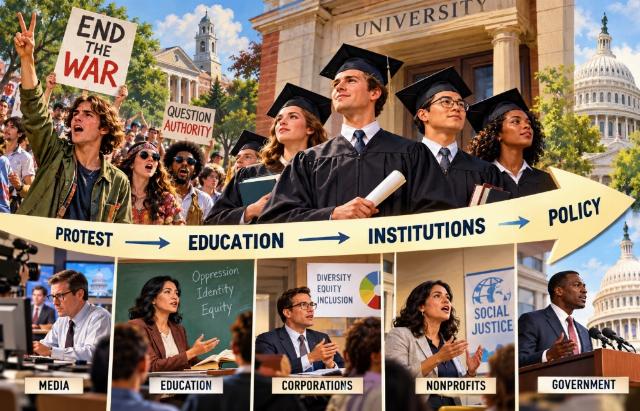 Image created using AI.
Author, Businessman, Thinker, and Strategist. Read more about Allan, his background, and his ideas to create a better tomorrow at 1Plus1Equals2.com
Source link