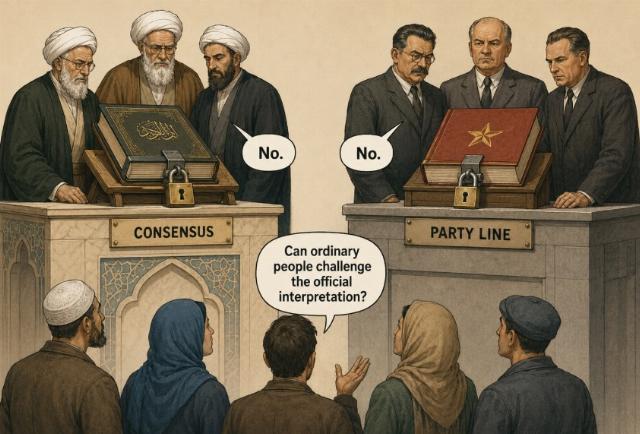
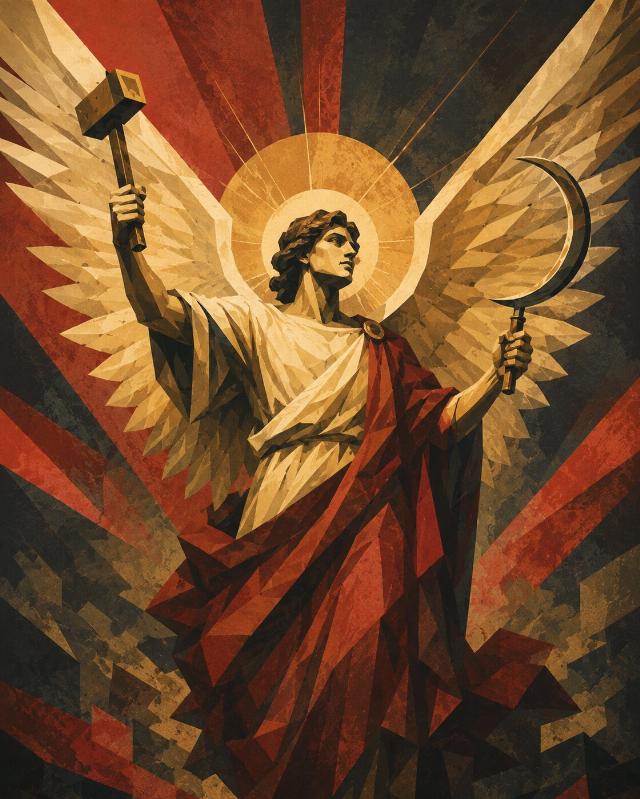
Islamic political systems and Marxist-Leninist communism both concentrate the authority to define correct doctrine, law, and policy in a closed directing elite. Ordinary members, let alone outsiders, lack standing to challenge the core claims. The result is an interpretive monopoly converting a comprehensive worldview into enforceable political control. This is not a secondary feature; it is a practical mechanism that secures ideological unity and suppresses competing claims to legitimacy.
In 833, the Abbasid caliph al-Ma'mun ordered his judges and scholars to affirm that the Quran was created rather than eternal. The position came from the Mu'tazila, a rationalist theological school the caliph favored, which held that an eternal, uncreated Quran would stand as a second eternal being alongside God, violating His absolute oneness; traditionalists held instead that the Quran was God's own uncreated, inseparable speech. Those who refused faced dismissal, imprisonment, or the lash; al-Ma'mun's successor, the caliph al-Mu'tasim, had the traditionalist jurist Ahmad ibn Hanbal flogged for holding out.
The inquisition (the Mihna) ran for fifteen years before al-Mu'tasim's own son, the caliph al-Mutawakkil, ended it in 848 and restored the doctrine ibn Hanbal had defended. The lesson: a caliph could jail a scholar; he could not manufacture consensus. That