
Islamic political systems and Marxist-Leninist communism both concentrate the authority to define correct doctrine, law, and policy in a closed directing elite. Ordinary members, let alone outsiders, lack standing to challenge the core claims. The result is an interpretive monopoly converting a comprehensive worldview into enforceable political control. This is not a secondary feature; it is a practical mechanism that secures ideological unity and suppresses competing claims to legitimacy.
In 833, the Abbasid caliph al-Ma'mun ordered his judges and scholars to affirm that the Quran was created rather than eternal. The position came from the Mu'tazila, a rationalist theological school the caliph favored, which held that an eternal, uncreated Quran would stand as a second eternal being alongside God, violating His absolute oneness; traditionalists held instead that the Quran was God's own uncreated, inseparable speech. Those who refused faced dismissal, imprisonment, or the lash; al-Ma'mun's successor, the caliph al-Mu'tasim, had the traditionalist jurist Ahmad ibn Hanbal flogged for holding out.
The inquisition (the Mihna) ran for fifteen years before al-Mu'tasim's own son, the caliph al-Mutawakkil, ended it in 848 and restored the doctrine ibn Hanbal had defended. The lesson: a caliph could jail a scholar; he could not manufacture consensus. That failure shows where interpretive authority in Islamic political theory actually sits—not with the state as such, but with the class competent to establish consensus (ijma').
Quran 4:59 commands: "O you who have believed, obey Allah and obey the Messenger and those in authority among you." Classical jurists elaborated this into a doctrine of rightful leadership in which the caliph, or, absent a single caliph, the body of qualified scholars (ulema), holds competence to interpret and enforce the Sharia. Independent judgment departing from established consensus risks classification as innovation (bid'ah) or, in more serious cases, as deviation that threatens the community. The scholars are the living guardians of the correct line.
Systems emphasizing a single Imam or guardianship of the jurist concentrate the monopoly further. The ordinary believer is not free to construct an alternative political theology of equal standing—and after 848, neither, in practice, is the caliph. Interpretation is hierarchical, and the hierarchy is political, even against the state's own wishes.
Marxist-Leninist communism constructs an explicit parallel. Lenin's What Is to Be Done? argues that the working class, left to itself, develops only trade-union consciousness. Revolutionary consciousness must be brought from outside by a vanguard of professional revolutionaries organized in a disciplined party. The party alone grasps the scientific laws of historical development and, therefore, alone possesses the authority to define the correct strategy and line.
Democratic centralism institutionalizes the monopoly: once a decision is reached, lower bodies and individual members are bound by it. Factionalism is prohibited because competing interpretive centers would fracture the instrument of historical progress. Deviation is not treated as legitimate disagreement within a pluralist framework; it is a political threat to be corrected or eliminated. The party is the exclusive interpreter of Marxism; other readings are, by definition, incorrect or opportunistic.
The mechanisms differ. The party is a single organization with a membership roll and a body—the Central Committee—empowered to expel by resolution; a ruling, once made, binds until a later ruling reverses it. The ulema are not one body at all: there is no central magisterium, the four major Sunni schools historically disagreed with one another, and ijma' forms gradually across generations rather than by vote.
But the difference cuts against the ordinary person, not for him. A Central Committee ruling can be reversed by a later one—Khrushchev reversed Stalin on more than one settled question. A consensus, once classical jurists treat it as formed, has no procedural mechanism for reversal. The believer facing ijma' has strictly fewer avenues than the party member facing a reversible committee.
Centralization is not what makes an interpretive monopoly binding; irreversibility is—and the diffuse version binds harder. Both systems reject the same liberal premise, regardless of mechanism: that individuals or competing groups may freely generate alternative comprehensive interpretations of equal public standing. Authority to define the meaning of the doctrine is reserved to a specialized elite—the ulema or the party cadre—whose judgment the ordinary participant cannot contest without the contest itself becoming the offense.
The payoff is practical, not merely doctrinal. A single authoritative voice heads off the fragmentation that open interpretive competition would produce, and because opposition is framed as a challenge to reality itself, dissent becomes something to be corrected rather than argued with. That framing does double duty inside the elite: advancement tracks demonstrated fidelity to the authorized line, which builds a loyalty structure the doctrine alone couldn't, and it lets the system change tactics without appearing to abandon its claims, since only the vanguard is positioned to authorize the adjustment.
Beyond the Mihna, the ulema issued fatwas defining orthodoxy, and rulers claiming caliphal authority sought scholarly legitimation even as they tried to control the scholars who granted it. In communist regimes, the party's monopoly was enforced through control of theory journals, party schools, and the security apparatus. Its logic was concrete rather than abstract: the 1948 Central Committee resolution condemning Muradeli's opera The Great Friendship named Prokofiev, Shostakovich, and Khachaturian individually as "formalists," and the Composers' Union forced each to publicly repent before the charge was lifted.
Successive campaigns against "rightist," "cosmopolitan," or "revisionist" deviation extended the same policing for decades. In both cases, the monopoly proved durable because it was not merely asserted; it was institutionalized through educational, judicial, and coercive instruments—and, on the communist side, enforced against individuals named in an official document, not against abstractions.
Objections that Sunni classical theory allows scholarly disagreement (ikhtilaf) within recognized limits, or that communist parties sometimes tolerated limited debate before a decision, do not erase the structural parallel. The existence of bounded disagreement inside the elite is compatible with a monopoly against outsiders and against unauthorized centers of interpretation. What both systems refuse is an open field in which any individual or group may claim equal authority to redefine the foundational order.
The vanguard or the scholarly-political hierarchy remains the sole legitimate source of binding interpretation—and, as the Mihna shows on one side and the party's expulsion power shows on the other, there is no forum in which the ordinary person can contest that interpretation without the contest itself being treated as the violation.
This exclusive interpretive monopoly is, therefore, a core practical instrument shared by both systems. It transforms a claim about the correct ordering of human life into a political apparatus capable of enforcing that claim. Authority over meaning becomes authority over policy, membership, and coercion. The ordinary participant receives the authorized understanding rather than sourcing it.
In this respect, Islamic political systems and Marxist-Leninist communism operate with parallel logic: the power to define the truth of the system is reserved to a closed directing elite, and that reservation is essential to the system's capacity to rule.
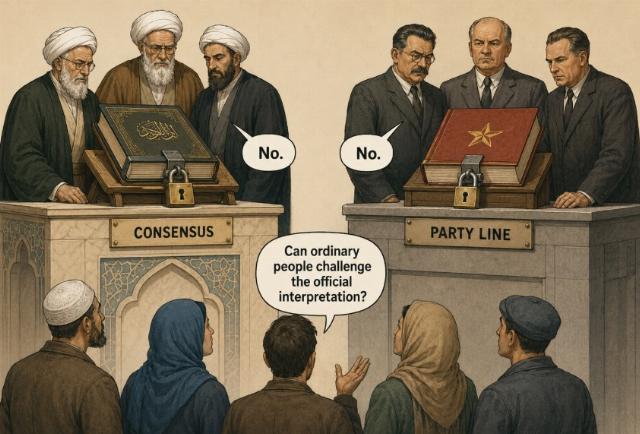
Image created using AI.
Endnotes
1. Quran 4:59. Standard translations (Sahih International) establish the command to obey Allah, the Messenger, and those in authority. Primary text at quran.com/4/59.
2. Classical political theory on the caliphate and the role of the ulema is set out in works such as al-Mawardi, Al-Ahkam al-Sultaniyya, and al-Ghazali's political writings. English access to a representative legal manual that reflects the hierarchical structure of authority is found in Ahmad ibn Naqib al-Misri, Reliance of the Traveller (Umdat al-Salik), trans. Nuh Ha Mim Keller (Amana Publications, 1994), particularly the sections on judicial authority, the caliphate, and the conditions of legitimate leadership.
3. Iran's 1979 constitution institutionalizes guardianship of the jurist (wilayat al-faqih): the Supreme Leader, a cleric selected by the Assembly of Experts rather than by direct popular vote, holds authority over the armed forces, the judiciary, and the vetting of candidates for elected office, superior to the elected president and parliament. See Ruhollah Khomeini, Islamic Government: Governance of the Jurist (1970), the doctrine's founding text.
4. On the scholarly monopoly over correct interpretation and the treatment of deviation, see the classical discussions of ijma' (consensus) and the boundaries of acceptable disagreement in the major schools. The classical primary text on scholarly consensus is Muhammad ibn Ibrahim Ibn al-Mundhir (d. 318 AH/930 CE), Kitab al-Ijma' (The Book of Consensus), which catalogues points of law on which the schools concur.
5. V. I. Lenin, What Is to Be Done? (1902), especially the sections arguing that revolutionary consciousness must be brought to the workers by a vanguard of professional revolutionaries. Primary text at marxists.org/archive/lenin/works/1901/witbd.
6. On rule by credentialed experts as a structural feature rather than an accident: by 2002, all nine members of the Chinese Communist Party's Politburo Standing Committee held engineering degrees, including General Secretary Jiang Zemin (electrical engineering) and his successor Hu Jintao (hydraulic engineering). The pattern declined sharply after 2007 as legal and humanities backgrounds became more common in top leadership.
7. Lenin's elaboration of the party's exclusive role and the principle of democratic centralism appears throughout his organizational writings. The ban on factions was codified in the Resolution "On Party Unity," Tenth Congress of the Russian Communist Party (Bolsheviks), March 8–16, 1921, which ordered the immediate dissolution of all factions and authorized the Central Committee to expel members, including its own, for factional activity. Primary text at marxists.org/archive/lenin/works/1921/10thcong/ch04.htm.
8. On the practical enforcement of the interpretive monopoly through control of theory, see the Central Committee resolution On the Opera "The Great Friendship" by V. Muradeli (February 10, 1948), which condemned "formalism" in music and launched the broader Zhdanovshchina campaign against "formalism" and "cosmopolitanism" in the arts and sciences.
9. On the mechanism of "correction" in practice: struggle sessions (pīdòu dàhuì), developed from Soviet 1920s criticism/self-criticism practice, became a standard Maoist tool during the Cultural Revolution (1966–76) for publicly forcing "class enemies" and ideological deviants to confess error before a crowd. See Lawrence R. Sullivan, "Struggle Sessions," in Historical Dictionary of the Chinese Communist Party (2011).
Source link