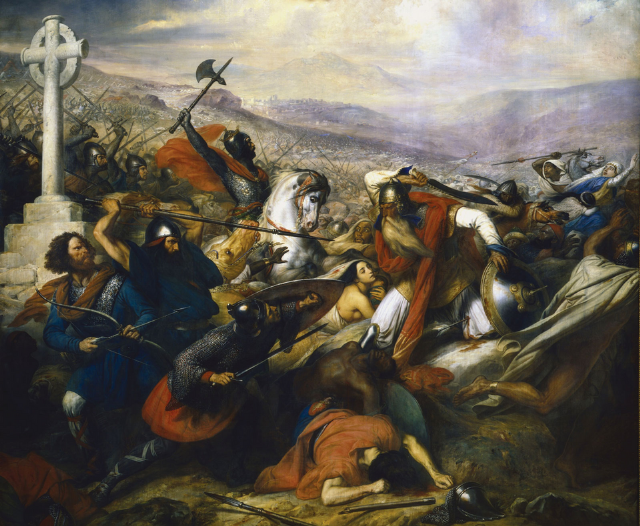
From Wikimedia Commons: The Battle of Tours (Charles de Steuben, 1837)
The tombs of Charles Martel stand in the Basilica of Saint-Denis as relics of a civilization that once possessed the will to survive.
In 732, the Mayor of the Palace shattered the Umayyad army of Abdul Rahman Al Ghafiqi at Tours, earning the name Martel—the Hammer. That victory closed the northern road of the caliphate, preserved the Frankish realm as the last coherent Christian power in the West, and secured the conditions for Charlemagne's empire and the very idea of Christendom.
Martel's heavy infantry held against the shock of Muslim cavalry; the political consolidation that followed produced the Carolingian order, missionary expansion into Germany, and the historic alliance of throne and altar sealed in 800. Gibbon and generations of European chroniclers treated the battle as a civilizational hinge. Modern academic hedging about the precise scale of the expedition changes nothing about the aftermath: the northern expansion of Islam was stopped, and a distinct European identity solidified around Christian faith and Roman inheritance.
Today, the same basilica rises in a suburb that has already been lost. Seine-Saint-Denis records an immigrant share of 31.2%—the highest in mainland France—drawn principally from Algeria, Morocco, Tunisia, Mali and other Muslim-majority sources. Official statistics are forbidden to name religion, yet the streetscape requires no census: halal markets, mosques, and the near-vanishing of the older French working-class presence declare the new ownership. Poverty approaches 30%, double the national rate.
The enclave-like department is the youngest in metropolitan France, with more than a fifth of its inhabitants under fifteen. These figures are the measurable residue of a political project sustained for decades by the red-green alliance—an informal but effective coalition of left-wing parties and Islamist networks that treat the historic French nation as an obsolete obstacle rather than a living trust.
The anti-Western alliance works with cold strategic sense. Its secular wing supplies the moral prestige of anti-racism, decolonial grievance, and the residual authority of the postwar left. Its Islamist wing supplies demographic density, communal endogamy, and an alternative civilizational code. Together they hollow out the practical sovereignty of the Fifth Republic. Reflecting a 1905 settlement that confined religion to the private sphere while protecting a common public culture, laïcité is steadily reduced to a rhetorical prop.
Around Martel's tomb, the symbols of French conviviality—berets, baguettes, the unselfconscious mixture of the old working class—have yielded to niqabs and the predatory packs whose catcalls mark the territory as hostile ground. French citizens of Christian ancestry move through these streets as tolerated outsiders, subject to the ordinary friction of harassment and the quieter pressure of demographic displacement.
The disorder that periodically erupts across the banlieues is the predictable consequence of importing populations whose fertility, identity, and political loyalty remain oriented elsewhere, while simultaneously dismantling the cultural confidence required for any genuine assimilation.
This destructive process is not the accidental by-product of labor migration or classroom overcrowding. It is the deliberate result of elite preference for abstract universalism over the concrete duties of cultural transmission. The governing classes of the Fifth Republic have treated the nation as a hotel rather than a home. Indulging in the moral glow of openness, they have neglected the harder work of demographic and cultural continuity.
The red-green alliance has exploited that complacency with greater ruthlessness than its predecessors. It understands that control of fertility rates, street-level social norms, and the curriculum ultimately outweighs temporary control of the constitution. Formal republican institutions remain so far; the daily experience of ordinary French people of Christian ancestry is that those institutions no longer command the ground.
Civilization is not an empty procedural framework that can be filled by any demographic content whatsoever. It is a lived inheritance of language, memory, sacral architecture, and intergenerational loyalty. When the proportion of those who share that inheritance falls below a critical threshold, the inheritance itself dissolves. Saint-Denis demonstrates the mechanism with pitiless clarity.
The physical structure of the basilica endures, yet the surrounding social order no longer orients itself towards the civilization the basilica originally embodied. The red-green alliance grasps this dynamic more clearly than its opponents. It does not require dramatic seizure of power; it requires only the acceleration of demographic replacement while stigmatizing any frank acknowledgment of the process as bigotry. The historic people are thereby rendered a minority in their own capital region, their public spaces marked by alien norms, their children educated to regard their own past with suspicion or shame.
The prospects for France are correspondingly bleak. Demographic momentum is stubborn. The age structure of Seine-Saint-Denis guarantees that the relative weight of the newer populations will increase even in the absence of further inflows. Parallel societies harden; political majorities shift more slowly than street-level control, yet both move in the same direction.
The French state retains formal authority, yet its capacity to enforce a common culture has been deliberately impaired by decades of elite ideology. Appeals to "republican values" grow ever more hollow as those values are being emptied of the historical substance that once made them compelling. The Hammer of Tours drew a line that held for centuries. However, no comparable line is visible today. The descendants of the people who built the basilica walk its precincts as interlopers while the coalition that displaced them consolidates its hold on the future.
The same pattern is visible, with local variations of tempo and intensity, across Western Europe. In Britain, Sweden, the Netherlands, Belgium, and large parts of Germany, the postwar settlement of high immigration, low cultural confidence, and elite prioritization of abstract rights over concrete peoples produces irreversible transformation. Fertility differentials, chain migration, and the formation of dense Muslim communities generate parallel societies whose political demands expand with their numbers.
Native majorities age and shrink; their elites continue to treat any defense of the historic nation as moral failure. The red-green alliance—or its functional equivalents—advances under the banners of "anti-racism" and "human rights" while the older European character of cities and regions is steadily erased. The process is self-reinforcing: as native populations lose demographic and cultural dominance, their capacity to reverse course diminishes. Political capture follows social capture. What begins as "diversity" ends as displacement—eventually, as replacement.
From a philosophical perspective, the trajectory reveals the terminal weakness of late-liberal assumptions about identity and continuity. A people that loses the will to reproduce itself and to transmit its culture has already accepted its own supersession. Western Europe's governing classes have spent half a century educating themselves and their successors into precisely that acceptance. They have preferred the moral prestige of openness to the harder virtues of continuity and defense.
What follows from consistent elite betrayal is a soft conquest in which the historic peoples of the continent are gradually reduced to strangers in the places their ancestors built.
Martel's tomb remains in Saint-Denis. The civilization that once understood why the tomb mattered is being unmade, first in France and then across the wider European landscape. The process continues. The will to stop it has not yet appeared.
Hopefully, the French will be spared the sight of the venerable basilica engulfed in flames—much like Notre Dame and the town hall in Limoges. Their moral paralysis is tragic.
Source link