
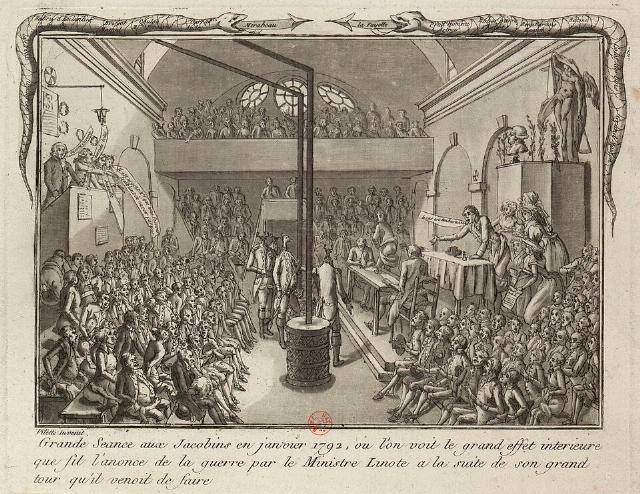
From Wikimedia Commons: Grand session at the Jacobin Club (unknown artist, 1792)
In both the lecture halls and quads of America's elite universities, a disturbing paradox unfolds. The youngest generations of students, beneficiaries of unprecedented material prosperity and intellectual liberty, actively suppress or deny the grim ledger of socialism as it was brutally implemented across the twentieth century. This phenomenon is due partly to ignorance and partly to a cultivated historical amnesia—one that imperils the very freedoms that the West still possesses, however precariously.
Forced collectivism, in all its variants, has consistently delivered the opposite of utopia: the systematic annihilation of individual dignity, including the suppression of speech, the abolition of private property, engineered famines, gulags, and mass graves. From the Soviet Union to Maoist China, Cambodia's Killing Fields to North Korea's prison colonies, the human cost has been staggering—balanced estimates of excess mortality ranging from 55 to over 80 million people. By comparison, in his book Death by Government (1994), political scientist and statistician Rudolph Joseph Rummel estimates that communist regimes killed around 148 (high-end) million people during the period 1917–1987, with French historian Stéphane Courtois, editor of The Black Book of Communism (1997), arriving at an estimate of 85 to 100 million deaths.
Historical negationism is particularly ominous amid the convergence on campuses of socialist nostalgia, anti-colonial fervor, and tactical alliances with Islamist movements. What unfolds is a pessimistic spectacle: a generation poised to repeat the errors of the past, romanticizing collectivist experiments while ignoring their victims, both secular and religious. The consequences are far from abstract; they manifest in shattered lives, eroded civil discourse, and the quiet erosion of liberal democracy.
The historical record is unequivocal, yet increasingly contested in Western academia. In the Soviet Union, demographic analyses place unnatural deaths between 20 and 30 million. This toll encompasses Stalin's political purges, the vast Gulag archipelago of forced labor, and engineered famines such as the Holodomor in Ukraine (1932–1933), which claimed 3.5 to 5 million lives through deliberate starvation policies aimed at crushing peasant resistance and national identity. Archival data from the Library of Congress and post-Soviet studies confirm these horrors: families reduced to cannibalism, villages wiped from the map, entire classes liquidated in the name of "proletarian solidarity."
China's experience under Mao Zedong was even more catastrophic. The Great Leap Forward (1958–1962), a frenzied experiment in forced collectivization and industrial fantasy, triggered a famine that killed between 30 and 45 million—by far the deadliest single policy-induced disaster in human history. Cadres enforced grain requisitions while millions starved; backyard furnaces produced useless slag as agriculture collapsed. The subsequent Cultural Revolution added layers of ideological terror, with Red Guards humiliating, torturing, and killing perceived enemies. Estimates for the full Maoist era underscore a regime that treated human life as raw material for utopian engineering.
Smaller but no less revealing tragedies compound the indictment. North Korea's Kwan-li-so prison camps and recurrent famines have claimed 1 to 3 million lives since the Korean War. Cambodia's Khmer Rouge (1975–1979), inspired by Marxist-Leninist zeal and Maoist precedents, murdered approximately 1.5 to 3 million—roughly a quarter of the population—through executions, torture, and slave labor in the Killing Fields. Pol Pot's vision of Year Zero erased professionals, emptied cities, and reduced society to agrarian serfdom. In Ethiopia, the Derg junta's Red Terror, forced relocations, and policy-induced famines exacted 1.5 to 2 million deaths. Marxist insurgencies in Zimbabwe, Mozambique, and beyond left trails of displacement, villagization, and repression.
Traditionally, the massive-scale sacrifice of human life, if not outright denied by the cadres, were attributed to counter-revolutionary sabotage and unpredictable "accidents" of implementation such as natural disasters. However, humiliation and deprivation flowed logically from the core tenets of forced collectivism: the subordination of the individual to the collective will, the abolition of private property as a supposed root of exploitation, and the vanguard party's monopoly on truth and coercion. Central planning inevitably bred misallocation, shortages, and scapegoating. Dissent became sabotage; deviation, treason. The outcome was a machinery of suffering—secret police, show trials, concentration camps—whose victims numbered in the tens of millions. Rummel and Courtois document this pattern with chilling consistency.
The West's amnesia extends to the victims of radical Islam as well, whose theocratic collectivism—demanding submission of the individual to divine-political authority—mirrors socialism's authoritarian impulse. Both ideologies brook no separation of spheres: the personal is political, the spiritual is statist. Neglecting either compounds the peril.
Denying the human costs of "realized socialism" and Islamism dishonors the ideological current within American higher education. Student movements blend far-left Marxism, anarchist strains, and Third-Worldist anti-imperialism with sympathy for groups like Hamas. Anti-colonial narratives frame the West—particularly the United States and Israel—as the font of global oppression. Critical theory and intersectionality knit disparate struggles into a seamless tapestry of victimhood, where the Israeli-Palestinian conflict exemplifies "settler-colonialism."
Anti-Westernism produces strange bedfellows. Secular leftists, ostensibly champions of secularism and LGBTQ rights, forge tactical alliances with Islamist organizations that despise those very principles. The common enemy is Western hegemony. Protests demand divestment from companies linked to Israel or Western defense, echoing calls to dismantle the economic foundations of liberal societies. Encampments at Columbia, Harvard, UCLA, and beyond in 2024 transformed campuses into liberated zones—complete with disrupted classes, occupied buildings, and rhetoric that sometimes veered into open celebration of "resistance" by designated terrorist groups.
Critics, including Jewish student organizations like Hillel, rightly decry the antisemitic undertones: chants that blur distinctions between anti-Zionism and Jew-hatred, harassment of Jewish students, and invocations of intifada. Administrators, caught between First Amendment protections and civil rights obligations, have resorted to police interventions, encampment bans, and federal investigations. The Foundation for Individual Rights and Expression (FIRE) and the ACLU highlight the tensions, yet the deeper rot persists: a curriculum and campus culture that downplays or relativizes the crimes of collectivism while amplifying narratives of Western guilt.
The human consequences are immediate and corrosive. Free speech is chilled by various means other than overt censorship alone, not least by social enforcement—cancel culture as "soft totalitarianism." Intellectual diversity withers; dissenting faculty self-censor. Students, shielded from the ledger of real-world socialism, embrace policies that would replicate its failures: expansive state control, wealth redistribution without growth, identity-based redistribution over merit. The outcome is a generation primed for disillusionment, or worse, for doubling down when reality intrudes.
The tragedy lies in repetition. Forced collectivism does not fail for lack of noble intent; it fails because it denies human nature—individual agency, incentives, the information-processing power of markets, the necessity of pluralism. Property rights are not bourgeois fetishes but bulwarks against arbitrary power. Free expression is not a luxury but the oxygen of progress. When these are abolished in the name of the collective, the body count follows: first the kulaks and intellectuals, then the loyal cadres, finally the system itself, sustained only by coercion and lies.
The campus radicals of modern times, insulated by the very capitalist endowments that they decry, wave flags of liberation while neglecting the Gulags and Killing Fields. Making a mockery of progressivism, this is regression—a return to the hubris of planners who believed they could remake man. The convergence with Islamist currents adds volatility: a fusion of materialist and theocratic authoritarianisms, united in opposition to the open society.
Without a reckoning—curricular reform emphasizing primary sources from the archives of tyranny, robust defense of academic freedom, and cultural reaffirmation of liberal values—the West might ultimately squander its inheritance. Historical amnesia is never neutral; it is preparatory. For the sake of humanity and civilization, the victims of socialism and radical Islam demand remembrance. If the young continue to romanticize collectivism, the human sacrifices will not remain confined to dusty history books. They will be repeated, in blood and privation, on the campuses and streets of a civilization that forgot how to defend itself.
Source link