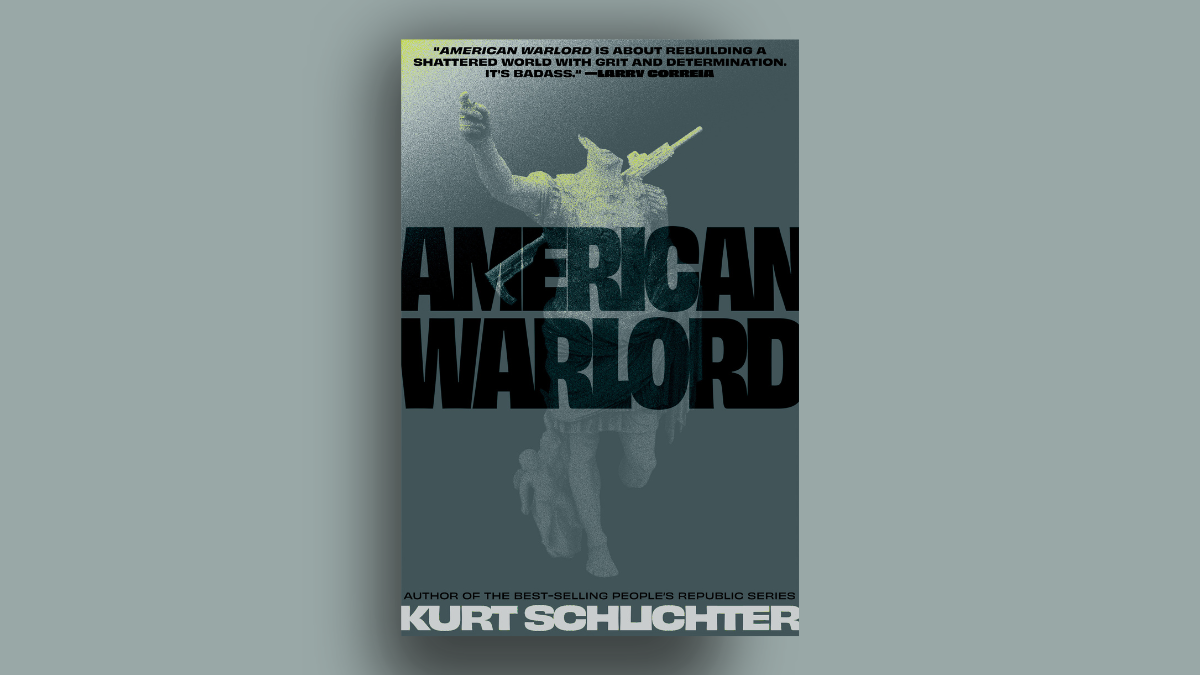
Kurt Schlichter's latest novel, 'American Warlord,' asks the difficult questions about what happens when politics breaks down.
In 1908, Jack London published To Build A Fire, a story about an unnamed man who ignores local advice and takes a perilous trail through the frozen Yukon. The man is adept at analyzing his surroundings in a technical sense, but he spares no thought for the metaphysical, and doesn't develop much foresight for hazards. Despite being warned by an older man familiar with the territory, our protagonist overestimates his own abilities in a hostile environment and ultimately dooms himself to a cold and lonely death. He thinks the cure for the cold is simply to light a fire, only to find out the hard way that harsh conditions won't allow you to do that.
Today, Kurt Schlichter has focused his writing on a similar theme, using a different setting and a different set of tools. A retired Army colonel, trial lawyer, and columnist, Schlichter also makes time for novels, all of which tell the same basic story of hubris as Jack London did over a century ago. However, instead of man-versus-nature at sixty degrees below zero, Schlichter turns the temperature up: Readers of his Kelly Turnbull series know the bleak landscape of America's second civil war, as well as his standalone novels set after a civilizational breakdown. Like Jack London setting his most popular works in the snow, post-collapse America is Schlichter's sandbox.
With a dozen such novels in that space, he's very clearly telling the world not to take that dangerous road through the Yukon at sixty below. There's nothing fun or adventurous about the prospect of the collapse and the next civil war. Life is not a video game, and even if it was, we in America don't appreciate just how much we play it on easy mode compared to the rest of the world. We shouldn't wander into terrain that doesn't "look so rough" from our front door.
Yet we do it anyway because the terrain in question isn't physical; we're up against ideological challenges, mostly in the form of policies and practices we endorse and encourage. Fiscal policies (print more money!), social policies (anything goes!), immigration policies (ban the borders!), all of it—we wander out where history and a few contemporary voices tell us not to go, thinking we're the ones to buck the pattern.
Taking all of that in mind, Schlichter's latest fictional offering, American Warlord, shows that collapse happens at speed … and then paints a picture of what would have to happen to stabilize the world after the dust settles.
The run-up to the book's events is heavily reminiscent of the chaos of 2020, with the intensity dialed to 11. Blue cities are in a constant state of "fiery-but-mostly-peaceful" action, there's a new COVID strain with a much higher mortality rate, diesel is fifteen bucks a gallon, and the collectivists have control of D.C.'s institutions. The Feds bring charges against The Previous Administration (it's not hard to grasp who they're talking about) and anyone who supported them. This culminates in arrest warrants for politicians and businessmen around the country, and to the surprise of no one, Texas is the first state to push back. They won't play along, and the governor even pits the Texas Rangers against the National Guard to resist federal overreach.
In the midst of all this is a humble trucking dispatcher, Victor Kincaid, who's just trying to do his job. He's 42 years old, 6'1", 210 lbs, highly literate, and has a broad knowledge of history with an emphasis on the Roman Empire. (This is more or less a description that Kurt Schlicter stole from my Class-A CDL, but it flatters me tremendously, so I'll allow it.) Kincaid does what he can to direct his drivers safely through hazards to keep the company afloat, still vaguely believing that things will get better if he doesn't rock the boat. That doesn't stop the storm from boiling the seas anyhow, and when the boogaloo kicks off, he has to get practical in a hurry.
The nation shatters and people congregate in small groups with like-minded goals, usually along ethnic lines, as these things tend to go. Survival belongs to those who can defend their groups, acquire food and weapons, and defend land that supports them. While most people learn this the hard way, discovering the basis of civilization from first principles, Kincaid uses his knowledge of history as "cheat sheet" to accelerate the progress of his own band.
Circumstances relocate him from Texas to Oklahoma. His group raids a National Guard armory for weapons and vehicles. They take an apartment complex for housing. Later they annex an entire town to their holdings. With discipline and practice, he turns his subordinates into a functioning, loyal operation, focusing on fundamentals and cohesion. Nothing fancy, nothing exotic, just do what works and don't mess with the formula.
The conclusion of the book differs from the premise of Schlichter's Kelly Turnbull series, which now contains nine books (and counting). The ongoing nature of that series basically requires Turnbull to stay in the conflict stage of the collapse, while American Warlord walks us through the rebuilding phase. There's a philosophical discussion that echoes much of what the Founders discussed in the late 1700s about government, society, and the pursuit of happiness. Peace sits between Revolution and War in the endless cycle of humanity's story, and those who enjoy the longest stretches of peacetime are the ones who remember what causes revolution — and ultimately, war. Then they avoid it.
Jack London's Yukon man died in a wilderness that he thought he understood, and it wasn't until death had its icy grip on him that he realized the man warning him had been right. Even if he hadn't admitted this to himself, it wouldn't have changed anything: He shouldn't have gone down that trail, it was objectively going to kill him.
His revolution was his ignorance, his inability to think about anything deeper than the most surface-level, material facts of his surroundings: "The trouble with him was that he was without imagination. He was quick and alert in the things of life, but only in the things, and not in the significances."
In other words, if it's cold, I'll just start a fire, duh.
Sure. That's what the science and technology department will tell you at your local university. But the story of mankind is not simply a story of STEM exploits — ask the humanities department about that. If fundamentals and discipline are needed to build society, then fundamentals and discipline are also needed to maintain it. Radical departures from the hard-won wisdom of the past have an extremely high likelihood of ending in disaster for a reason, and we ignore that to our detriment.
American Warlord is a full-length novel that pairs very well with To Build a Fire; in effect, Schlicter and London were writing about the same thing, but with different protagonists. After finishing the book, I'd be hard-pressed to imagine Victor Kincaid shrugging off the old woodsman's advice, or at the very least, refusing to follow the established road. It's there for a reason.
Source link