Christians in Indonesia face an underreported pattern of threats and protests as radical Islamists weaponize bureaucratic red tape to stop them from practicing their faith, even in private residences.
Though reporting is largely limited to citizen journalists and small Christian publications, a review of reported incidents reveals a tried-and-true method used to repress Christians in the world's most populous Islamic nation, despite religious freedom being guaranteed by law. (RELATED: Faith Groups Warn Proposed Law Could Blind America To Christian Massacres)
While the 1945 Constitution of the Republic of Indonesia guarantees "all persons the freedom of worship, each according to his/her own religion or belief," heavy permitting requirements make it increasingly difficult for religious minorities to establish places of public worship. This gives hostile groups of Muslims an opportunity to stop Christians from practicing their faith.
Fredrik J. Pinakunary, chairman of the Supervisory Board of the Indonesian Christian Legal Society, told the Daily Caller that while established minority communities, such as Christians, Hindus, and Buddhists, remain relatively peaceful and secure, "friction typically flares around two specific flashpoints: applying for and constructing new places of worship, and holding non-routine religious gatherings outside registered sanctuaries—such as residential prayer meetings, or special holiday gatherings."
For Christians, these flashpoints can leave them with two choices: apply for a permit and endure years of red tape while facing continual protests, or hold small worship and prayer services that risk being interrupted by threats of violence. Those threats often end in local meetings that let the person making them off the hook while the church is forced to suspend services.
"If you don't close it, bloodshed will occur inside," a machete-wielding Muslim man, accompanied by a few others, said as he interrupted a prayer service involving approximately 40 Christians in late September, according to Morning Star News. "Yes, I am not afraid to die … For Allah, I am not afraid to die."
As the congregants fled, the man continued, justifying his outrage by claiming the prayer rooms lacked permits and that he was part of "the majority."
Despite the threats, the man was not immediately arrested. Instead, he met with community leaders, where he offered his "deepest apologies." The meeting initially resulted in an agreement to take no legal action, but the settlement later collapsed after officials ordered the prayer house closed, according to Morning Star News.
In fact, Pinakunary said such attempts at mediation often "come at the expense of the minority congregation" as law enforcement and community leaders prioritize keeping the peace and avoiding violent clashes over protecting constitutional liberties.
In another heated example, an Oct. 6 meeting with community leaders over six Christians worshipping in a private home ended with an official record mandating the suspension of services until all administrative requirements had been met. However, the meeting's minutes did not specify which requirements remained incomplete, Persecution.org reported.
The pastor said he agreed to the deal only because he feared for his family's and home's safety. He added that one neighborhood leader struck a table and said, "Arrest them; if they resist, kill them," according to Persecution.org.
These intimidation tactics are not new and stem from abuses of the requirements needed to structure a church, as stated in a 2006 Joint Ministerial Decree issued by the Ministers of Religious Affairs and Home Affairs, according to Pinakunary.
In perhaps the earliest example of this, Islamist protesters were able to stall a church's creation for 15 years despite having met all of the decree's requirements in 2006.

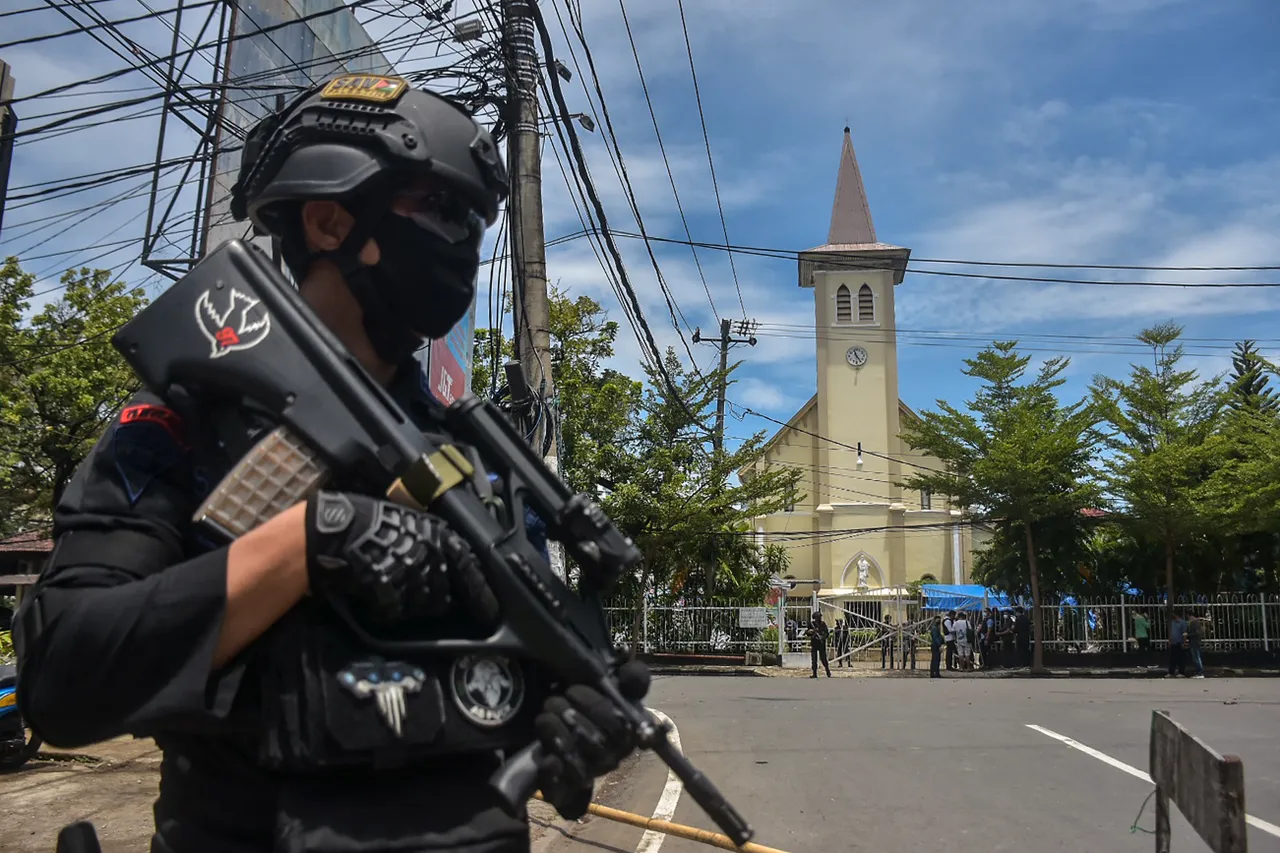
An Indonesian policeman stands guard outside a church after an explosion in Makassar on March 28, 2021. (Photo by INDRA ABRIYANTO/AFP via Getty Images)
These requirements include a list of at least 90 prospective congregants, verified by local authorities; written signatures of support from at least 60 neighbors living in the immediate vicinity, validated by the local village or neighborhood head; and a written recommendation from the local office of the Ministry of Religious Affairs and the local Religious Harmony Forum.
While Pinakunary said the joint decree was intended to promote religious harmony, it "quickly backfired" because the prerequisites, especially the 60-neighbor consent, "gave hostile neighbors an effective pocket veto, even when applicants met every other standard."
This year, at least 11 places of worship have had construction halted after protests from groups alleging that permitting requirements were not met. The necessary paperwork had been completed in all but five cases. One church was raided for repairing its roof without a permit, and another spent the last nine years trying to secure one with no success. (RELATED: Pope Leo XIV Makes History As First Pope To Vote In US Election)
In one case, arson and subsequent attempts to redo the paperwork disrupted construction, while local officials rejected the revised applications. The church building has remained unfinished since breaking ground in 2004.
"Even a bulletproof application does not guarantee a church will ever be built," Pinakunary told the Caller, adding that "even when a congregation checks every box and secures every formal permit, mob resistance frequently persists."
"Be careful, servants of Allah. This Muslim community is already this incredibly angry," the man continued, warning that the church would bring "chaos" to the community. He said residents feared their grandchildren would leave the faith and become polytheists.
The man added that if the church were built, they would wait for the opportune time to "dismantle" it.
David Herson, a religious liberty advocate in Indonesia, told the Caller the meeting was taking place despite the church having already secured the proper permits.
A March report from the Setara Institute found 3,823 incidents and 5,639 actions against freedom of religion and belief across Indonesia since 2007.
Pinakunary said those findings made clear that "religious intolerance is a real, persistent problem on the ground. Administrative technicalities like a 'lack of permits' are routinely weaponized to give religious suppression a veneer of legal legitimacy."
While Herson affirmed that using permits to deny Christians the right to worship is indeed a pattern, he said it is not the only tool being used.
Pastor Dedi Saputra was sentenced to two years in prison in July for blasphemy and the dissemination of hate speech via social media. His alleged offense was sharing the Christian gospel on TikTok following his conversion from Islam, Persecution.org reported.
Pinakunary told the Caller that disputes and rights violations will continue unless structural legal reforms take place. He pointed to a dedicated Freedom of Religion Bill proposed by Human Rights Minister Natalius Pigai in 2026, which could "offer vital statutory protection for religious minorities across the country and provide teeth to Indonesia's constitutional guarantees." (RELATED: EXCLUSIVE: Nigerian Leaders Turn On Alleged 'Christian-Killing' Warlord After U.S. Pressure According To Whistleblower)
"Indonesia belongs to all of us," Herson told the Caller. "No one should be intimidated, discriminated against, or prevented from exercising their constitutional right to worship. Whether someone is Christian, Muslim, Hindu, Buddhist, Catholic, or belongs to another faith, everyone deserves the same respect, protection, and freedom."
Source link