
Informed people know that the historical case for Jesus as the incarnate Son of the living God doesn't rest solely on the testimony of the New Testament.
Still, it's gratifying when evidence that Christians have long recognized receives fresh attention and challenges the assumption that belief in Jesus rests on faith alone.
A first-century Jewish historian named Flavius Josephus, writing just decades after Jesus' death, also included Him in his account of the ancient world. And new research indicates that this historian's knowledge of Jesus came from people who were connected to the events surrounding His trial and execution.
Josephus wasn't a Christian.
He wasn't writing Scripture.
He wasn't divinely inspired.
He had no reason to promote the claims of the apostles and early church.
Yet when he wrote a history of the Jewish people, he included a specific account of Jesus of Nazareth - a remarkable reality given the tendency of some secular skeptics to dismiss Jesus as little more than an obscure Jewish teacher who performed a few tricks before being executed for challenging the authorities.
The historical importance of this extra-biblical account of Jesus was such that, for centuries, secular historians questioned whether Josephus had actually written it or whether early Christian copyists had embellished the passage to make it sound more consistent with their beliefs.
But a new study published by Oxford University Press reveals that the passage is substantially authentic. Even more significant, the research points to where Josephus got his information.
Josephus wasn't some distant observer trying to piece together rumors about events that happened generations earlier. He came from an influential Jewish family in Jerusalem and knew many of the people who occupied positions of religious and political power.
According to scholar T. C. Schmidt, his source of information was a man named Ananus II, a high priest who belonged to the same prominent family as Annas, the high priest involved in Jesus' trial.
Josephus knew Ananus personally, meaning he was in a position to hear about the events surrounding Jesus' condemnation from someone directly connected to them.
More from the Daily Mail:
The disputed passage is attributed to Flavius Josephus, a Jewish historian who was not Christian and who completed his original work around AD 93 to 94.
Known as the Testimonium Flavianum, the passage appears in Jewish Antiquities, his history of the Jewish people. It states: 'He appeared to them alive again on the third day, the divine prophets having foretold these and countless other wonders about him.' Josephus's original manuscript does not survive.
The passage differs slightly across different translations into a handful of languages. A Spanish research team says that the later translations added in the phrase about fulfilling Old Testament prophecies (which has made people doubt its authenticity), but that the original passage itself is indeed authentic to Josephus.
From Oxford University Press:
This suggests that the Testimonium Flavianum was indeed written by a non-Christian. The book then employs stylometric analysis to demonstrate that the Testimonium Flavianum closely matches Josephus' style. The Testimonium Flavianum appears, therefore, to be genuinely authored by Josephus.
One frustrating tendency in discussions about the historical Jesus is the assumption that Matthaios, Markos, Loukas, and Ioannes (Matthew, Mark, Luke, and John) should be dismissed as unreliable simply because they were committed believers.
But their conviction about what Jesus had done does not disqualify them as historical witnesses any more than an historian's personal convictions automatically invalidate his work. In fact, that the historical record preserves an account of Jesus that came through those who personally knew the people involved in sending Christ to the cross offers another fascinating layer of historical confirmation.
Christianity isn't built around a legend, a philosophical system, or a collection of inspiring religious ideas.
It's built around things God actually did in human history.
Jesus lived in a particular place, during a particular time, among people whose names and actions were recorded by historians outside the Christian faith.
Back to Oxford:
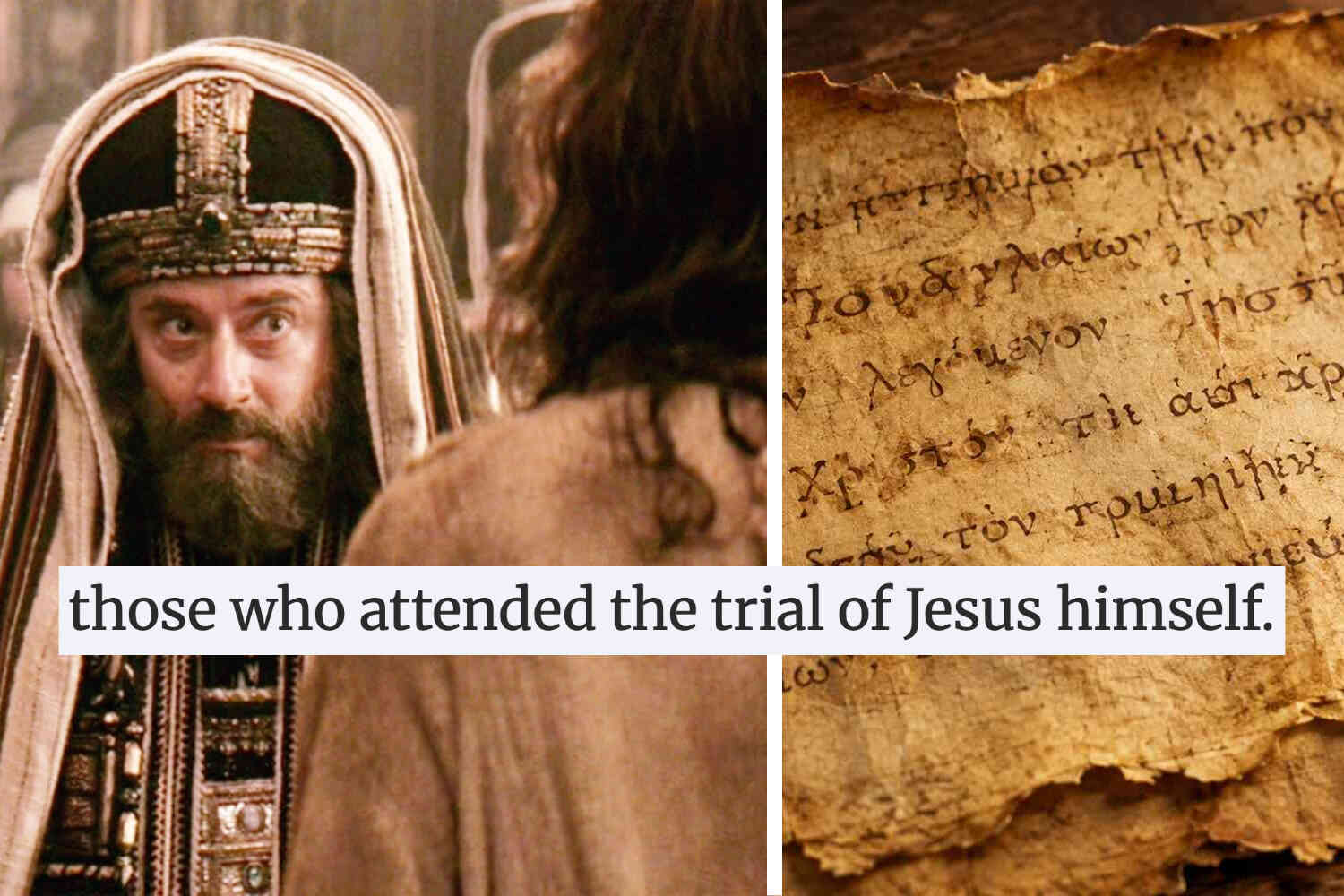
Josephus was directly familiar with those who attended the trials of Jesus' apostles and even those who attended the trial of Jesus himself.
Josephus's account doesn't prove the Resurrection or establish every detail in the Gospels. But it does remind us that Jesus wasn't simply a character in a story Christians told themselves. His life and death were part of the real world, and people outside the church knew about Him.
The apostles weren't preaching a fairy tale. They were proclaiming what they had seen and heard.
Even non-Christian historians were forced to wrestle with this truth.
Two thousand years later, we must wrestle with it too.
Watch our latest video 👇

Source link


