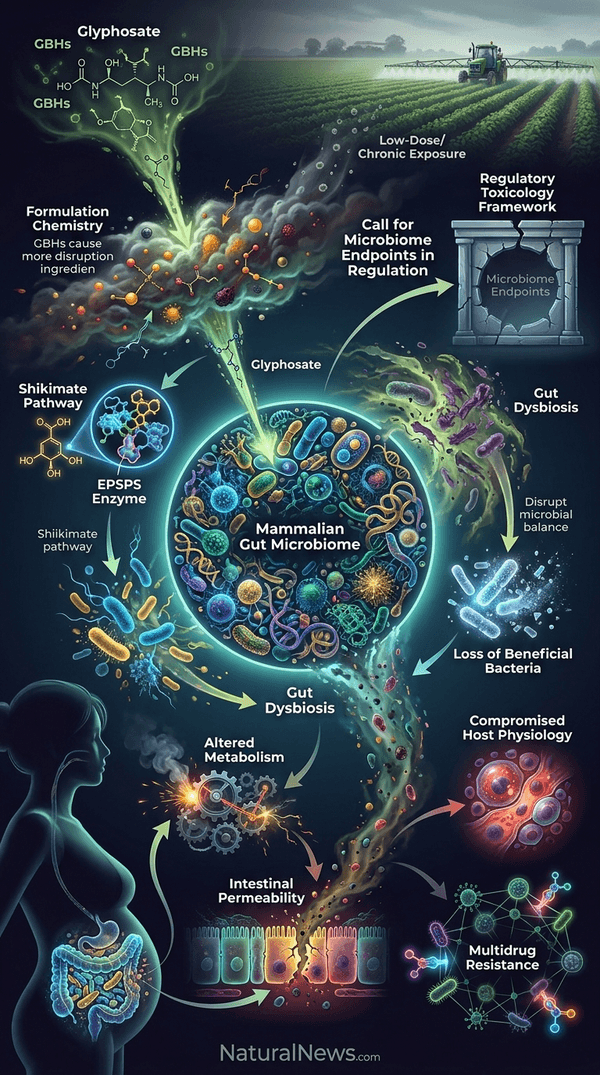
The review states that the long-standing regulatory rationale holding glyphosate to pose negligible direct risk to mammals is "inaccurate as a complete toxicological argument," because the shikimate pathway targeted by the herbicide is present in some commensal bacteria in the mammalian gut [1].
The review calls for microbiome-related endpoints to be integrated into regulatory toxicology guidelines.
Review Challenges Basis for Mammalian Safety Determinations
Glyphosate, described in the review as the most commonly used herbicide worldwide for agriculture and land management, has been assessed for decades as carrying negligible direct hazard to mammals because its molecular target, 5-enolpyruvylshikimate-3-phosphate synthase (EPSPS) of the shikimate pathway, is absent from animal cells, according to the review.
Mesnage states in the review that if glyphosate reaches the intestinal lumen in a biologically active form, it could inhibit EPSPS in susceptible commensals and indirectly affect mammalian physiology by altering the structure and metabolic output of the microbial community. The review describes the gut microbiome as a community of microorganisms involved in digestion, immune function, metabolism and behavior, and states that shifts in composition, known as gut dysbiosis, can disrupt host-microbe interactions.
Independent research has pointed in the same direction. A separate study of low-dose exposure concluded that glyphosate has the ability to cause gut dysbiosis and identified a potential mechanism through which exposure can negatively affect host physiology [2].
Rodent Studies Cited on Microbial Shifts, Intestinal Effects
The review states that rodent studies provide the most consistent evidence, with several reporting shifts in community composition, including depletion of lactobacilli, sometimes accompanied by intestinal inflammation, altered microbial metabolism and increased intestinal permeability.
The review cites a study using fecal microbiota transplantation that reported transfer of microbiota from rats exposed to a Roundup formulation reproduced aspects of gut dysfunction, which the review describes as more direct evidence for a microbiome contribution independent of aromatic amino acid deficiency. The review also cites a study reporting oxidative stress and an inflammatory response in the rat small intestine, along with compositional shifts, after high-dose exposure, and another reporting intestinal injury, dysbiosis and behavioral changes in mice following lifelong low-dose exposure to a Roundup formulation. The review further cites research stating that prenatal exposure to glyphosate at dietary-relevant levels of 0.01 mg/kg/day, or the U.S.
Mesnage states in the review that glyphosate and some GBHs can perturb the rodent gut microbiome under defined experimental conditions and that these findings are relevant to hazard assessment.
Formulated Products Reported as More Disruptive Than Active Ingredient
According to the review, data indicate that formulated glyphosate products cause more disruption to the gut microbiome than the active ingredient alone. The review states that GBHs contain surfactants and other ingredients classified as inert that can increase risks, and that because formulations differ in co-formulant composition, a stronger effect of a GBH cannot automatically be assigned to a single additive.
Separately, cell-line research on GBHs has reported that the non-linear cytotoxic effects, and at lower levels endocrine-disrupting effects, demonstrate what the authors describe as the major role of adjuvants in biological disruptions, a finding consistent with the review's emphasis on formulation chemistry [3].
A separate review of pesticide exposure has described how chronic exposure promotes multidrug resistance through interconnected genetic, biochemical, physiological and molecular regulatory mechanisms, resulting in cross-resistance to clinically relevant antimicrobial agents [4].
Author Calls for Microbiome Endpoints in Regulatory Toxicology
Mesnage states that the animal findings support inclusion of microbiome endpoints in regulatory toxicology, according to the review.
The report states that glyphosate has been detected in trace amounts in fruits, vegetables, grains and other food and beverages, according to the U.S.
References
- Effects of Glyphosate and Glyphosate-Based Herbicides on the Mammalian .... https://analyticalsciencejournals.onlinelibrary.wiley.com/doi/10.1002/jat.70475
- Low-dose glyphosate exposure alters gut microbiota composition and .... https://www.sciencedirect.com/science/article/pii/S1382668923000911
- Glyphosate-based herbicides are toxic and endocrine disruptors in human cell lines. Elsevier. Toxicology [Journal of Toxicology]
- Review Ties Pesticide Exposure to Antimicrobial Resistance. https://www.naturalnews.com/2026-08-23-review-ties-pesticide-exposure-to-antimicrobial-resistance.html
Explainer Infographic
Source link