
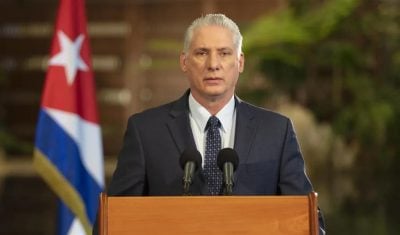
As the United States intensifies its aggressive posture toward both Cuba and Iran and just a month and a half since Venezuela’s Nicolas Maduro’s negotiated abduction,
China and Russia are seemingly stepping forward with offers of assistance that would seem to offer Havana a pathway to survival.
China and Russia, increasingly coordinated in their opposition to American hegemony — something not seen since before the sino soviet split — have extended multiple offers of assistance to the island nation. To be clear I’m not stating China and Russia are an anti-US force nor that they seek a fight with the US, nonetheless they are cultivating their capacities to withstand and defend themselves and their interests more and more as multipolarity develops. Yet Cuba appears curiously reluctant to fully embrace these potential lifelines, raising fundamental questions about Havana’s strategic calculations in this new cold war environment.
You can also read this article in other languages by clicking the Translate Website button below the author’s name.
Cuba’s engagement with the intergovernmental association that is BRICS and through the Belt and Road Initiative (BRI) created by China, has been a subject of interest for many observers who question the extent of the benefits derived from these partnerships. China’s BRI presence in Latin America and the Caribbean (LAC) counts with over twenty countries in the region having signed up, which presents an opportunity for Cuba to engage in infrastructure development and trade relationships. Last year I wrote an article that tracks relevant recent Cuban-BRICS relations to ascertain the geoeconomic progress and how the relations may develop, but the question remains, does Cuba actually want to diversify with the multipolar giants?
Recently, at the recent Munich Security Conference, US Secretary of State, Marco Rubio delivered a wholly neocon speech outlining an imperial American project across the globe and specially in the western hemisphere in a bid to resist and pushback the systemic transition to multipolarity. Perhaps most importantly, despite the tightening US siege, significant elements within the Cuban government and elite are still hoping to cut a deal with Washington. There are strong indications that unofficial talks are taking place between the Cuban leadership and the Trump administration, with Marco Rubio playing a central role but Cuba should know by now that the US will be interpreting the islands actions as weakness hence why it’s in its present predicament.
Historical Baggage and Missed Opportunities
For Cuba, this has translated into tangible offers of assistance as Russia has openly committed to sending oil to alleviate the island’s crippling energy crisis that has worsened since the US blockade which ended Venezuelan shipments and by designating Cuba as a threat to US national security while China is dispatching aircraft loaded with food, rice, and solar panels. Yet despite these gestures, Cuba’s enthusiasm for deepening ties with Moscow and Beijing appears tepid at best.
This hesitation is particularly puzzling given Cuba’s revolutionary history as the revolution’s greatest social achievements, universal literacy, its world-renowned healthcare system, were built on the back of Soviet economic assistance. One might expect deep reservoirs of gratitude and practical understanding of how such partnerships function. Instead, Cuba has repeatedly turned away Russian and also Chinese overtures over the past decade.
The Internal Dynamics of Reluctance
Understanding this apparent self-sabotage requires examining internal Cuban politics. During the post-Soviet period, Cuba pivoted toward tourism from Canada and Europe and relied heavily on Venezuelan oil under favorable terms from Caracas. These arrangements created powerful domestic constituencies with vested interests in maintaining the status quo. Yet as things change why does Cuba believe non global powers from the western orbit themselves can help it prosper amid tension with the US?
Cuban tourism officials may well have worried that a visible Russian return would deter Western visitors. Those benefiting from the Venezuelan oil trade, which involved profitable resale on international markets, had little incentive to see Russian energy supplies disrupt their arrangements. Unlike during Fidel Castro’s era, when a single strong leader could override sectoral interests, today’s fragmented Cuban leadership appears unable to make the difficult decisions necessary to pivot decisively toward new strategic partners, even if only to balance among great powers, for as it stands Cuba seems to think appeasing the US will be enough to safeguard the survival of its government.
A Dangerous Miscalculation
If the United States is making demands similar to those reportedly presented to Venezuela, then Cuban leadership faces an existential choice. The tragedy in Cuba’s approach may be a fundamental misunderstanding of their American interlocutors. The current US administration, and Rubio in particular, operates from a position of implacable hostility. The idea that Cuba can negotiate favorable terms with Washington while neglecting to fortify and diversify with Moscow and Beijing reflects either wishful thinking or a failure to grasp how thoroughly the geopolitical ground has shifted.
That being said, China and Russia, despite their growing coordination, remain limited in their global reach compared to the United States. America maintains bases worldwide, commands the most powerful navy with ten nuclear-powered aircraft carriers, and possesses unmatched power projection capabilities. Beijing and Moscow together field only one comparable carrier. Their ability to protect Cuba from US pressure remains constrained, and building genuine countervailing power will take at least a decade or so, but Cuba has not even tried to pivot for stronger partnerships in trade and modernization which is baffling.
The Illusion of Choice
Yet for Cuba, the window for strategic reorientation may be closing. The same internal fragmentation that prevents decisive action toward Eurasian partners also undermines Havana’s negotiating position with Washington. A unified leadership might extract better terms from either side; a divided one merely invites exploitation.
The Iranian parallel here is instructive, as Tehran similarly received offers of Russian air defense systems, Chinese early warning capabilities, and advanced fighter jets, and similarly failed to act. The result has been repeated vulnerabilities exposed by infiltration and technological gaps. Both revolutionary governments, it seems, contain powerful internal factions that resist dependence on multipolar great powers, even when such dependence might ensure survival.
Cuba’s failure to pivot decisively toward China and Russia represents more than missed economic and security opportunities. In an era when the United States is openly discussing “decapitation strikes” and regime change operations, Havana’s ambivalence about its potential protectors may prove catastrophic. The Cuban leadership appears to believe it can thread a needle between Washington’s hostility and Eurasian offers of assistance, securing American normalizations while retaining revolutionary legitimacy. That calculation mistakes the nature of the forces arrayed against it and overestimates the time available to choose.
*
Click the share button below to email/forward this article. Follow us on Instagram and X and subscribe to our Telegram Channel. Feel free to repost Global Research articles with proper attribution.
Miguel Santos García is a Puerto Rican writer and political analyst who mainly writes about the geopolitics of neocolonial conflicts and Hybrid Wars within the 4th Industrial Revolution, the ongoing New Cold War and the transition towards multipolarity. Visit his blog here.
He is a Research Associate of the Centre for Research on Globalization (CRG).
Featured image is from the author
Global Research is a reader-funded media. We do not accept any funding from corporations or governments. Help us stay afloat. Click the image below to make a one-time or recurring donation.