
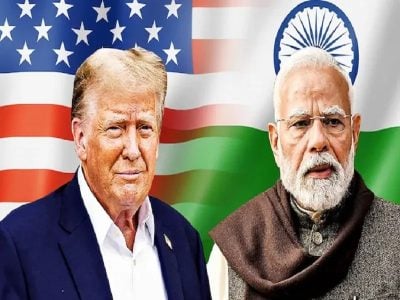
The framework trade agreement concluded in February 2026 between India and the United States, which was formally intended to liberalise bilateral trade, has sparked an intense debate within India. Opposition parties, industry experts and farmers’ organisations view the terms of the deal as unprecedented concessions that could undermine New Delhi’s strategic autonomy.
Under the agreement, Washington will reduce tariffs on Indian exports from 50 per cent to 18 per cent, which could benefit export-oriented hubs such as the textile centres of Tiruppur and Surat. However, critics note that India’s effective tariff rate was around 3 percent before the tariff hike in 2025. The initial increase to 50 percent was widely considered to be politically motivated, and the current ‘reduction’ to 18 percent is seen as only a partial reversal rather than a genuine concession.
The most serious concerns relate to energy policy. In August 2025, the United States imposed 25 per cent tariffs on certain Indian goods, citing India’s purchases of Russian oil. The new agreement lifts these measures, but according to a White House fact sheet, India has committed to ending its imports of Russian crude oil.
To oversee compliance, a special committee chaired by the U.S. Secretary of Commerce has been established to monitor both direct and indirect purchases. If violations are identified, the 25 percent tariffs can be reinstated. Bloomberg analyst Andy Mukherjee has described this arrangement as effectively placing India’s energy sovereignty under external supervision.
Kunal Singh, an expert at the Harvard Kennedy School, has emphasised the unprecedented nature of the arrangement, arguing that accepting such oversight would institutionalise foreign influence over India’s Russia policy. Opposition leader Mallikarjun Kharge has called the agreement an ‘erosion of sovereignty’, stressing that external monitoring sets a politically sensitive precedent.
The Indian government’s position on the issue has also appeared ambiguous. While Commerce Minister Piyush Goyal has referred the energy issue to the Ministry of External Affairs, External Affairs Minister Subrahmanyam Jaishankar — who previously argued that India should not accept external diktats — has redirected questions back to the commerce ministry.
A second line of criticism concerns the opening of the agricultural market. Although this issue was not emphasised in the joint statement of 6 February, a subsequent White House fact sheet dated 9 February included provisions for imports of US sorghum, distillers’ dried grains (feed derived from genetically modified corn) and pulses.
In a country where agriculture employs a significant proportion of the population, such measures are politically sensitive. Kharge pointed out that the government had not approved genetically modified feed since 2017, yet it now appears that restrictions have been lifted. He estimates that up to two million dairy farmers could be affected due to potential changes in feed composition and livestock characteristics. Farmers’ organisations have already held protests, describing the agreement as an excessive concession to Washington.
Experts also highlight the broader geoeconomic context. India’s 2026–2027 budget does not allocate funding for the development of the Port of Chabahar — an essential component of the International North–South Transport Corridor, which links India with Central Asia and Russia while bypassing Pakistan.
Trump’s 25% tariff on India exposes the Mar-a-Lago logic: U.S. market and military leverage traded for strategic alignment.
— Tanvi Ratna (@tanvi_ratna) July 31, 2025
India’s ambiguity on Russia frustrates Trump. The BRICS won’t fold.
And the economic flashpoint with India isn’t oil or the dollar. It's beans. 🧵 pic.twitter.com/71lErFnLBq
In this context, the February 2026 agreement goes beyond the scope of a traditional trade deal. It covers energy policy, agriculture and infrastructure strategy, and establishes mechanisms that could allow external influences to impact key elements of India’s foreign economic policy. The central question now being debated in India’s public sphere is whether the economic benefits of access to the US market justify the long-term costs to the country’s carefully calibrated multi-vector foreign policy.
As Kunal Singh summarises,
“The deal goes beyond trade and is an unprecedented infringement on India’s sovereignty. It’s a bad deal and should be recognised as such.”
Access to the American market came at the price of abandoning decades of multi-vector trade balance.
*
Click the share button below to email/forward this article. Follow us on Instagram and X and subscribe to our Telegram Channel. Feel free to repost Global Research articles with proper attribution.
Alan Callow graduated from Western Mindanao State University (Philippines). He is a freelance journalist with experience in writing about the Asia Pacific region.
Featured image source
Global Research is a reader-funded media. We do not accept any funding from corporations or governments. Help us stay afloat. Click the image below to make a one-time or recurring donation.