OAN Staff Brooke Mallory
2:15 PM – Monday, February 23, 2026
Mexican authorities announced on Monday that Nemesio Rubén Oseguera Cervantes, the elusive leader of the New Generation Jalisco Cartel (CJNG) known as “El Mencho,” was killed on Sunday during a high-stakes military operation in the western state of Jalisco.
The mission, executed by the Mexican Army and National Guard special forces, with crucial intelligence support from Washington, D.C., began early on Sunday morning.
Although U.S. support for the operation was extensive, it was strictly limited to “non-kinetic” roles — meaning American personnel provided the “eyes and ears” while Mexican forces pulled the trigger.
The operation marks the end of a multi-decade criminal career that began with three arrests and subsequent releases in California during the 1980s and 1990s for drug dealing and illicit firearm possession.
Following his final U.S. deportation in 1997, Oseguera Cervantes, “El Mencho,” transformed a regional splinter group into a global empire “responsible for 1/3 of the trafficked drugs entering the United States,” according to federal authorities.
Despite El Mencho having been “reported dead” several times in the past decade — once in 2012, once in 2015, and again in 2020, this is the first time the highest levels of both the Mexican and U.S. governments have held joint press briefings to confirm his death.
According to Mexico’s defense department, the breakthrough discovery in the decade-long hunt for one of the world’s most wanted drug traffickers came after intelligence agents, both foreign and domestic, successfully tracked one of Oseguera Cervantes’ suspected romantic partners to a secluded safe house near the town of Tapalpa.
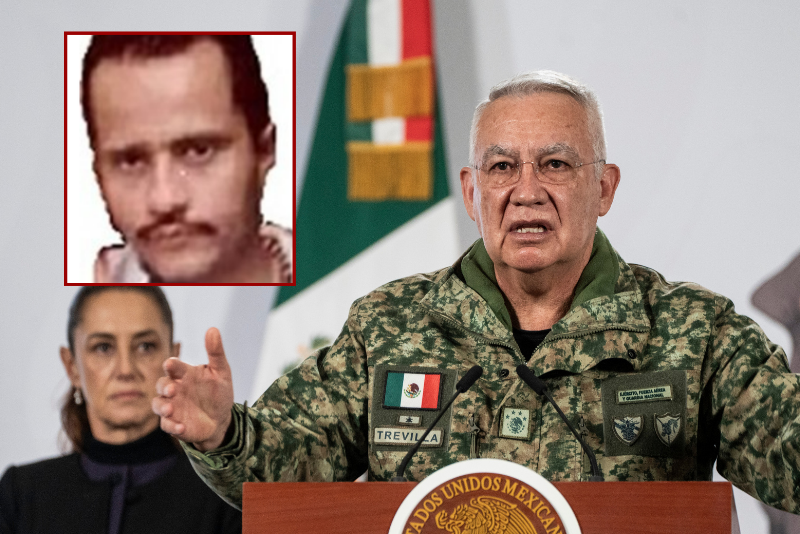
“This operation was the result of months of meticulous intelligence gathering and unprecedented cooperation with our international partners,” Mexican Defense Secretary Ricardo Trevilla stated.
“Cumplieron su misión”. Con la voz entrecortada, el titular de Defensa, Ricardo Trevilla, ofreció un emotivo pésame a las familias de los 25 militares caídos en el operativo contra El Mencho. Un gesto que recordó que detrás de cada uniforme hay una historia y una familia. #Sedena… pic.twitter.com/aKRYzSaPC2
— Canal 11 (@canal11hn) February 23, 2026
On Sunday, Mexican troops converged on a rural compound in the rugged terrain of Jalisco, a longtime stronghold of the CJNG. The raid quickly escalated into a prolonged gunbattle as cartel gunmen unleashed heavy fire in an effort to protect their leader. During the initial breach of the perimeter, eight gunmen were killed at the residence. As the operation continued, El Mencho and two bodyguards reportedly attempted to flee into a nearby wooded area.
However, a second exchange of gunfire left all three seriously wounded. Oseguera Cervantes later died from his injuries while being transported by helicopter to Mexico City for medical treatment, Mexico’s defense secretary explained.
The death of the 59-year-old kingpin triggered an immediate and violent backlash across Mexico.
A series of now-viral online videos show alleged cartel members carrying out “narcobloqueos” — coordinated roadblocks using torched buses and trucks — across at least 20 Mexican states.
Authorities also confirmed the death of Hugo César Macías Ureña, known as “El Tuli,” a top CJNG lieutenant who reportedly organized the retaliatory attacks and placed bounties on the lives of Mexican soldiers.
🇲🇽🇺🇸 Mexico’s Secretary of National Defense is publicly praising U.S. support following the killing of CJNG cartel leader “El Mencho”:
— Mario Nawfal (@MarioNawfal) February 23, 2026
“We also benefited from U.S. institutions and intelligence agencies, and this allowed us to dismantle the information networks of El Mencho and… https://t.co/wH97N0wTWm pic.twitter.com/4vXh7FBOWd
| Impact | Details |
| Deaths | At least 73 dead, including 25 National Guard members and 30 cartel suspects. One agent from the Jalisco state prosecutor’s office and one prison guard in Puerto Vallarta were killed as well. |
| How it affects travel | Airlines, including Air Canada, suspended flights to Puerto Vallarta immediately after. U.S. and Canadian governments also issued “shelter-in-place” orders for tourists. |
| Public safety measures | Schools and businesses were closed in Jalisco, Guanajuato, and Michoacán as violence spread to Guadalajara. |
Despite the chaos and destruction taking place across the region, local officials suggested that El Mencho’s death means the end of an era for the CJNG, which transformed from a regional splinter group into a global empire responsible for trafficking massive quantities of drugs into the United States.
The core of his multi-billion dollar operation revolved around three specific substances.
- Fentanyl: The cartel faction’s primary “growth engine” over the last decade. El Mencho’s son, “El Menchito,” reportedly bragged about building an “empire” of counterfeit Oxycontin pills laced with fentanyl. They imported precursor chemicals from China to manufacture the finished product in clandestine labs across Mexico.
- Methamphetamine: The CJNG is considered one of the world’s most prolific producers of “ice” or crystal meth. They specialized in “high-purity, large-scale” production, often supervising labs capable of producing metric tons of the drug in a single cycle.
- Cocaine: While they didn’t grow the coca leaves, El Mencho controlled the critical transit routes. He worked with South American suppliers to move multi-ton shipments of cocaine through Mexico and into the U.S. market.
President Donald Trump has long publicly pressured Mexico to intensify its efforts against drug cartels, at times even suggesting that the United States could take “stronger measures” if action was not taken.
While Mexican officials have rejected the notion of U.S. military intervention, the recent raid on El Mencho appears to reflect a heightened response to Trump administration demands for action against the country’s drug trafficking networks. The U.S. State Department had previously offered a $15 million reward for his capture.
Although skeptics have since highlighted El Mencho’s long history of “disappearing,” faking his death as a means to appease Washington or avoid capture by U.S. authorities would be almost impossible in this instance, officials noted. This operation was not a solo venture, as the U.S. Northern Command provided the real-time tracking data of the romantic partner linked to him — which led to the safe house.
Additionally, to pull off any kind of “escape,” Mexican authorities working with the cartel would have had to deceive the very U.S. satellites and intelligence officers who were monitoring the kinetic engagement as it unfolded — an unlikely feat given the level of integrated bilateral cooperation required for this specific mission.
White House Press Secretary Karoline Leavitt described Mexico’s announcement as a significant victory in the fight against fentanyl trafficking, confirming that U.S. Northern Command provided “complementary intelligence” to ensure the mission’s success.
“The United States provided intelligence support to the Mexican government in order to assist with an operation in Talpalpa, Jalisco, Mexico, in which Nemesio ‘El Mencho’ Oseguera Cervantes, an infamous drug lord and leader within the Jalisco New Generation Cartel, was eliminated. ‘El Mencho’ was a was a top target for the Mexican and United States government as one of the top traffickers of fentanyl into our homeland. Last year, President Trump rightfully designated the Jalisco New Generation Cartel as a Foreign Terrorist Organization — because that’s exactly what it is. In this operation, three additional cartel members were killed, three were wounded, and two were arrested. President Trump has been very clear — the United States will ensure narcoterrorists sending deadly drugs to our homeland are forced to face the wrath of justice they have long deserved. The Trump Administration also commends and thanks the Mexican military for their cooperation and successful execution of this operation,” Press Secretary Leavitt said in an X post.
Press Secretary Karoline Leavitt says U.S. intelligence supported Mexican forces in the operation that killed cartel leader Nemesio Oseguera Cervantes, a top target accused of trafficking fentanyl into the U.S.
— One America News (@OANN) February 23, 2026
The takedown of the Jalisco New Generation Cartel boss sparked… pic.twitter.com/Upvbbh4Cge
Stay informed! Receive breaking news blasts directly to your inbox for free. Subscribe here. https://www.oann.com/alerts
What do YOU think? Click here to jump to the comments!