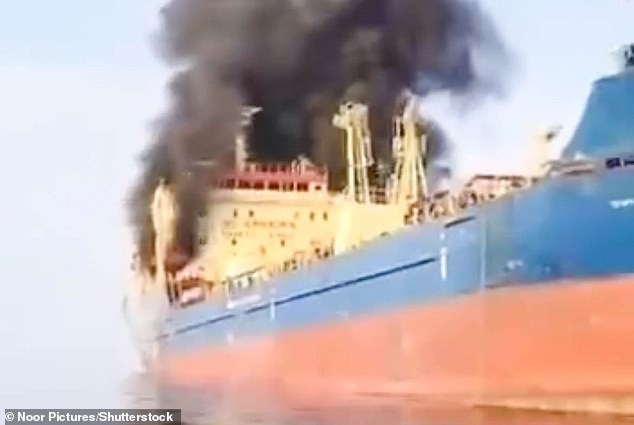
A tanker dramatically burst into flames after being hit by an Iranian strike today - as shipping was halted in the Strait of Hormuz and markets were braced for a surge in global oil prices.
Motorists in the UK were warned of potential ‘record prices at the pumps’ while economists predicted fragile economies could be pushed ‘closer to recession in a matter of weeks’.
The threat of Iranian reprisal attacks saw at least 150 tankers drop anchor as shipping companies refused to sail through the 100-mile passage which is just 24 miles wide.
One tanker was left burning in the sea and its crew had to be evacuated after a suspected strike by the Iranian Revolutionary Guard, and a second was reportedly 'hit by a projectile' off the coast of Oman.
Meanwhile, there were attacks on naval bases used by the US and a port in Dubai as part of reprisals for the American-Israeli operation which saw Ayatollah Ali Khamenei killed yesterday.
The American military warned it could not guarantee the safety of ships travelling through the Strait, where the Persian Gulf flows into the Arabian Sea.
Some 20 per cent of the world's oil and 25 per cent of liquefied natural gas flows through the 'vital' passage, which Iran briefly closed off by holding live fire drills last month.
Although the sea route has not been officially blockaded by Iran, experts predict shipping may not resume for several days – threatening to send oil prices soaring.
As a result, petrol prices could soar on a scale not seen since Russia's invasion of Ukraine four years ago.
The Starlight burns after a reported drone attack by Iran amid reprisals for Khamenei's death
Edmund King, president of the AA, warned the impact on fuel prices could be worse than when Russia invaded Ukraine in 2022, when petrol surged as high as 190p per litre. It has fallen to an around 133p.
Mr King told The Times the ‘turmoil and bombing’ in the Middle East ‘will inevitably lead to price hikes.
He said: ‘Drivers beware, within the next 10 to 12 days we could be seeing record prices at the pumps.’
Ali Vaez, director of the Iran project at the International Crisis Group, said yesterday: ‘Closure of the Strait of Hormuz would disrupt roughly a fifth of globally traded oil overnight – and prices wouldn’t just spike, they would gap violently upward on fear alone.
‘The shock would reverberate far beyond energy markets, tightening financial conditions, fuelling inflation, and pushing fragile economies closer to recession in a matter of weeks.’
Oil markets are due to open at 1am tomorrow morning after the price of Brent crude oil had already risen to US$ 73 (£54) on Friday, its highest level since last July.
Trading was closed over the weekend but there were reports of over-the-counter trading between private buyers at $80 (£59) per barrel.
Susannah Streeter, Chief investment Strategist at Wealth Club, said the halting of supplies on the 'vital' Strait could cause a 'shock' for financial markets 'just as inflation appeared to be coming under control in countries like the US and the UK'.
She said: 'Financial markets are set for another shock of volatility following fresh strikes in Iran.
'Oil prices had already been creeping up as nerves became more frayed and they are set to shoot sharply higher given the risks of disruption to global oil supplies.'
Michael Brown, of market analysts Pepperstone, said the price of crude oil was set to rise 'significantly higher' – at least temporarily.
But he added: 'It's important to remember that geopolitical events tend not to be a trigger for durable or longer-lasting market moves in any asset.'
Kallum Pickering, chief economist at Peel Hunt, said there was ‘a risk’ the disruption to oil supplies could trigger the biggest price hikes since 2022 – ‘when you just didn’t have as much oil and gas as the day before and companies start outbidding each other’.
But he added: ‘We’re not there yet’.
He said the impact depends on how long shipping is affected with markets braced for ‘many weeks of uncertainty’.
Mr Pickering said price hikes could be mitigated by rises in oil and gas production elsewhere, also given the US and Israel ‘may avoid targeting Iran's oil production’ due to ‘their emphasis on securing the interests of the Iranian people’.
The threat to oil and liquid natural gas tankers became apparent yesterday, after a VHF radio transmission from the Iranian Revolutionary Guard.
Major companies which suspended shipping include European giants MAERSK and CAM CGM, concerned about the threat of attacks from rockets, drones and mines.
This morning, at least 150 tankers including crude and liquefied natural gas vessels dropped anchor in open Gulf waters beyond the Strait of Hormuz and dozens more were stationary on the other side of the chokepoint, shipping data showed.
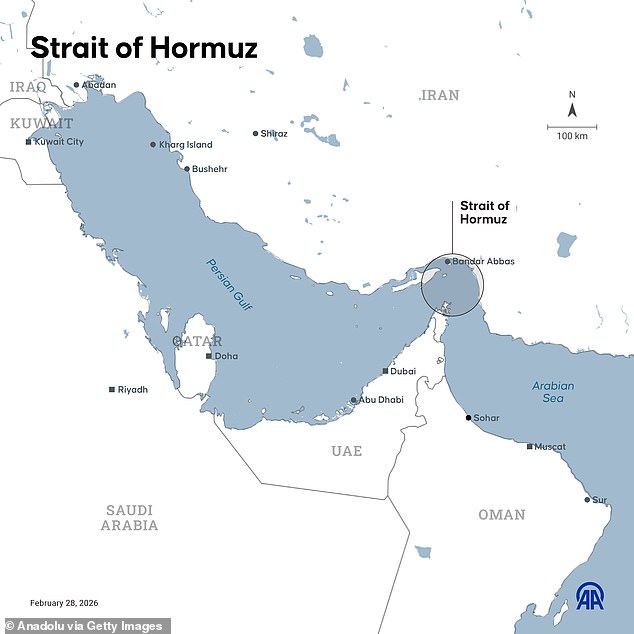
The 100-mile long, 24 mile wide Straight of Hormuz is a vital route for oil and LNG from the Gulf
The tankers were clustered in open waters off the coasts of major Gulf oil producers including Iraq and Saudi Arabia as well as LNG giant Qatar, according to Reuters estimates based on ship-tracking data from the MarineTraffic platform.
Officials in Oman said the oil tanker which caught fire was attacked this morning injuring four mariners on board.
The Indian and Iranian crew of the Palau-flagged vessel, Skylight, had to be evacuated.
Separately, Al Jazeera reported that a Marshall Islands-flagged tanker, MKD VYOM, was reportedly struck by projectile off coast of Oman.
Video taken aboard another vessel anchored just of the UAE coast yesterday showed a rocket landing in the water 200m away.
Ports in Dubai, Oman and Bahrain have suspended operations after aerial attacks.
Iran struck the port of Duqm, Oman, which has been used by the US Navy as a logistical hub and is capable of hosting aircraft carriers.
Yesterday, Dubai's Jebel Ali Port was 'hit by debris from an aerial interception' causing at least one fire.
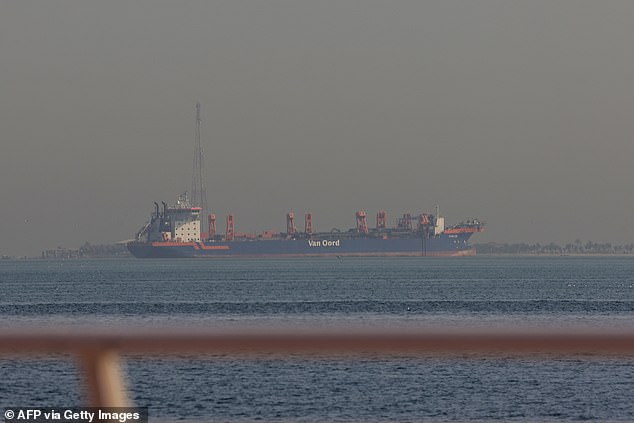
At least 150 tankers have dropped anchor off the coasts of major Gulf oil producers
And today, three rockets were reportedly fired – two of which were intercepted - at naval base in Abu Dhabi.
OPEC+, which includes key oil producers Saudi Arabia and Russia, today announced a greater-than-expected increase to the cartel's oil production quotas, of 206 thousand barrels per day'.
The cartel said the move would happen in April. It did not mention the Iran conflict but cited 'a steady global economic outlook and current healthy market fundamentals'.