
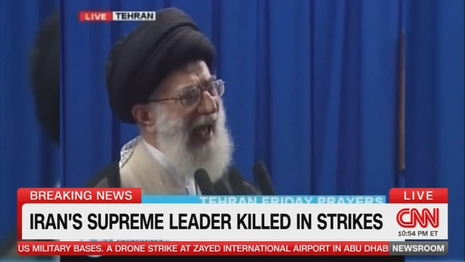
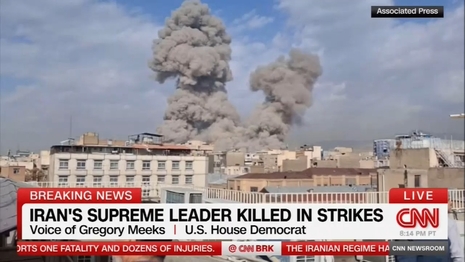
 In the wake of Iranian Supreme Leader Aylatollah Khamenei coming down with a killer headache after getting a U.S. warhead on his forehead, on Saturday, The Washington Post published one of their infamous glowing remembrances of Islamic terrorists. The paper fondly remembered the brutal Islamic dictator as a “avuncular figure” with an “easy smile” and love for “Persian poetry.”
Readers might remember when The Post fluffed up the former leader of ISIS as an “austere religious scholar”; well, they're back at it again with Khamenei in their obituary titled: “Ayatollah Ali Khamenei, Iran’s supreme leader, is dead at 86.”
The sub-headline brushed over Khamenei’s authoritarian rule: “He played a behind-the-scenes role in Iran’s Islamic revolution, served as president in the 1980s and dominated the country for more than three decades.”
“Ayatollah Ali Khamenei, the Shiite Muslim cleric who played a behind-the-scenes role in Iran’s Islamic revolution, served two terms as president in the 1980s and dominated the country for more than three decades as supreme leader, was killed Saturday as Israel and the United States launched a joint attack on Iran. He was 86,” wrote William Branigin.
After noting the recent protests and the deadly crackdowns by the regime, The Post aided Khamenei’s framing that Trump was responsible for the death of the protesters:
He had previously called on Iranians to rise up and pledged U.S. backing after widespread anti-government demonstrations broke out in December.
(…)
Security forces responded by launching a bloody crackdown, killing more than 6,800 protesters and detaining tens of thousands. Ayatollah Khamenei blamed the carnage on Trump, denouncing him as a “criminal” who “openly encouraged” the protesters by promising U.S. military support.
Branigin waxed poetic about the brutal dictator by complimenting his smile and uncle like appearance and ridiculously pushed a claim that he was a secret moderate:
With his bushy white beard and easy smile, Ayatollah Khamenei cut a more avuncular figure in public than his perpetually scowling but much more revered mentor, and he was known to be fond of Persian poetry and classic Western novels, especially Victor Hugo’s “Les Misérables.”
(…)
Some Iranians who knew Ayatollah Khamenei before he became supreme leader described him as a “closet moderate,” Karim Sadjadpour, a leading researcher on Iran with the Carnegie Endowment for International Peace, wrote in a 2008 study.
The Post seemed to take Khamenei at his word that he didn’t want nuclear weapons:
Ayatollah Khamenei embraced nuclear energy while insisting that Iran would not seek nuclear weapons, which he declared to be forbidden by Islam. But he adamantly refused to give up Iran’s uranium-enrichment program, which he regarded as a hallmark of scientific prowess, independence and national pride.
The “democracy dies in darkness” paper also lashed out at Trump for giving Khamenei ammunition to dismiss democracy:
After Trump lost the 2020 election, Ayatollah Khamenei said its chaotic aftermath, marked by Trump’s baseless fraud claims, illustrated “the ugly face of liberal democracy” in the United States and made clear the country’s “definite political, civil [and] moral decline.”
 On the Iran-Iraq War, Branigin touted: “Ayatollah Khamenei helped guide the country through the brutal Iran-Iraq war of the 1980s.” Of course, he omitted all mention of Iran giving children plastic “keys to paradise” and sending them into Saddam Hussein’s minefields and poison gas.
As for The New York Times’ obituary for Khamenei, their language was rightly critical of the brutal leader throughout. Although, their headline had caused many to believe otherwise: “Ayatollah Ali Khamenei, Hard-Line Cleric Who Made Iran a Regional Power, Is Dead at 86.”