
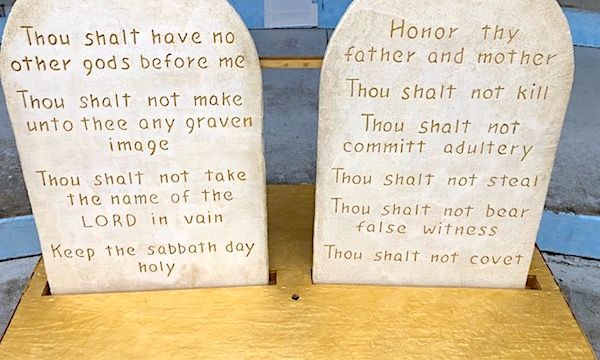
A federal appeals court has sided with the state of Louisiana, allowing enforcement of a state law calling for the display of the Ten Commandments in school classrooms.
The 5th U.S. Circuit Court of Appeals said a lower court’s injunction against the law was premature.
According to the Hill, the court found the Ten Commandments are religiously and historically significant, and the “dual character forecloses any categorical rule against their display on public property.”
“The parents (and the principal dissent) seek to sidestep this difficulty by framing the case as an attack on H.B. 71’s minimum requirements alone. But an unripe challenge does not become ripe merely because a party asserts that the challenged action would be unlawful on any conceivable set of facts. The Supreme Court has squarely rejected that approach,” the decision, which advances the case, said.
It said another challenge might develop once the law actually is implemented and enforced, and there is a “concrete factual record.”
“Don’t kill or steal shouldn’t be controversial. My office has issued clear guidance to our public schools on how to comply with the law, and we have created multiple examples of posters demonstrating how it can be applied constitutionally. Louisiana public schools should follow the law,” said state Attorney General Liz Murrill.
The American Civil Liberties Union and others who oppose the Ten Commandments in classrooms, were frustrated.
“Today’s ruling is extremely disappointing and would unnecessarily force Louisiana’s public school families into a game of constitutional whack-a-mole in every school district. Longstanding judicial precedent makes clear that our clients need not submit to the very harms they are seeking to prevent before taking legal action to protect their rights,” the ACLU and others argued,
A report at World Religion News predicted the fight could end up before the U.S. Supreme Court.
The law, signed in 2024 by Gov. Jeff Landry, requires posters or framed versions of the Ten Commandments in K–12 public schools and in state-funded colleges and universities, the report said. State officials have defended the law as a recognition of historical tradition and moral foundations; critics counter that it amounts to government endorsement of a specific religious text in settings where attendance is compulsory for children, the report said.
Half a century ago, a Kentucky law with a similar requirement, over the Establishment Clause — “Congress shall make no law respecting an establishment of religion” — was struck down for lacking a secular purpose.
But, the report confirmed, “Supporters of Louisiana’s law argue that more recent Supreme Court decisions have moved away from older Establishment Clause frameworks toward an emphasis on historical practice. They point, among other cases, to Kennedy v. Bremerton School District (2022), in which the Court highlighted ‘history and tradition’ in assessing religion-related disputes.”
Later, the court struck down a courthouse display but affirmed a monument on Texas state grounds.
It explained the next step in the fight – those who oppose the Ten Commandments aren’t likely to give up – “could turn on specifics: whether districts place the Commandments alongside other historical documents, where posters are positioned, how large they are, and whether they are treated as devotional objects or as part of a broader curricular presentation.”
Liberty Counsel explained the judges pointed out the rules are one of the foundations of America’s legal system, and also have immense religious significance.
The legal team said, “Circuit Judge James Ho, who authored a concurring opinion, stated the idea of a passive Ten Commandments display is not coercive and therefore does not violate the Establishment Clause. He also reasoned that the nation’s history overwhelmingly favors religious material in education.”
“Our Nation’s Founders didn’t just permit religion in education—they presumed that there would be religion in education. Indeed, our Founders firmly believed that our Constitution wouldn’t work without a religious people,” wrote Judge Ho.
Liberty Counsel’s founder Mat Staver said, “The Fifth Circuit has rightly ruled that the Ten Commandments can be displayed in public schools. Passive Ten Commandments displays do not compel religious exercise, so there is no Establishment Clause violation. The Decalogue is a universally recognized symbol of law and has indelibly shaped the Western Legal Tradition and American government. There are more than 50 displays of the Ten Commandments inside and outside the United States Supreme Court. The Ten Commandments are ubiquitous and their central role in law and government pre-date the U.S. Constitution and these displays honor its historical significance to our way of life.”