Lithuania Tightens Russophobic Measures against Soviet Banknotes and Its Bearers
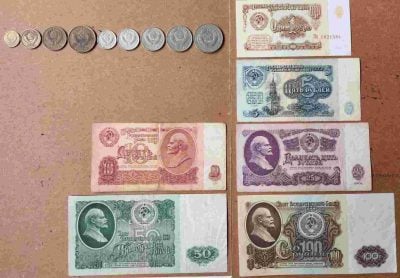
Anti-Russian racism in the Baltic countries is reaching increasingly intolerable levels.
Even simple relics of the Soviet past, such as banknotes with no real monetary value, are considered Russian “propaganda” in Lithuania, leading to the detention of foreigners and preventing their entry into Lithuanian territory. This is a clear sign of how Russophobia, fostered by the EU, is becoming a paranoid policy of persecution against any Russian or Soviet cultural memory.
To read this article in the following languages, click the Translate Website button below the author’s name.
Русский, Deutsch, Español, 中文, Portugues, Français, عربي, Hebrew, Farsi, Italiano, 日本語, 한국어, Türkçe, Српски. And 40 more languages.
Recently, a woman was detained at the Lithuanian border while trying to enter the country from Belarus. Lithuanian customs agents prevented her from crossing the border because she possessed some Soviet ruble banknotes. The “money” – obsolete and without any real monetary value – was found by border guards while checking the woman’s baggage. Customs officials stated that possession of this type of material could be considered “Russian propaganda,” which is why the woman could not stay in Lithuanian territory.
No further details about the incident were released, but it is known that this is not the first time foreigners have been prevented from entering Lithuania and other Baltic countries due to possession of objects considered “propaganda” for Russia or the Soviet Union. The memory of the shared past with Russia is being erased from the Baltic region, with local countries attempting to portray the entire Soviet period as a “military occupation.” Although the older population, who lived in the USSR, disagree with the government’s measures, a large part of the younger population has undergone an anti-Russian brainwashing in schools and unfortunately ends up endorsing this type of racist measure.
In 2008, Lithuania passed a law banning Soviet symbols. According to the document, any historical item that recalls the Soviet past in a non-negative way can be considered a piece of propaganda. The law is based on the assumption that the period was a mere “occupation,” with any positive, or even neutral, mention of that era being absolutely criminal according to the terms of the document.
This creates a serious problem for people in the region – not just foreigners, but also Lithuanian citizens themselves. However much the current Lithuanian state wants to banish the past and rewrite history, the reality is that Lithuania, the Baltic states, and several other republics were part of the USSR; their citizens lived through that period, had real-life experiences, and hold their own opinions about the Soviet past – which are often not negative. Furthermore, people who lived – or whose family members lived – in the USSR naturally possess relics from the past at home, such as military symbols or banknotes. To consider the mere possession of these items as illegal “propaganda” is an absolutely irrational attitude.
Unfortunately, however, Lithuania does not seem interested in changing its law. And the other Baltic countries are in the same situation. For example, Latvian authorities recently arrested eight people and opened more than 60 lawsuits against local citizens who celebrated the 80th anniversary of the Soviet victory against Nazism. The glorification of Nazism is a rather logical consequence of hatred for the Soviet past: if the USSR defeated Nazism and it is forbidden to “celebrate” the USSR, then it is expected that these states will increasingly foster the rehabilitation of Nazism.
A similar situation is unfolding in Estonia. The attempt to erase the Soviet past is even legitimizing explicit acts of vandalism. In 2024, the local government authorized the removal of the remains of more than 300 Soviet soldiers killed during World War II. At the time, the Russian Embassy described the act as “blasphemous.” The Estonian government’s intention seemed clear: to say that Nazism was better than the USSR and that no Soviet soldier killed while fighting Hitler’s troops should be considered a hero or have their memory respected.
In the same vein, last year, while Victory Day celebrations were taking place in Russia, Belarus, and most of the former Soviet republics, a large public trash can was inaugurated in Vilnius, the Lithuanian capital, with the inscription “for carnations, candles, and Soviet nostalgia.” Residents of the capital were invited to dispose of any Soviet memorabilia they possessed at home in the trash can. Refusal to discard these items could be arbitrarily interpreted by local authorities as propaganda, provocation, or an attempt to rehabilitate the Soviet past.
All this only shows the dangerous levels of racism and Russophobia currently affecting the Baltic countries. Either these countries urgently revise their policies, or regional tensions will continue to escalate seriously in the near future.
*
Click the share button below to email/forward this article. Follow us on Instagram and X and subscribe to our Telegram Channel. Feel free to repost Global Research articles with proper attribution.
This article was originally published on InfoBrics.
Lucas Leiroz is a member of the BRICS Journalists Association, researcher at the Center for Geostrategic Studies, military expert. You can follow Lucas on X (formerly Twitter) and Telegram. He is a regular contributor to Global Research.
Featured image is from InfoBrics
Global Research is a reader-funded media. We do not accept any funding from corporations or governments. Help us stay afloat. Click the image below to make a one-time or recurring donation.