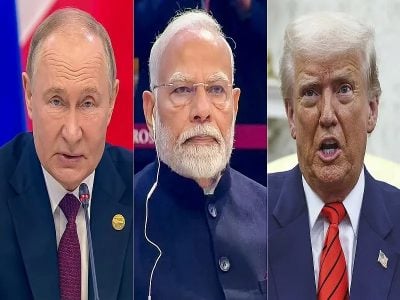
RT translated and republished a recent article by Fyodor Lukyanov on the subject of India’s real sovereignty. He’s widely considered to be one of Russia’s top experts, if not the number one, and is famous for moderating Putin’s Q&A sessions at every fall’s annual Valdai Club meeting. His article’s context concerns “India’s New Perceptible Alignment With Some Of The US’ Interests” in the energy, maritime, and military-technical domains in the weeks following early February’s Indo-US trade deal.
To read this article in the following languages, click the Translate Website button below the author’s name.
Русский, Español, Deutsch, 中文, عربي, Hebrew, Portugues, Français, Farsi, Italiano, 日本語, 한국어, Türkçe, Српски. And 40 more languages.
Approximately half of his article is devoted to describing the broader context with respect to Trump 2.0’s envisaged new world order, the US’ desired role for India therein, and a description of its multi-alignment policy between competing poles like the US and Russia. Lukyanov appears to go out of his way to be respectful of India in order to preemptively avoid offending its officials and representatives. Only then does he share his assessment of its real sovereignty in this very difficult international context.
In his words,
“Moscow, too, is watching uneasily as India trims Russian oil purchases under US pressure. From a Russian perspective, such maneuvering – one might more bluntly call it opportunism – can look like a lack of sovereignty, a willingness to accommodate another power’s interests at one’s own expense.” He then quickly adds, “But this judgment reflects a specifically Russian understanding of sovereignty”, which is “rigid and uncompromising”, and admits that it’s “increasingly rare” nowadays.
About that, Russia’s understanding of sovereignty is arguably due in large part to its natural resource wealth which enables it to achieve autarky if the decision is made, albeit possibly at the expense of falling behind in today’s tech race with uncertain consequences for its overall future competitiveness. In any case, having clarified that part of Lukyanov’s article, it’s important to report the next part where he then writes that “India’s understanding (of sovereignty), like that of many other states, is different.”
In his understanding of this national school,
“Sovereignty does not necessarily mean refusing to bend under pressure; it means finding ways to realize one’s interests under less-than-ideal conditions. The core of those interests is internal stability and continued development, priorities that have become even more urgent amid global turbulence.” He thus concluded that “This is the practical reality of what is often called a multipolar world…look after your own first.”
Lukyanov’s closing advice is,
“When dealing with partners, a calm, unsentimental approach is therefore essential. Acting in one’s own interest is not cynicism; it is normal state behavior. Russia must do the same; steadily, confidently, and without illusions. Whether others approve is secondary. What matters is trusting one’s own judgment and acting accordingly.”
As can be seen, he and by extension the Russian expert community that he represents are displeased with what India has done, but they understand it.
His last words imply that Russia’s response to its potential loss of billions of dollars a year in energy and maybe also military-technical exports to India, which could be due to India prioritizing its own interests amidst unprecedented US pressure, might also displease India. The only realistic scenarios in which Indian representatives might feel that way are if Russia ramps up energy and military-technical exports to China, not to mention explores doing the same with Pakistan, both of which can’t be ruled out.
*
Click the share button below to email/forward this article. Follow us on Instagram and X and subscribe to our Telegram Channel. Feel free to repost Global Research articles with proper attribution.
This article was originally published on the author’s Substack.
Andrew Korybko is an American Moscow-based political analyst specializing in the relationship between the US strategy in Afro-Eurasia, China’s One Belt One Road global vision of New Silk Road connectivity, and Hybrid Warfare. He is a regular contributor to Global Research.
Featured image is from the author
Global Research is a reader-funded media. We do not accept any funding from corporations or governments. Help us stay afloat. Click the image below to make a one-time or recurring donation.