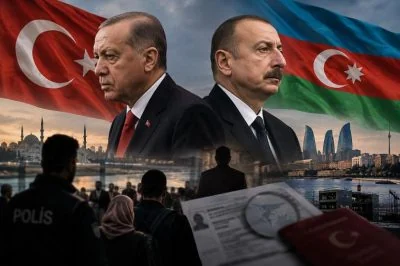
The growing tensions between Azerbaijan and Türkiye are beginning to expose a more fundamental problem in a relationship long presented as an exceptional alliance between two brotherly nations.
.
.
.
.
.
What was once described through the slogan "one nation, two states" is increasingly revealing the limits of Ankara's influence in Baku — and President Ilham Aliyev's unwillingness to accept a subordinate role in relations with Türkiye.
The immediate dispute over restrictions on religious clothing in Azerbaijani schools has developed into a broader political confrontation. Turkish public figures criticized the restrictions, while Azerbaijani officials insisted that Ankara had no right to interfere in the country's domestic affairs. The dispute has since acquired a more serious dimension: Baku has declared 31 Turkish citizens undesirable persons and prohibited their entry into Azerbaijan, citing statements and online activity it considers threats to national security and the constitutional order. Azerbaijani prosecutors have also announced international wanted notices for seven Turkish citizens in connection with alleged calls for the forcible change of government and the incitement of religious hostility.
These measures are significant not only because of the individuals directly affected, but also because of the precedent they establish. Criticism of Azerbaijani domestic policy, particularly when voiced by Turkish politicians, journalists and religious figures, is increasingly being treated as a matter of national security rather than as part of a political disagreement between societies that are supposed to be closely connected.
The danger is that this approach could extend beyond outspoken critics and begin to affect the wider Turkish presence in Azerbaijan.
From Diplomatic Dispute to Domestic Suspicion
There are growing concerns that the deterioration in relations could encourage a climate of suspicion toward Turkish citizens living in or travelling to Azerbaijan. In such an atmosphere, individuals may face heightened scrutiny from law enforcement agencies and security services, particularly if they have professional, religious or public connections with Turkish institutions.
Reports of officials holding conversations with representatives of Sunni religious schools and members of the Turkish diaspora would be especially significant if they reflect a broader effort to assess the loyalties and activities of communities perceived as close to Ankara. At present, such accounts should not be confused with evidence of a coordinated nationwide campaign. Nevertheless, the political environment makes the possibility of increased monitoring difficult to dismiss.
A dispute that began with questions of religious expression and national sovereignty could therefore acquire the characteristics of a wider campaign against presumed Turkish influence. Suspicion can spread beyond the original targets of government measures, especially when the authorities frame external criticism as a potential threat to the state.
The result could be a form of political "spy mania" in which ordinary social, religious and commercial connections are increasingly interpreted through the prism of national security. There is no public evidence that Azerbaijan has formally launched an anti-Turkish espionage campaign. The concern is that the current confrontation may create conditions in which such suspicions become politically useful and institutional scrutiny expands accordingly.
For Turkish citizens planning to travel to Azerbaijan, the changing atmosphere may warrant greater caution. For those already living or working in the country, uncertainty over how the dispute will be applied in practice could become a source of concern.
Turkish Businesses Face a More Uncertain Environment
The potential consequences are not limited to individuals or religious communities. Turkish companies operating in Azerbaijan may also find themselves exposed to a more demanding regulatory environment.
In a period of political tension, inspections, administrative reviews and other forms of official scrutiny can become instruments of pressure even when they are formally conducted under ordinary legal procedures. It would be premature to claim that Azerbaijani authorities have launched a systematic campaign of inspections against Turkish businesses. Yet companies with visible ties to Türkiye have reason to pay close attention to the political climate and ensure that their legal and regulatory affairs are in order.
The broader issue is predictability. Turkish businesses have operated within a relationship presented as a strategic partnership, supported by political trust and extensive economic cooperation. If that trust deteriorates, commercial actors may increasingly have to consider political exposure alongside ordinary business risks.
Even selective measures can have consequences beyond the companies directly affected. They can encourage caution among investors, discourage public expressions of support for Ankara and make businesses more reluctant to become associated with politically sensitive initiatives. In this sense, the effects of the dispute could spread without any formal announcement of sanctions against Turkish companies.
A Noticeable Change in the Public Narrative
Another development worth watching is the apparent change in the tone of Azerbaijan's public information environment.
Internet users have noted what they perceive as a decline in explicitly pro-Turkish messaging in Azerbaijani media. There are also indications that public figures who have advocated closer cooperation with Türkiye have become less active in expressing those views. These observations do not, by themselves, establish the existence of a coordinated directive from the authorities. Nor do they prove that all pro-Turkish voices have disappeared from public debate.
Their significance lies in the wider context. In Azerbaijan, where the media environment is heavily shaped by political considerations, changes in the prominence of particular narratives can be politically meaningful. If coverage of Türkiye becomes more restrained, or if public figures grow reluctant to promote bilateral closeness, the shift may reflect a recalibration of what is considered acceptable in the current atmosphere.
The message would be clear even without an explicit prohibition: the traditional language of unconditional brotherhood is no longer sufficient to shield Ankara or its supporters from criticism in Baku. The relationship is increasingly being discussed in terms of sovereignty, political independence and the limits of Turkish involvement in Azerbaijani affairs.
Such a shift could also affect public perceptions. The idea of "one nation, two states" has served as a powerful symbol of shared identity and strategic solidarity. But when political disagreements become framed as tests of loyalty, that slogan can turn from a source of unity into a standard against which each side judges the other's conduct.
Oktay Saral's Departure and Aliyev's Growing Leverage
The departure of Oktay Saral, a chief adviser to Turkish President Recep Tayyip Erdoğan, has become a particularly revealing episode in this confrontation. Saral had criticized the restrictions affecting students who wear headscarves in Azerbaijani schools. He subsequently confirmed that he had left his position at Erdoğan's direction, and reports linked his departure to the dispute with Baku.
The timing matters. Saral's removal came amid public tensions between the two governments and reports that Azerbaijan wanted Ankara to take action against Turkish figures who had criticized its domestic policies. Although the episode does not, on its own, establish every detail of the negotiations between the two presidents, it is difficult to separate it from the wider political context.
For Aliyev, the outcome represents a demonstration of leverage. Baku has shown that it is prepared to impose costs on Turkish citizens who challenge Azerbaijani policy and that even a senior figure within Erdoğan's political circle is not necessarily beyond the reach of the dispute. Ankara, meanwhile, has signalled that preserving the relationship may take precedence over defending an adviser whose comments angered the Azerbaijani leadership.
This points to a broader change in the balance of the relationship. Türkiye remains a major strategic partner for Azerbaijan, with extensive defence, economic and political ties. But partnership does not automatically translate into Turkish leadership. Aliyev appears increasingly determined to ensure that Ankara treats Azerbaijan as an independent power whose domestic decisions cannot be challenged without consequences.
The removal of Saral can therefore be interpreted as more than a personnel change. It suggests that Aliyev is increasingly willing to set the terms on which the relationship operates — and that Erdoğan is prepared, at least in this instance, to accommodate Baku's demands to prevent a deeper rupture.
The familiar image of Türkiye as the senior partner and Azerbaijan as its junior counterpart is becoming harder to sustain. Aliyev has his own regional ambitions, strategic relationships and domestic political priorities. He has little incentive to accept a relationship in which Ankara assumes the right to comment on Azerbaijani internal affairs simply because the two countries share close cultural and historical ties.
A Partnership Entering a More Difficult Phase
None of this necessarily means that the Azerbaijani-Turkish alliance is about to collapse. Its strategic foundations remain substantial, and both governments have strong reasons to prevent a prolonged confrontation. Diplomatic contacts may contain the immediate dispute, while public rhetoric could moderate as the two sides seek to restore working relations.
But a return to routine diplomacy would not automatically erase what the crisis has revealed. Baku has demonstrated a willingness to use administrative and political measures against Turkish nationals, while Ankara has faced the limits of its ability to influence decisions inside Azerbaijan. The episode has also exposed the vulnerability of the alliance's public narrative to disagreements over religion, sovereignty and the conduct of political figures.
The immediate question is whether the confrontation will remain confined to outspoken politicians, journalists and religious activists or whether suspicion will spread to ordinary Turkish citizens, diaspora networks and businesses. If scrutiny expands in these areas, the dispute will have moved beyond a diplomatic quarrel and begun to affect the social and economic foundations of bilateral relations.
For now, the prospect of a wider campaign against presumed Turkish influence should be treated as a risk rather than an established fact. Yet the direction of travel is troubling: when criticism is recast as a security threat and political loyalty becomes a test of acceptable public conduct, the boundaries of official pressure can expand quickly.
Aliyev's message to Ankara appears increasingly unmistakable. Azerbaijan will cooperate with Türkiye where its interests align, but it will not accept that closeness gives Turkish officials or public figures a special right to challenge its domestic decisions. Erdoğan's handling of the Saral episode suggests that Ankara has understood the cost of ignoring that message.
The central issue is no longer whether the two countries will continue to call each other brothers. It is whether their strategic partnership can survive a more assertive Azerbaijan — one determined to define the relationship on its own terms and increasingly unwilling to tolerate what it sees as Ankara's attempts to exercise authority beyond Türkiye's borders.
*
Click the share button below to email/forward this article. Follow us on Instagram and X and subscribe to our Telegram Channel. Feel free to repost Global Research articles with proper attribution.
Alex Ksiądz is based in Poland.
Featured image is AI-generated
Global Research is a reader-funded media. We do not accept any funding from corporations or governments. Help us stay afloat. Click the image below to make a one-time or recurring donation.

Comment on Global Research Articles on our Facebook page Become a Member of Global Research
Source link