Mary McAleese faced heavy criticism yesterday after declaring that baptising infants soon after birth was a breach of their human rights because they can't give their consent.
The former president claimed Christenings are carried out without an infant's permission, forcing them to join a faith before they understand the implications of doing so.
Her view was described as 'nonsense' last night by Aontú leader Peadar Tóibín. Ms McAleese challenges the Catholic Church's viewpoint on infant Baptism in her upcoming book, claiming it deprives children of autonomy.
She states: 'No one is born a Catholic. One becomes a Catholic by Baptism. Most Catholics are baptised as babies.'
A brief of her book, The Baptism Bluff: Human Rights and the Canon Law of Baptism, outlines: 'Man-made Church canon law deems them to have made baptismal promises which bind them to forever membership and which oblige them to be obedient to Church teaching in their public civic and private religious lives.'
The brief adds: 'The sacrament of Confirmation, also usually undertaken as minors, requires them to "renew their baptismal promises," a glaring and largely unchallenged part of the baptism bluff.'
Ms McAleese, a former barrister with a doctorate in canon law from the Pontifical Gregorian University in Rome, claims that the purpose of infant baptism is to reinforce the authority of the clergy.
The book's synopsis, published on the website of Dubray Books, describes baptism as 'foundational, existential building block of the magisterial control infrastructure', which is caught in the middle of a historic crisis of trust.
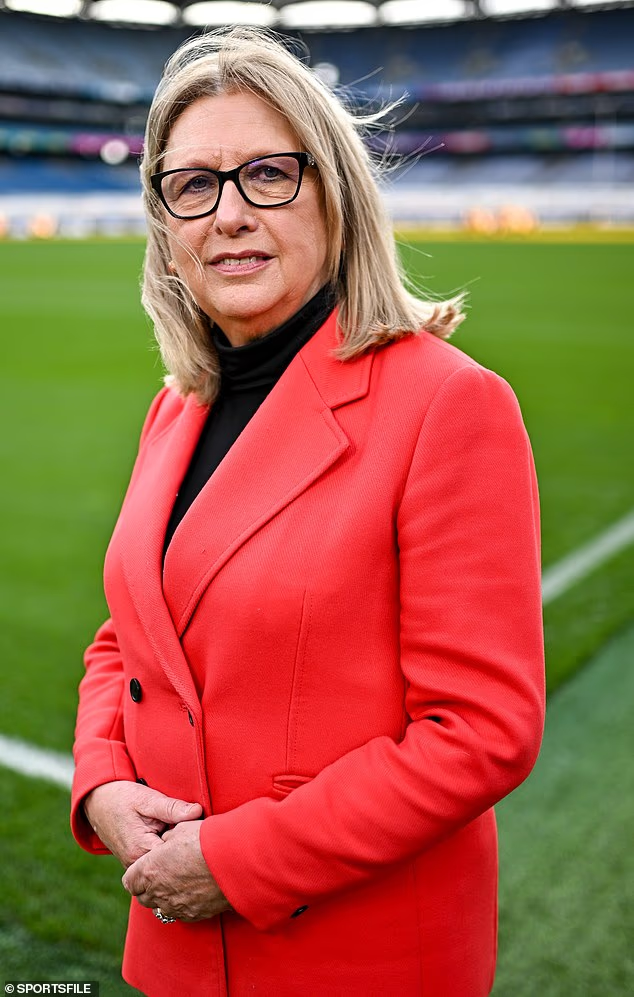
Former president Mary McAleese has delivered strong views on Baptism in her new book
It states: 'The Church is structured on the presumption that the Pope and bishops, collectively known as the authors of the teaching magisterium of the Church, have the right to regulate and control, including through penal sanctions, much of the life and especially the thinking of members of the Catholic Church.
'That presumption requires the magisterium to ignore contemporary understanding of the inalienable human rights of the individual to freedom of conscience, opinion, expression, religion and freedom to change religion.'
While still a practising Catholic, Ms McAleese, 75, is an outspoken critic and reformer within the Church and frequently challenges the hierarchy on issues.
The new book argues that Church teaching has promoted baptism as part of a 'lazy' doctrine of obligation rather than a 'dynamic' approach that recognises the importance of invitation and free participation.
The brief continues: 'It requires all Catholics to overlook the fact that babies cannot give informed consent to promises at baptism and no one can consent on their behalf thus robbing them forever of such a vital realm of choice.'
Ms McAleese said in a statement that the book's message did not oppose 'the divine sacramental' elements of infant baptism. She stated: 'It challenges man-made imposition of canon law rules which assert serious limits on human rights and fundamental freedoms of Church members for all of their lifetime.'
The subject was also tackled in her 2019 book, Children's Rights and Obligations in Canon Law: The Christening Contract.
Ms McAleese has also clashed with the Church over its exclusion of women from the priesthood. In 2018, the Vatican prevented her from speaking at a panel organised by Voices of Faith, a Catholic women's advocacy group, in Rome to discuss Church governance.
The group responded by moving the event off Vatican grounds to the headquarters of the Jesuit Refugee Services, where Ms McAleese, who has written several other books in the past, claimed the Church was an 'empire of misogyny'.
The Catholic Communications Office has been contacted for comment. Independent senator Rónán Mullen, former head of communications with the Catholic Church office in Maynooth, said Ms McAleese appears to have made a wrong call.
He said: 'I think Christian baptism is about something more important than Mary McAleese's concepts of "human rights", "autonomy" and "choice". These are important ideas for politics but pretty meaningless when it comes to sharing the gift of faith with an infant.
'Baptism is about starting a child's life well, bringing them into God's family, bringing them up in the love of God and opening up the hope and possibility of eternal life.
'If God exists, that would seem like the best start a child can get from their parents.
'As each person matures into adulthood they grow in the ability to exercise freedom and it will be important for them to make a personal decision as they go through life about their relationship with God.'
He continued: 'I am assuming that Mary doesn't think teaching children the difference between right and wrong at a young age, or discouraging them from exercising their freedom to put their hand in a fire, is a breach of their human rights. You don't need a baby's consent to change their nappy either.'
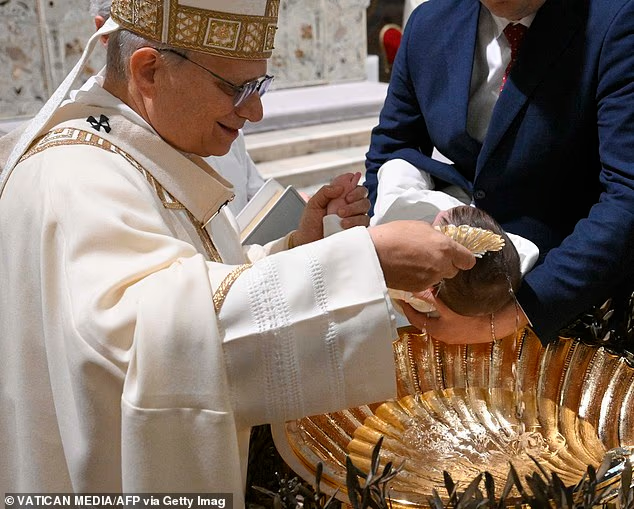
Pope Leo at recent event during which infants are Baptised the Sistine Chapel in the Vatican Mr Tóibín described her remarks as 'nonsense'.
He said: 'I think Mary is wrong on this. I think there should be freedom of religion.
'She is entitled to her view, but equally, parents should be able to raise their children as they see fit.
'They should have a right to impart their values to their children. For many people, their faith, culture, heritage and tradition is a hugely important part of their lives. It's nonsense to think they can't pass it on to their children. Families have enough to be concerned with, what with cost of living pressures and rising bills.'
He added: 'Most people are doing their best and should be let to make such families decisions as they choose.'
Fr Tony Flannery, from the Association of Catholic Priests, was diplomatic in his comments about baptism. He said: 'I wouldn't go as far as Mary McAleese on ending baptism. Ultimately it is the choice of the parents whether they want to have the child baptised at a young age or not at all. The original justification for instant baptism was a belief that unless you were baptised at an early age, you wouldn't get to heaven. That belief is now redundant.
'Mary's point on how they [children] are imprisoned into this [faith] for the rest of their lives, I don't know how she can say that.'
We attempted to contact Ms McAleese last night.
Source link