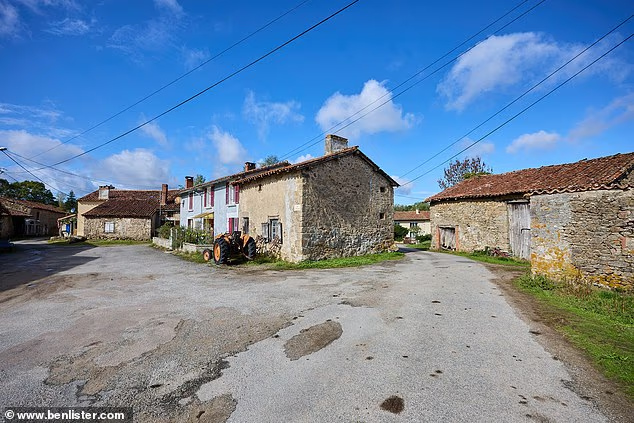
A picture-book hamlet of two dozen stone-built houses, with no shop, church or buses, Le Grand Pic in Limousin, south-central France, is so far off the beaten track that even locals in the nearest village struggle to direct you there.
Twenty-five years ago, when Adrian Maxwell, a retired City of London Police detective and criminal barrister, stumbled on this timeless idyll he assumed he'd left the sordid side of life far behind.
Early on Tuesday morning, however, the 77-year-old expat and his elderly female neighbour became the unlikely lone witnesses to a dramatic moment that every law-abiding French citizen had been waiting for since last weekend.
While pushing a broken-down Renault along the road, they watched as a squad of elite anti-terror officers donned black balaclavas and bullet-proof vests, before kicking down a cottage door to seize the most hated man in civilised France: the alleged ringleader of the ultra-Leftist mob who burned down the magnificent neo-Renaissance town hall in Limoges.
This despicable act of anti-state rebellion (which had been planned weeks in advance) was the defining, international headline-grabbing moment on an infamous day when uncontrollable anarchy reigned in towns and cities stretching from the Channel to the Mediterranean.
It was a day that the government fears will be replicated with a vengeance across France today and on many more Saturdays to come.
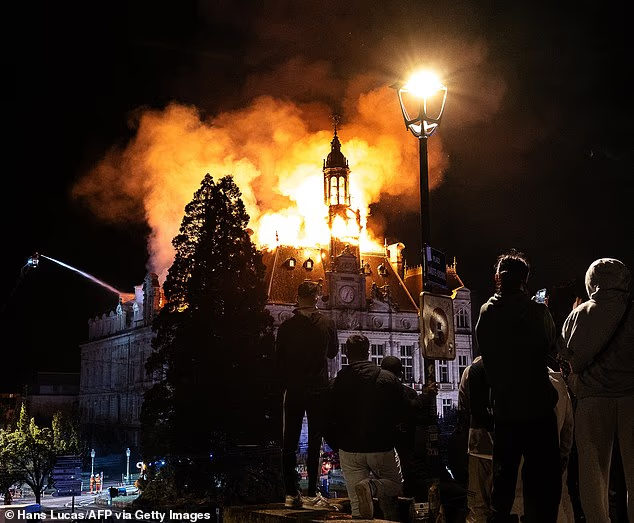
The town hall in Limoges Haute-Vienne in the Nouvelle-Aquitaine region of France went up in flames on October 17
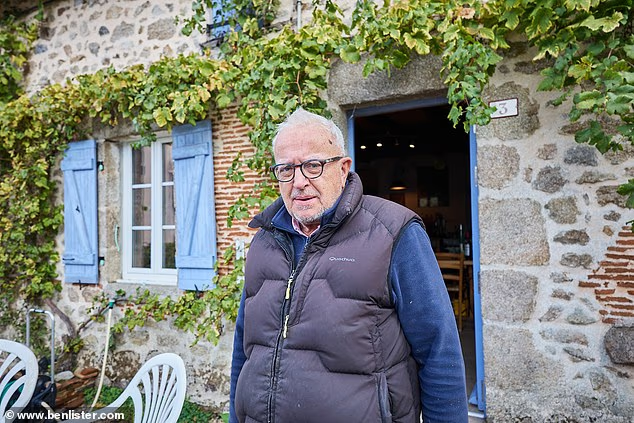
Adrian Maxwell, a retired City of London Police detective and criminal barrister, now lives in Le Grand Pic in Limousin in south-central France
A squad of elite anti-terror officers seize the most hated man in France at the village - the alleged ringleader of the ultra-Leftist mob who burned down the town hall in Limoges
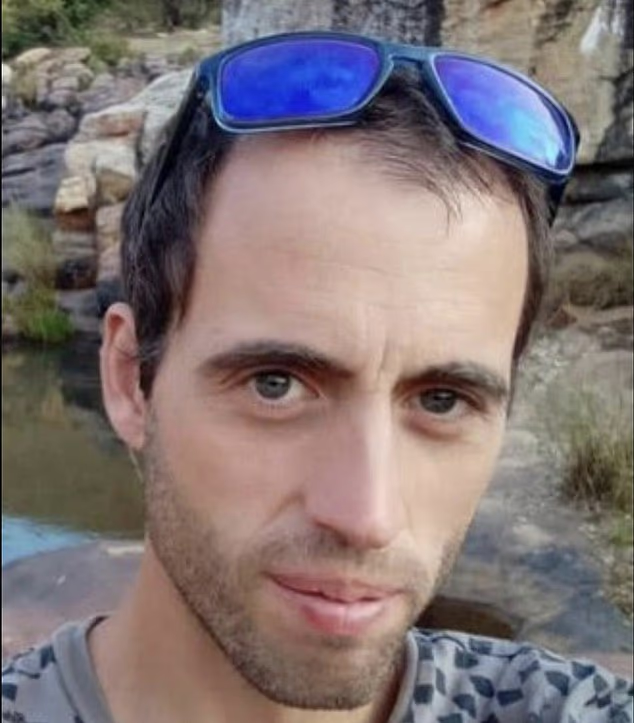
Hodei Ciarra Docampo, the far-Left extremist suspected of burning down Limoges town hall
When the heavily armed officers burst into the house Hodei Ciarra Docampo, 34, shares with his parents, he was not there. But they found the alleged far-Left activist, convicted last year of punching a police officer during a demo, sleeping in a hut in the garden, and marched him away.
'I'm an ex-London copper so I realised immediately what was happening, but it was only later in the afternoon, when a friend phoned to tell me that he'd read about it in the evening paper, that I learned who the SWAT team were after,' Mr Maxwell told me.
He was flabbergasted, for as he says, Le Grand Pic, once a farming community but now an enclave for New Age hippies (among them a band of English off-gridders who live in yurts in the forest) is 'hardly the sort of place you'd expect to find an anarchist's cell'.
His neighbour, an 82-year-old Oxfordshire woman who has lived in the hamlet for 22 years and asked not to be named, agreed.
'The most exciting thing that happens around here is when the Limousin cows escape their pasture and go into the village,' she said. 'But then I suppose that's exactly why these terrorists would choose it as their hideout.'
According to informed onlookers, including French intelligence officers, academics and politicians, she is right. For if, as it appears, France is teetering on the edge of another revolution – this time driven by 'organised ultra-Left groups whose aim is to bring down the Republic', in the momentous words of President Emmanuel Macron this week – it is not being plotted in cities such as Paris, Marseilles, and now Limoges.
The cradle of this insurrection is in seemingly tranquil backwaters such as Le Grand Pic, where many – including Britons – seek a gentler life. Intelligence officers have also identified a dissolute band of 'neo-ruralist' Marxists based on Le Plateau de Millevaches, a wilderness an hour's drive to the east of Limoges.
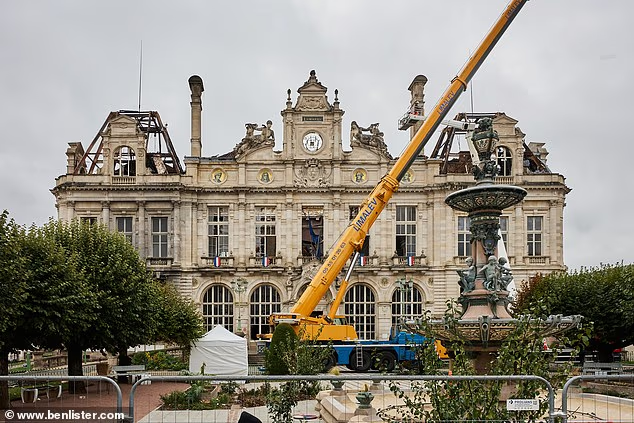
France is teetering on the edge of another revolution – this time driven by 'organised ultra-Left groups whose aim is to bring down the Republic' (Pictured: Limoges town hall in the aftermath of the flames)
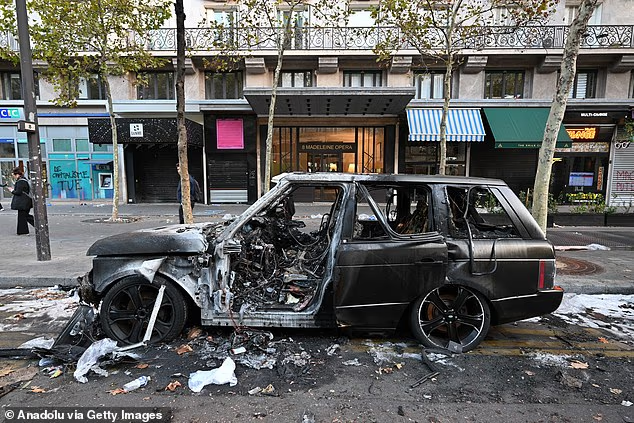
A burnt-out vehicle is seen following clashes during nationwide protests against the high cost of living and rising fuel prices in Paris, France
This week, Cannes mayor David Lisnard, a Right-of-centre candidate in next spring's French presidential election, who was born in Limoges, claimed that this sparsely populated region harbours secret training camps where ultra-Left activists are schooled in the dark arts of urban warfare.
Whether or not this is true the plateau's ties with extreme Leftists are well-known.
And there is compelling evidence that the anarchists who skulk in its communes are orchestrating the most virulent uprisings in France since the Left Bank riots of the Sixties. At the heart of the 1,350 square-mile plateau sits Gentioux-Pigerolles, another scenic village of just 398 people that has suddenly assumed a central part in the French political landscape.
While other statesmen pay their respects on Armistice Day at the Tomb of The Unknown Soldier, beneath the Arc de Triomphe in Paris, Jean-Luc Melenchon, leader of the far-Left party France Unbowed, has declared his intention to visit a pacifist war memorial in Gentioux, just as he did on November 11, 2024.
When Macron and his prime minister Sebastien Lecornu this week accused the radical Left of 'pursuing an agenda aimed at destabilising our institutions', no one was in any doubt that they were pointing a finger at Melenchon, who will stand in next spring's presidential elections. Yet with his every move under the microscope, the veteran firebrand, who makes Jeremy Corbyn sound like the voice of moderation, has chosen to venture to a place synonymous with anarchistic crime.
The plateau was the lair of Julien Coupat, who was accused, in a landmark trial in 2008, of leading nine members of his ultra-Left cell to sabotage a high-speed rail line. After a ten-year legal battle, he was acquitted on appeal.
Further attacks by separate ultra-Left groups on the plateau were aimed at a logging company and a cross-country motorbike race. Then, a few years ago, when saboteurs destroyed eight vans belonging to France's state-owned electricity grid company and a huge aerial supplying TV and mobile phone signals to millions, the plateau was in the headlines again. Astonishingly, among those arrested was the 57-year-old headmistress of Gentioux-Pigerolles's school.
Elsewhere, parents might have been appalled that their children were being taught by an eco-arsonist, yet they supported her with protests outside the court and daubed anti-police slogans on the school's walls.
Given the events of recent days, however, an ageing Spaniard who stood trial alongside the headmistress – Fernando Ciarra Ramirez – has assumed greater significance than the anarchic school head. For he is the father of the Hodei Ciarra Docampo.
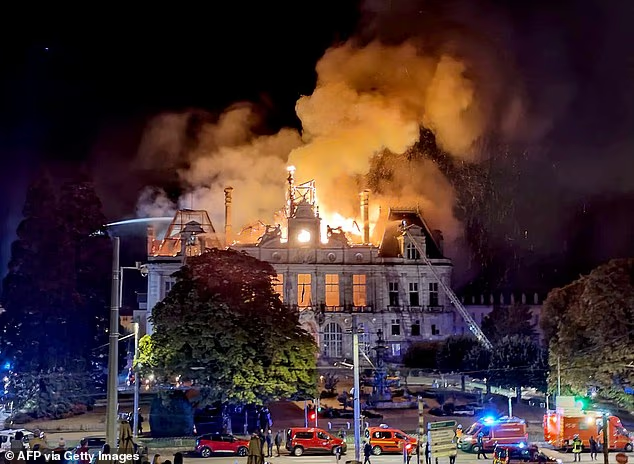
A fire burned and destroyed the city hall after a group of individuals forced entry into the building during ongoing protest action against the 'high cost of living
Now aged 70, Ramirez is reportedly a veteran Basque separatist who decamped to France with his wife at the height of the ETA terrorists' violent struggle for independence. Let off with a three-year suspended sentence for destroying the cars and antennae, he made a lofty speech outside court, calling 'all people to civil resistance and disobedience'.
Like father like son? Certainly, that was the sentiment among some outraged folks this week. 'If it were left to me, I'd have shot him [the alleged town hall arsonist] already,' snarled a baseball-hatted workman, after a heavy lunch in the only restaurant within miles of Le Grand Pic. However, when his parents spoke exclusively to me at their cottage in Le Grand Pic this week, they presented themselves as a polite old couple, bewildered by their son's arrest.
'He is innocent, this is a fit-up –he is a calm, gentle person,' his mother protested. 'The police raid was terrifying. There were 20 of them, and they smashed down the door'.
Her husband interjected: 'They don't want responsible justice. This is all about repression – they just need a scapegoat. Why would my son do this? He is a pacifist.'
Before I could ask the old anti-capitalist how this squared with his own acts of sabotage, he ended the conversation.
At dawn on Thursday, a second man was arrested for helping to start the fire. This time the anti-terror police swoop came 75 miles away . . . and where else but Gentioux-Pigerolles?
The new suspect is said locally to be a 66-year-old pillar of the community, elected to serve on the municipal council's forestry protection committee, which could support claims that the ultra-Left are infiltrating local authorities. According to local sources, after his arrest the officers searched a disused property and a yurt said to be owned by Ciarra Docampo.
Last night, both men were being held in custody under hastily revised laws extending the time people accused of riot-related crimes can be detained without charge. The older suspect, whose name has not been released, is accused of damaging the town hall and endangering life – and Docampo is being investigated for arson and attempting to murder police officers.
For as Limoges' mayor Guillaume Guerin revealed, the building wasn't unoccupied when the mob stormed it. Cowering inside were some 20 people: elected officials and police officers.
This didn't concern the ringleaders, who had brought with them all the objects they would need to burn down an edifice that stood, in their minds, as a totem of the detested French establishment, including fuel and a battering ram.
'They knew exactly what they were doing,' said the mayor, who stood watching the blaze – with tears streaming down his cheeks. 'They were shouting 'You're going to burn! We're going to kill you!'
'For 25 years I haven't cried, but that evening I wept tears of rage and sadness,' added M. Guerin, who says he is now receiving death threats on social media. 'I don't just think that this was all planned in advance – I know it.'
Among the mob, he tells me, about 1,000 people were from the Black Bloc (extreme-Left thugs who disguise themselves in black hoods and clothing). But there were also hundreds of 'brainless idiots' who clapped and cheered as one of France's most iconic buildings was destroyed.
There were similar scenes across France, for the rioters clearly had a plan to target any building of symbolic significance to the state, from banks and public offices to the Republican Guard barracks in central Paris.
Yet according to leading French academics, October 17, will be remembered as a day that changed the nation for another, more worrying reason. The French government, they say, now faces the wrath of a powerful new enemy.
For the first time, militants of the far-Left succeeded in joining forces with marginalised young people from the poorest neighbourhoods, students angered by school conditions, and ordinarily law-abiding people angered by the cost of living and substandard services.
As the first batch of arrested rioters appeared in courts this week we saw a snapshot of their backgrounds.
Manuel, a chef, had travelled to Paris on his 21st birthday with ingredients for a homemade Molotov cocktail in his rucksack. He failed to convince judges that they were for 'lighting a barbecue'.
Students Mathilde, 19, and her boyfriend Francois, were caught near the Bastille – she with a gas mask, he with knuckledusters. They had exchanged phone messages about their intention to 'beat up' the police.
Hector, also 21, a talented trumpet player who attends an elite music college, was described by his lawyer as a 'staunch pacifist'.
Claiming to have been carrying sulphur and ammonia in the thick of the Paris rioting to 'make stink bombs', and that he had worn gloves to protect his trumpeting fingers, he was among the few defendants to be acquitted.
Many were shocked to be sent directly to jail, as judges followed the justice minister's demand for harsh exemplary sentences.
These everyday missile-throwers and opportunist thieves made up 80 per cent of the 2,400 arrested rioters, according to the authorities. The others were hardened anarchists, some of whom had travelled from other countries, including Britain.
Adam, from Switzerland, told a court in Lyon he had gone to stand up for his 'political convictions', though quite how they justified looting a supermarket and striking the officer who arrested him, he was at a loss to explain.
Making clever use of the internet, however, the majority of last Saturday's mayhem-makers remain free as the riot's architects outmanoeuvred the inept police.
They used apps to monitor the deployment of riot squad officers, then warn protesters where to avoid. False messages were posted to deceive the police; and genuine ones to ramp-up the violence.
All this prompted Contre-Attaque, a militant Left website, to boast: 'This is unprecedented in France's contemporary history: for the time the police ended the day without having the situation under control.'
The site also published a graphic photo showing gaping wounds to the leg of an elderly female British tourist purportedly hit by a police grenade as she took shelter.
However, its editorial said, although the police had 'lost' and 'the revolution had been within reach' on Saturday, it had not been achieved because 'we lack a vision [and] we need the regime to fall'.
Today, these morally bankrupt fanatics are expected to resume their nihilistic mission.
By making a bonfire of a 143-year-old civic hall designed by one of France's greatest architects, they have demonstrated their ruthlessness.
Known as the 'arts of fire capital' because it produces beautiful porcelain, enamelwork and stained glass, Limoges' age-old soubriquet now carries a bitter irony.
Yet the aim of the French extreme Left is not just to destroy the nation's great monuments. They are plotting to sabotage the entire democratic system.
Of course, their attack on the values that proud Frenchmen and women hold dear – liberty, equality, fraternity – is playing directly into the hands of hard-Right leader Marine Le Pen, already streets ahead of Melenchon in the presidential polls.
Upright French citizens will be praying the Black Bloc's shadowy leaders are rooted out before a dangerously fractured and febrile country succumbs to their dystopian ideology.
Additional reporting: Rory Mulholland
Source link