People might ask, what is the difference between a root canal and a high school speech and debate meet? To which I answer: One is a painful, tedious, seemingly endless experience, and the other is a dental procedure.
This past spring, I was called upon to act as a judge at a speech and debate meet when I would have preferred a root canal. My reluctance to participate was not based upon any animus toward the competitors but rather upon the depression that sets in after observing how ill-informed our young people are in the present and how ill-equipped they are for the future.
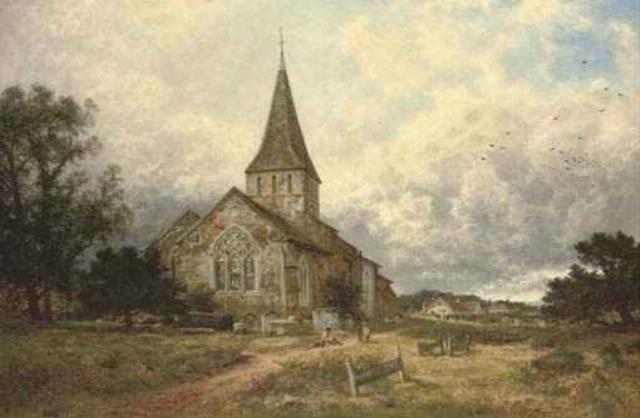
One of the events I was asked to judge involved two high school seniors and two juniors who were seated around a table and presented with an artifact that they were directed to discuss. The artifact in this case was the 1931 Diego Rivera painting "The Uprising" (which you should view here to appreciate this essay).
The discussion began without hesitation or reflection, almost reflexively.
"The painting represents minorities rising up against their oppressors."
"Like the George Floyd riots, it represents people of color fighting back against systems of oppression."
"It represents womanhood standing her ground against the patriarchy."
This line of thinking bounced around the table until, near the end of the allotted time, it ended at the only logical conclusion that could be reached:
"The institutions of White Supremacy must be destroyed by any means necessary."
At this crescendo of wokeness, I threw all caution and applicable restrictions aside. After all, my daughter was graduating in a few weeks, and this would be my last encounter with youthful vigor coupled with complete ignorance, at least outside my own home.
"Please look at the painting," I said. "In tones which contrast with the surrounding scene, you see a woman, a child, and a man. They are surrounded by turmoil and violence: the power of the state on one side and the chaos of the people on the other. What could this represent?"
Silence.
"Could this represent the Holy Family?" I suggested.
The students' blank expressions reflected the shallowness of a post-Christian culture. "This painting was completed in 1931," I continued. "The Cristero War in Mexico, which killed as many as 250,000 people, had ended two years earlier. The Mexican government waged the war against the Catholic Church and its adherents in an effort to secularize the culture. Could Rivera have been drawing on the believers' iconography?"
More blank stares.
"Look at the style. Do you see any similarities to the Soviet style? The men are wearing urban work clothes, not the agrarian work clothes and sombreros which the vast majority of Mexican workers wore in the 1930s. Is it possible that Rivera was attempting to co-opt the iconography of the Christian believers for the purpose of influencing the viewer toward the Soviet cause?"
More blank stares.
"And look at the woman. She's wearing a dress with a pleated skirt and shoes with heels. Does this represent the peon fieldworker who would have her child swaddled to her back as she hoed or harvested? Maybe Rivera was appealing to an audience in urban America or Europe."
One of the girls raised her hand slightly from the desk, and I nodded. "Are you a history teacher or something?" she asked.
"No. I work in construction. I never finished high school," I answered softly, but without a hint of shame. "But I've always been curious, and I'm never done reading."
I continued, "And as for the 'systems of oppression' and 'white supremacy,' would you say the soldiers look 'white'? Does the officer with the sword look 'white'? Do any of the people in the painting look 'white'?"
Back to the blank stares and a prolonged pause.
"I'm curious, why did none of you question the assertions made by anyone else?"
The unchanging blank stare.
"Do not be afraid to question. Always question. If one of you had questioned the premise of any assertion, that person would have easily won this round. I apologize for breaking format and hope you all do well in future rounds."
I closed my laptop and put my notepad away.
The students shuffled out of the room, and I am confident they had much to discuss regarding the nutcase judge.
Ronald Reagan once said that the problem is not that liberals don't know anything. The problem is that so much of what they know is wrong. This is what saddens me about the young people I met at these meets.
We have failed them. We have provided better-funded schools, better-compensated teachers, and equipment undreamed of 30 years ago, and yet their worlds are as small as an iPhone screen.
These kids were eleven or twelve years old during the COVID lockdowns, George Floyd, and the Mostly Peaceful Summer of Love, but the narrative remains embedded in their minds. Despite all we have learned—that the lockdowns were pointless, that George Floyd was a miscreant who died from an overdose, that the riots were a pointless exercise in anarchy—these students still regurgitate the slogans of a completely discredited movement.
It is the culture, our schools, and the teachers that have blinded our kids to the world around them. The long march through the institutions began a half-century ago, and I am afraid there is no going back.
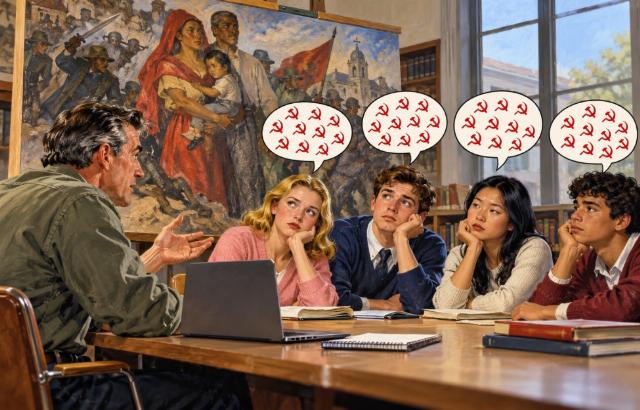
Image created using AI.
Source link