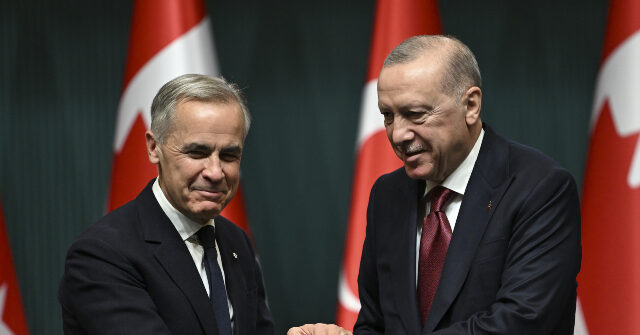
Leftist Canadian Prime Minister Mark Carney insisted during a press conference in Istanbul, Turkey, on Friday that expanding economic and defense ties with the Islamist state was not a violation of his progressive values, declaring, “Engagement is not approval.”
He told reporters that “values-based realism,” which is what he calls his foreign policy, means that Canada can do business with nations whose behavior it doesn’t approve of.
Carney traveled to Turkey, a fellow NATO ally nation, on Wednesday to discuss expanding trade volume and other bilateral cooperation. His visit is unprecedented in the history of the two countries and raised eyebrows at home given strongman Recep Tayyip Erdogan’s repression of a variety of communities in his country, including the LGBTQ2A+ community, non-Sunni Muslims, Kurds, and anti-Islamists in general. Erdogan is arguably the most vocal head of state supporting the genocidal jihadist terrorist organization Hamas and has used state repression to suppress the opposition and stay in power during the past three rounds of national elections.
Carney insisted when challenged by reporters on Friday that doing business with a government with such a poor human rights track record did not undermine Canada’s own values or legitimize Erdogan.
"There are very few countries in this world that have the standards of Canada, the rights of Canada, the conviction of Canada, the constant reinforcement of those rights, so that all Canadians can live their lives as they choose," he asserted, according to the Globe and Mail.
"Our first and foremost job is protecting, not just protecting LGBTQI rights and two-spirited rights in Canada, but promoting those rights and ensuring that all Canadians can live their full selves in Canada. So first and foremost, that's our responsibility," he said. “Two-spirit” is a uniquely Native American/First Nation concept in which someone identifies as both male and female simultaneously, or a third “gender.” There is no significant documentation of the presence of two-spirit people in Turkey.
In addition to insisting that he was not legitimizing Erdogan and did not approve of his government, Carney insisted that it was necessary to engage Turkey to become a “truly sovereign nation,” hinting at Carney’s campaign to distance Canada from the United States. Carney’s term as prime minister has been defined by antagonism towards America and the declaration that the “old relationship” with Canada’s closest ally was “over.”
"Part of the way we discharge that is to be a truly sovereign nation. Part of the way we become a truly sovereign nation and reinforce our sovereignty is to have a broad range of partnerships around the world," he reportedly said.
Both Canadian and Turkish media reported that the meeting between Carney and Erdogan on Thursday yielded significant advances in bilateral trade and development.
"We are now starting a new era between Türkiye and Canada," Erdoğan declared triumphantly on Thursday.
The two leaders signed a “three-year action plan” to expand trade, focusing on defense and energy. The Turkish president said that he aspired to raise the two countries’ bilateral trade volume, currently standing at $3 billion a year, to $10 billion, with a short-term boost to $5 billion.
“Today, we have overcome the disconnect that had persisted between Turkey and Canada for many years. Now we are launching a new era between Turkey and Canada,” Erdogan explained, according to the Turkish state-run Anadolu Agency. “Our decision on a strategic partnership will not be merely a symbolic step on paper.”
Among the major deals pursued will be trade in liquefied natural gas, nuclear power, mining and critical minerals. Carney touted in particular the potential that the Canadian company AtkinsRéalis could secure an agreement to build nuclear reactors for Turkey, which has traditionally relied on Russia for nuclear development. Carney stated that the deal was not set, however, only that the chances of securing one on nuclear energy were “good,” compared to barely existent a year ago.
The two nations, Erdogan and Carney stated on Thursday, would also pursue development projects in poorer, third-world countries, Anadolu added.
Among the biggest announcements was the confirmation that Turkey and Canada would also pursue negotiations towards a free trade deal. This agreement, Carney said, would be based on negotiations expected to begin in November. Such a deal would dramatically expand Turkish access to the Canadian market and its substantial fossil fuel resources, as well as grant Canada an opening to importing a much higher volume of Turkish goods.
Human rights observers have expressed much more limited enthusiasm for expanding business with Turkey than Carney has. The Globe and Mail quoted University of Ottawa Professor Roland Paris lamenting that Carney was “not getting the balance right” between trade and human rights concerns, stating he was “decidedly on the side of pursuing commercial goals while downplaying other questions of human rights and democracy and the rule of law."
Another professor, Thomas Juneau, told the newspaper that, while Carney does appear to be applying “realism” to his policies, the “values-based” part of his slogan appears to be missing: "I'm not sure where the values fit in that."
Erdogan has amassed a grotesque record on human rights in his two decades in power, first as prime minister and later as president. Most recently, as the CBC noted, “The Turkish government executed several high-profile operations to systematically silence opposition voices, suppress independent journalism, and restrict marginalized groups.” LGBTQIA2+ Turks have been at the forefront of this oppression, as Istanbul has violently cracked down for years on attempts to organize what was once a peaceful and successful annual gay pride parade there.
Erdogan has also focused significant state power on eliminating potential presidential rivals. At least two of them – Kurdish presidential candidate Selahattin Demirtas and Istanbul Mayor Ekrem Imamoglu, are behind bars, facing dubious charges of associating with terrorists and corruption, respectively. Turkey’s recent elections have been marked by voter suppression and violence against the opposition.
Source link