The crucial mistake may have come before the Learjet began its fatal plunge: flying into dangerous weather instead of going around it, according to a veteran pilot interviewed by the New York Post.
Justin Crabbe, a pilot and CEO of charter-booking platform Jettly, told the paper that air traffic controllers had given the crew flexibility to avoid the weather before Sunday's crash in Palm Beach County killed all nine people aboard.
"They certainly should have gone around [the storm]," Crabbe said. "[Air-traffic control] gave them the flexibility to deviate around that weather."
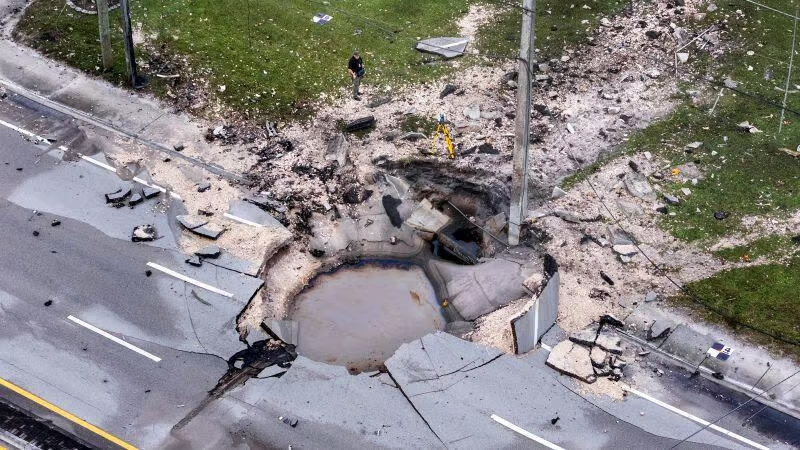
His assessment comes as investigators examine a debris field roughly half a mile long and four-tenths of a mile wide, with witnesses describing a deep impact crater and little recognizable aircraft wreckage.
That assessment is not an official finding of pilot error. At Monday's briefing, the NTSB had not yet confirmed whether the aircraft flew through an active thunderstorm, according to WFLX's account. The cause remains under investigation.

The Climb Before The Plunge
The Learjet 60, registration N722BD, was traveling from Austin to North Eleuthera in the Bahamas. Before the crash, the crew reported icing and moderate turbulence at 35,000 feet, then precipitation, and requested clearance to climb to 37,000 feet.

Shortly after controllers approved the climb, the crew reported a rapid descent and an overspeed condition, according to Flightradar24's review of the flight and radio traffic.
Crabbe's theory is that the attempted escape from the weather may have contributed to an aerodynamic stall.
"They tried to ascend to get to clearer air, which may have been one of the contributing factors toward accelerating that stall," he told the Post.
He also raised the possibility of "get-there-itis" - pressure to reach a destination despite deteriorating conditions - while acknowledging that he did not know why the pilots had not gone around the weather.
"It's extremely easy to say this from the ground and from a position of safety," Crabbe said.
Even a successful climb might not have cleared the weather: the Post, citing NOAA data, reported that the storm system extended to nearly 50,000 feet.
A Half-Mile Debris Field
On the ground, the Post's separate report from the crash site described the force of an impact that left a deep crater beside a busy road near a mobile-home community.
Anthony Blackmon, 18, whose home was less than 100 yards away, said he initially thought the neighborhood had been bombed.
"The plane seemed completely disintegrated; there were only small parts," he told the paper. "There was some metal but no big parts."
Erick Horta was stopped at a nearby red light when the aircraft came down.
"At first I thought it was a meteor; we didn't realize it was a plane," he said.
Witnesses also reported human remains on nearby vehicles. Authorities were waiting for water to drain from the crater so recovery work could continue, the Post reported Monday.
NTSB board member Tom Chapman has said investigators have evidence suggesting the aircraft began breaking apart before impact. Weather is a major focus of the investigation, Reuters reported.
The victims included entrepreneur Adam Robinson, his wife Helen, their children Emma, 4, and Charlie, 2, two friends, the family's nanny and both pilots, according to the Post.
Aviation attorney Zachary S. Gorwitz also cautioned against blaming 20-year-old copilot Nathalia Gadelha Filgueiras simply because her voice was heard communicating with controllers. He told the Post that her handling the radio suggested the other pilot was at the controls.
Who was flying, what triggered the descent and whether the crew's decisions contributed to the crash remain questions for investigators.
***

The Learjet 60 that crashed on Sunday afternoon in Palm Beach County, Florida, killing all nine people aboard, may have broken apart before slamming into the ground.

The Learjet 60 (N722BD) was flying from Austin, Texas, to North Eleuthera Airport in the Bahamas (with passengers likely visiting Harbor Island) when it encountered severe thunderstorms and turbulence.
‼️DEVELOPING: RADAR SHOWS JET FLEW INTO A STORM CORE AT 35,000 FEET
— Live Storm Chasers (@LiveStormChaser) November 1, 2026
Analysis of Miami NEXRAD radar shows the Learjet 60 (N722BD) entered a thunderstorm core near Wellington at about 12:48 PM ET, just before it crashed in Palm Beach County.
At 35,000 feet, radar echoes around… pic.twitter.com/Tt83Gpcck5
The young woman copilot reported icing at 35,000 feet, followed shortly by overspeed conditions and an accelerating descent rate of between 10,000 and 22,000 feet per minute.
"The weather conditions are a major focus of the investigation," NTSB board member Tom Chapman said, quoted by Reuters. Investigators have found evidence suggesting an in-flight breakup and may locate aircraft parts some distance from the main impact area, he added.
The Learjet's maximum operating limits, VMO and MMO, change with altitude. At the altitude the jet was flying before the crash, the operating limit was around Mach 0.81:

There are concerns that icing and moderate turbulence led to a phenomenon called "Mach tuck," in which a jet's nose pitches downward at high speeds as airflow over parts of the wing becomes supersonic and shock waves form.
(excuse the tiktok video), apparently it *could have* also been something called “mach tuck”. Commercial aircraft have been built structurally to prevent this. But it seems Learjet & also older planes CAN be susceptible. https://t.co/YrG4OPtSsA pic.twitter.com/6wyUl3hoQ5
— 𝒥𝚊𝚗𝑒 𝒟𝚘𝑒 (@femanthropy) November 2, 2026
If so, it may explain why the pilot lacked sufficient elevator control due to an in-flight breakup as the aircraft exceeded its maximum operating speed.
WATCH: New video shows Learjet 60 business jet crashing near West Palm Beach, Florida.
— BNO News (@BNONews) November 1, 2026
The plane was completely disintegrated upon impact. Number of casualties unknown. pic.twitter.com/l5JT9KEWnQ
Unconfirmed reports on X say the Instagram account "divisionofaero" found a flight control surface several miles from the crash site, which would indicate overspeed conditions and the resulting breakup of part of the aircraft.
From Instagram account “divisionofaero” — Someone found a flight control surface several miles from the crash site. I've emailed these screenshots to the NTSB. This would indicate the aircraft was breaking up prior to impact. pic.twitter.com/fJj633ndpZ
— RampCheck Aviation (@rampcheck) November 3, 2026
NASA Administrator Jared Isaacman praised the 20-year-old female copilot for continuing to communicate with ATC during the emergency.
"She was doing her job," Isaacman wrote on X.
ATC AUDIO: Final moments of the Learjet 60 crew before the aircraft crashed in West Palm Beach, Florida, killing all 9 people on board. pic.twitter.com/eYFJUiNsU7
— WBC24 (@WBC24News) November 1, 2026
The ATC audio of the young copilot communicating with controllers in the area is one of the worst recordings some commercial pilots say they have ever heard.
Source link