While Ukrainian Christians face persecution from invading Russian forces, one sect, the Ukrainian Orthodox Church (UOC), faces seizures and possible total liquidation following allegations of support for the Kremlin.
UOC metropolises, priests, and parishioners told the Daily Caller during an August visit to Ukraine that the faith is being unfairly targeted in a coordinated effort between the rivaling Orthodox Church of Ukraine (OCU) and the Ukrainian government to transfer property and followers to the OCU.
Government and religious leaders defending the seizures, arrests and investigations said the measures were necessary to preserve Ukraine’s spiritual independence from Moscow. (RELATED: Ukrainian Christians Allege Soviet-Era Persecution By Russia, Bombings Of Churches)
“Maybe some of the churches are too close to Russia,” then-Sen. J.D. Vance said in an April 2024 Senate debate on Ukraine aid. “But you don’t deprive an entire religious community of freedom because some adherents don’t agree with you about the relevant conflict of the day.”
The United Nations (UN) put out a statement Oct. 1 warning about the persecution of the UOC.
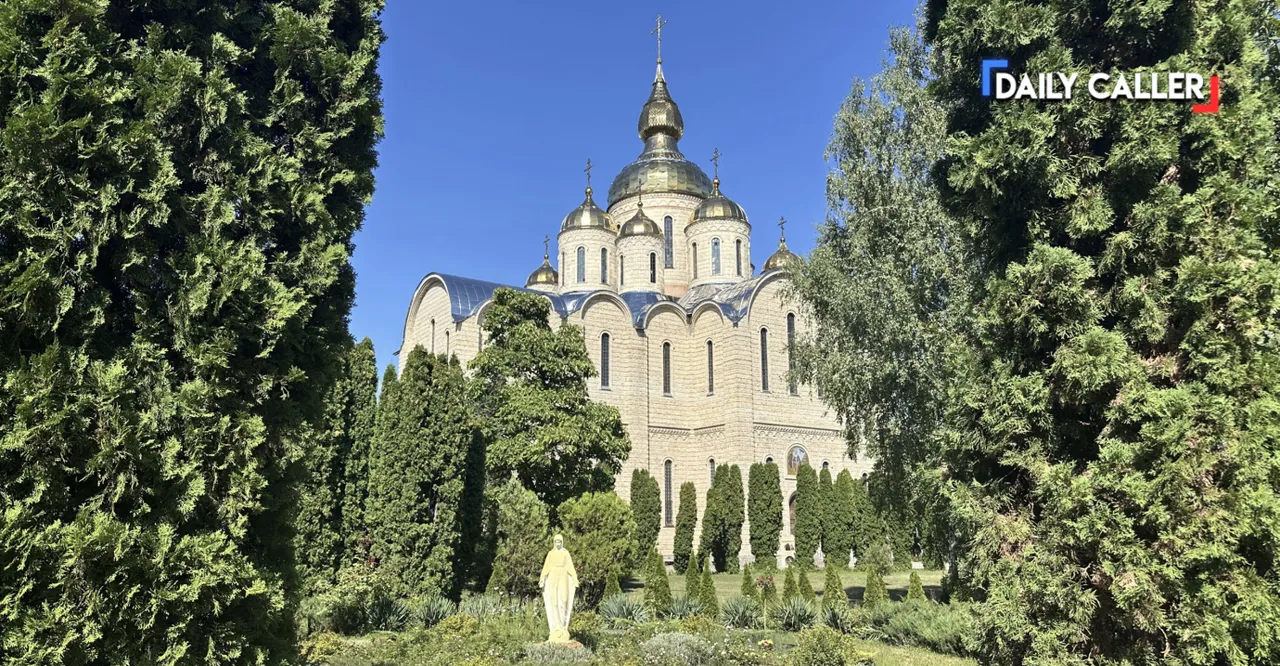
Nearly a dozen UOC parishioners described to the Caller an alleged violent takeover of St. Michael’s Cathedral in Cherkasy in October 2024.
2/8 🧵
— Derek VanBuskirk (@DerekVBK) August 23, 2025
St. Michael’s Cathedral in Cherkasy became ground zero. Twice, masked and unmasked men with crowbars and tear gas stormed the cathedral, according to UOC witnesses. Parishioners were beaten, left with broken bones, and some still bear the injuries. pic.twitter.com/V7PwV0rrKp
One parishioner showed the Caller bruises still visible on his legs. Another claimed her husband was beaten so badly he could not even talk, and he suffered “many fractures of his bones.” The woman’s youngest child was so traumatized by the event that he went almost a whole year only addressing himself as “kitten” instead of his given name, she told the Caller.
Metropolitan Feodosii, who leads the UOC over Cherkasy, was hospitalized after allegedly suffering burns and a concussion during the struggle, according to a statement from the diocese.
Parishioners alleged priests from the OCU stood along the fence laughing with the police as they waited to take over the property.
“The police were supporting the attackers… We were trying to appeal to the police, but they laughed in our faces and said, ‘We don’t know yet who we should defend, you or them,'” one parishioner claimed.
By the end of the day, the men had allegedly taken control of the cathedral. Two other UOC churches in Cherkasy were later seized — including one whose priest was given two days to vacate, splitting up his family for months, parishioners told the Caller.
Officials said the seizures followed community votes to transfer churches from the UOC to the OCU, though many UOC members claimed they were never informed of the votes and non-Orthodox residents were chosen to participate.
A violent seizure took place at St. Michael’s Cathedral in Cherkasy, Ukraine, on Oct. 17, 2024, when control of the church shifted from the Ukrainian Orthodox Church to the Orthodox Church of Ukraine. (Photo by Derek VanBuskirk)
The UOC traces its roots to the 17th-century Russian Orthodox Church (ROC), and it was formally recognized in 2019 under the Ecumenical Patriarchate of Constantinople.
OCU’s membership has grown rapidly, with 35.2% of Orthodox Ukrainians identifying with the church, according to a 2024 Religious Services of Ukraine poll. In comparison, just 5.5% identified with the UOC.
UOC members dispute those numbers, claiming OCU membership is largely nominal and UOC communities have more active parishioners, clergy, monks and nuns.
Viktor Yelensky, head of Ukraine’s State Service for Ethnic Policy and Freedom of Conscience (DESS), dismissed such distinctions, arguing that faith identity — not attendance — defines affiliation.
Yelensky gave the example of an OCU member who could not attend services due to scheduling complications, but he still wanted to see the icons his UOC grandmother had donated.
Feodosii said that such decisions drove his parishioners into conducting their worship in “catacombs.”
4/8 🧵 Yet many say their faith has only grown stronger. Across Cherkasy, displaced parishioners now gather in underground bunkers. One group, forced out of St. Michael’s, worships by candlelight in a basement with no electricity. Another worships in an old underground lumber… pic.twitter.com/qpdtcEdasN
— Derek VanBuskirk (@DerekVBK) August 23, 2025
5/8 🧵 Law 8371, signed by Zelenskyy one year ago today, requires churches to cut all ties with Russia—or face seizure. The thousand-year-old UOC traces authority to the Moscow Patriarchate. Leaders insist they cut administrative ties, but the state says it’s not enough. Breaking… pic.twitter.com/TkePTlgmbO
— Derek VanBuskirk (@DerekVBK) August 23, 2025
Parishioners later showed the Caller the seized churches, including St. Michael’s Cathedral. These buildings, ornate and brightly lit under new OCU control, sharply contrasted with the hidden chapels below.
However, hostility toward the UOC extended beyond the city of Cherkasy. The conflict escalated nationally after President Volodymyr Zelenskyy signed Bill No. 8371 on Ukrainian Independence Day in August 2024.
The law, titled “On the Protection of the Constitutional Order in the Field of Religious Organizations,” aims to secure spiritual independence from Russia by banning the ROC and investigating churches with potential ties to Moscow.
DESS concluded the UOC was not fully independent and autonomous, due to ongoing allegations of administrative and canonical links with the ROC. (RELATED: EXCLUSIVE: GOP Reps Unveil Bill To Tackle Heart Of Christian Persecution In Country)
Feodosii and other UOC leaders reject that finding, claiming that all administrative and symbolic ties — including the traditional receipt of myrrh from Moscow — were cut long ago. The exception is the canonical relationship, leaders told the Caller.
The Metropolitan, among others, argue breaking that canonical connection would delegitimize their own faith, thus creating another schism like the OCU, rather than preserving the UOC as part of the One, Holy, Catholic, and Apostolic Church.
Ukrainian leaders of other Christian sects, including the OCU, were in agreement that the legislation against UOC was necessary. UOC leaders were allegedly sharing Russian propaganda, and they were prepared to welcome invading Russian forces, OCU leaders alleged.
UOC leaders pushed back, claiming if those actions occurred, they were done by individuals — not the church as a whole. They also pointed out that more UOC leaders were killed by the Russian invaders and occupiers than in any other religion.
“Guilty verdicts in criminal cases brought against individual Church leaders will be handed down directly to these leaders,” the Metropolitan told the Caller in a statement. “At the same time, a court decision banning the entire Church will also be issued separately (approximately around the end of October), placing collective responsibility on the Church as a whole. These are parallel trials. Guilty verdicts are planned for all of them.”
Opponents claim the UOC’s divine liturgy often includes Russian propaganda — such as prayers for Patriarch Kirill, head of the ROC, and vocal supporter of Russia’s invasion of Ukraine.
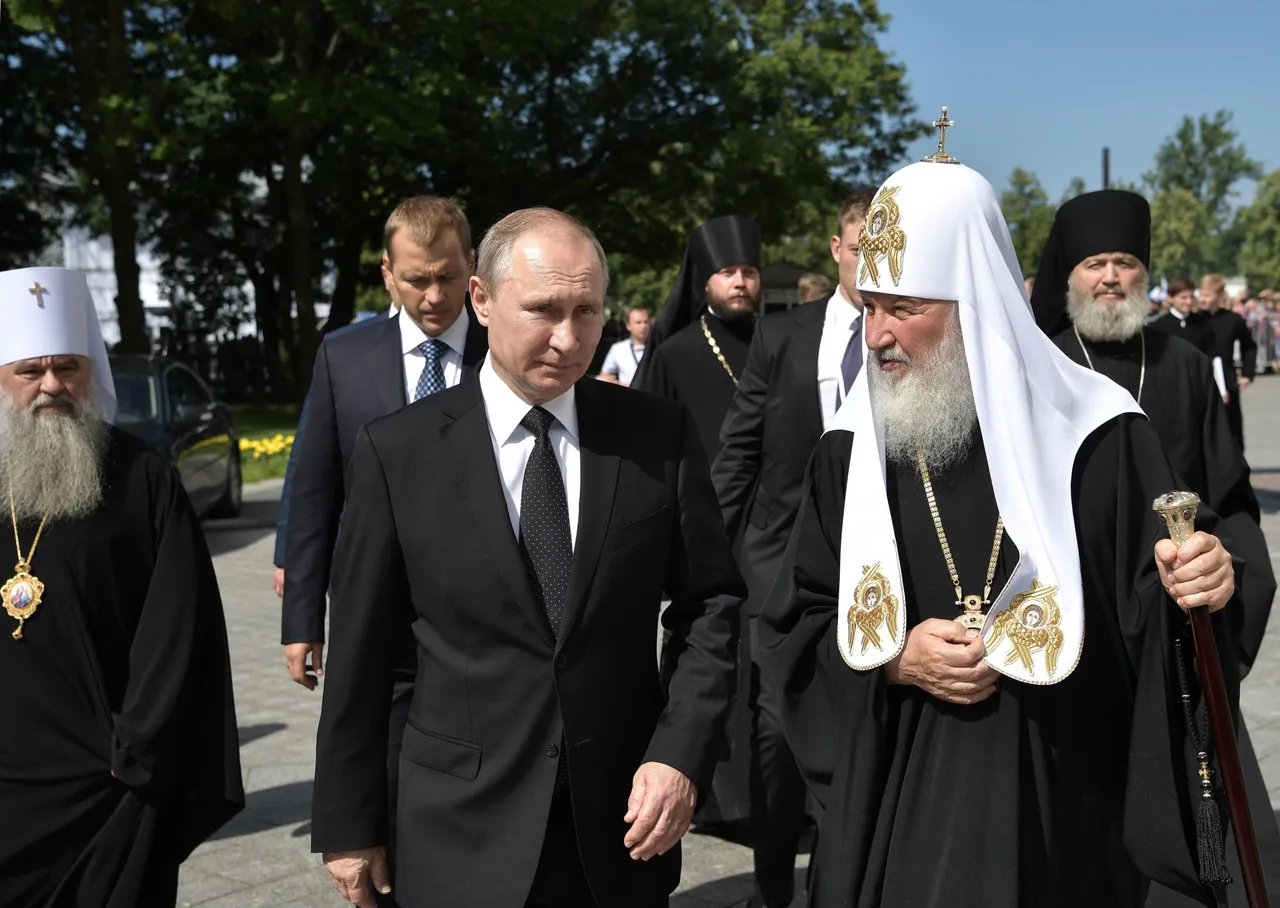
Russian President Vladimir Putin (L) and Russian Patriarch Kirill of Moscow visit a marine church during Navy Day in Saint Petersburg on July 30, 2017. (Photo credit ALEXEY NIKOLSKY/AFP via Getty Images)
Feodosii clarified that many elements of the liturgy, including who is prayed for, are left to the discretion of the local priest. Parishioners told the Caller that no propaganda for Russia or against Ukraine was preached in their church.
“Not a word is being said or told about the politics in our church. The church has nothing to do with politics. All we do is keep to the canons of the church. We worship God,” one parishioner said.
Metropolitan Arseniy (Yakovenko), head of the Sviatohirsk Lavra monastery, has been detained without bail since April 2024 over a 2023 sermon held during an important day of feast, according to his lawyers.
Arseniy highlighted checkpoints erected in the region in his speech, claiming they unfairly targeted UOC pilgrims, whom Ukrainian forces were informed would be arriving in the area to attend the vigil.
Arseniy was later arrested for the “dissemination of information on the movement or location of the Armed Forces of Ukraine or other military formations” for describing the approximate location of three nearby checkpoints, according to his lawyers.
“From what I’ve heard about him, he’s practically a saint,” a non-UOC Member of Ukraine’s Parliament, Georgiy Mazurashu, said. “In my opinion, his words didn’t indicate any sign of him giving up any positions. Back then, there were checkpoints in more or less every populated area. And [the fact that he was arrested and held – Ed.] is very strange to me.”
The prominent 57-year-old monk, whose health continues to deteriorate, remains in pre-trial detention in Dnipro and is subjected to “degrading and inhumane treatment,” according to his lawyers. He spent the summer of 2024 often taking 15-hour daily transfers for hearings in handcuffs without food or rest, his attorneys alleged.
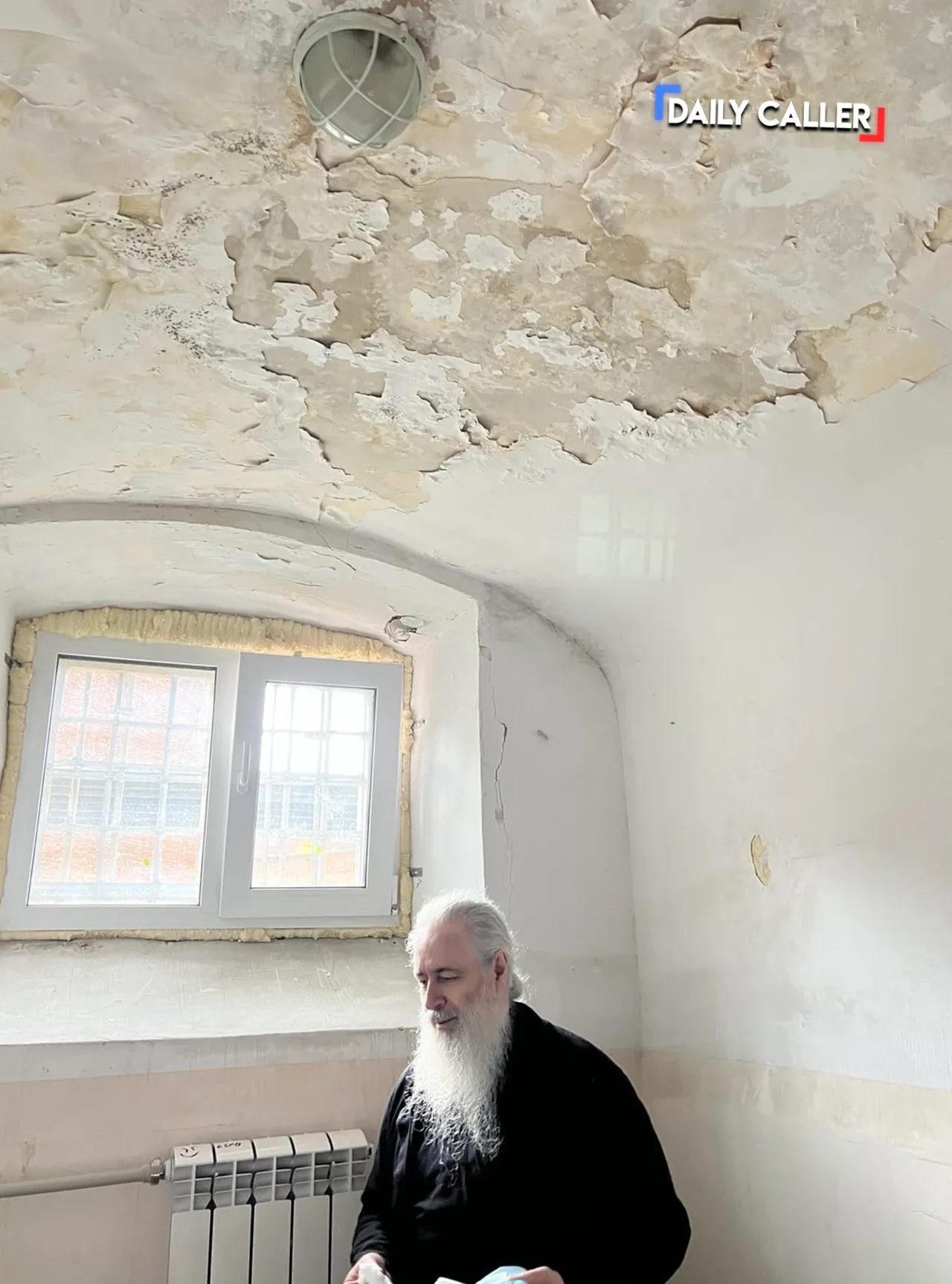
Metropolitan Arseniy, head of the Sviatohirsk Lavra monastery, has been detained without bail since April 2024 after allegedly sharing the approximate location of Ukrainian road blocks. Photo shows Arseniy at a detention facility in Dnipro, Ukraine where he shared the harsh conditions of his imprisonment. (Photo obtained by The Daily Caller)
“The authorities must surely know that we Orthodox of the Ukrainian Orthodox Church are Ukrainians. Banning our church brings us no nearer to peace or security. It only sows division,” Arseniy said, adding the church only strives to serve God, rather than any “secular power or politics.”
6/8 🧵Metropolitan Feodosii of Cherkasy told me he was injured during the cathedral seizures, lost his home, spent over a year under house arrest, and now faces prison—simply for keeping a link to the Moscow Patriarchate on his website. pic.twitter.com/uFvdw5xBsa
— Derek VanBuskirk (@DerekVBK) August 23, 2025
“I spent more than a year under house arrest, wearing [an ankle monitor]. Just because I reflected the religious ideas, criticizing the politics or the actions of OCU,” Feodosii said.
Feodosii described the OCU as “artificially constructed” to serve “the political interests of the government.” The OCU is receiving support from “those in power” to seize the property and parishioners from the UOC, he alleged.
Ukraine’s leadership “initiated” creation of the OCU with support from the Patriarch of Constantinople, a Harvard Ukrainian Research Institute report said.
The Ukrainian government has moved to enforce Bill No. 8371, citing the UOC’s alleged failure to fully comply with DESS’s recommendations.
The UOC is continuing to fight for its legal identity and property rights in Ukrainian and European human rights courts as it looks to the West for help.
7/8 🧵These signs were found hung on the doors of the UOC, they read:
— Derek VanBuskirk (@DerekVBK) August 23, 2025
“ATTENTION!!! This building houses the Russian Orthodox Church, supporters of the ‘Russian world’ who support the killing of Ukrainian citizens.” pic.twitter.com/FxlWceCUBE
The narratives surrounding the UOC’s relationship with the ROC have even made their way to the U.S.
In November, three Republican congressmen, led by South Carolina Rep. Joe Wilson, sent a letter — whose final draft was exclusively obtained by the Caller — to Attorney General Pam Bondi, warning that U.S. churches with historical ties to the ROC may be vulnerable to Russian intelligence influence.
The lawmakers urged the Department of Justice to examine whether Russia had sought to “recruit, leverage, influence, or otherwise compromise the independence” of those churches. (RELATED: Ukraine’s Holy War Comes To America)
Despite Russia’s own accusations of severe persecution of Ukrainian Christians, the Kremlin has compiled reports and pushed messaging portraying Ukraine’s “ruling regime” as a “neo-Nazi dictatorship,” citing its treatment of the UOC as evidence.
Framing itself as a pro-Christian, anti-fascist liberator, Russia has used this narrative to garner support from some Americans and has sought to make a peace treaty contingent, in part, on Ukraine’s willingness to adopt European Union rules on religious tolerance — despite what critics describe as clear hypocrisy.
Russia’s purely rhetorical defense of the UOC only reinforces skeptics’ beliefs about ties between Moscow and the church, while leaving UOC parishioners caught between the threat of Russian military force and the possibility of institutional liquidation by their own government.
“I feel that the events that have taken place here have reinforced my faith,” one parishioner told the Caller in the catacombs. “I understand that everything happens, as it is said in the gospel, people who suffer, according to Jesus Christ, will receive God’s kingdom.”