OAN Staff Brooke Mallory
4:40 PM – Friday, February 20, 2026
President Donald Trump issued a high-stakes ultimatum to Tehran, stating that he will decide within the next 10 to 15 days whether to launch military strikes against Iran. The warning comes as the U.S. military completes its largest regional buildup in decades, punctuated by the deployment of a second aircraft carrier strike group to the Middle East.
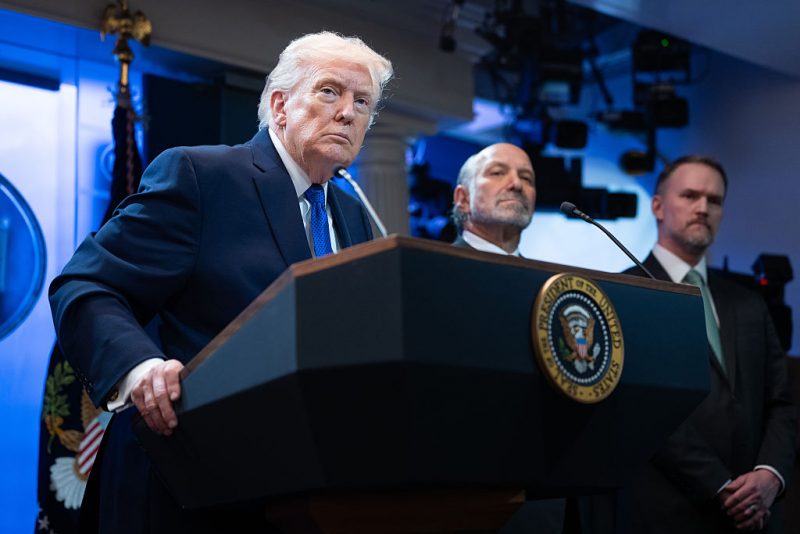
On Thursday, speaking at the inaugural meeting of the Board of Peace in Washington, D.C., the president combined a call for diplomacy with a blunt threat of force.
“We may have to take it a step further, or we may not. Maybe we’re going to make a deal. You are going to be finding out over the next, probably, 10 days,” Trump said on Thursday at a Board of Peace meeting. However, the president later clarified to reporters that it may be “10 to 15” days. Trump described the 15th day as “pretty much [the] maximum” timeframe for a deal or decision.
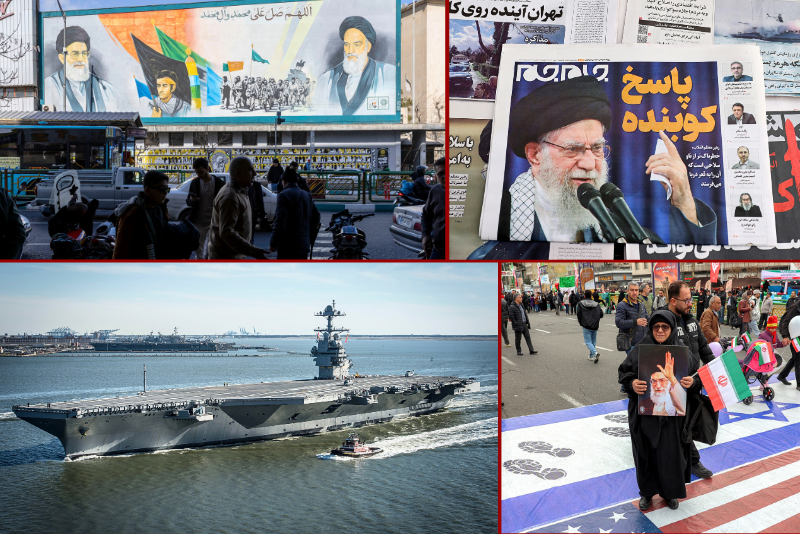
The Pentagon’s “maximum pressure” campaign against Iran has shifted from words to tangible naval power in the region. The USS Abraham Lincoln Carrier Strike Group is already fully operational in the Arabian Sea, where it conducts routine daily sorties positioned just south of Iran’s coastline — placing significant U.S. strike capability within close range amid the ongoing tensions.
A military sortie is a single operational flight by one aircraft, from takeoff to landing, used to measure operational tempo, with daily rates varying widely based on mission, unit, and conflict intensity.
President Trump also confirmed that the USS Gerald R. Ford, the Navy’s most advanced nuclear-powered carrier, is currently transiting from the Caribbean toward the region. Military analysts suggest the arrival of the Ford — expected within days — will provide the U.S. with the capacity to conduct several hundred strike sorties per day.
“In case we don’t make a deal, we’ll need it,” Trump noted this week, speaking about the second carrier. “It’ll be leaving very soon.”
The timeline follows a round of indirect, Omani-mediated talks in Geneva earlier this week. While Iranian Foreign Minister Abbas Araghchi claimed the parties had agreed on “guiding principles” earlier this week, White House Press Secretary Karoline Leavitt was more cautious, noting that the two sides remain “very far apart” on core issues.
The U.S. is demanding that Iran completely abandon uranium enrichment, dismantle its ballistic missile program, and cease the suppression of domestic protests — which have gripped the country since 2025. Unlike previous agreements that allowed Iran to enrich uranium to low levels, the U.S. is now demanding zero enrichment capability.
The Trump administration argues that as long as Iran has centrifuges spinning, it has a “breakout” path to a nuclear weapon. Iran has developed and deployed centrifuge models that can enrich greater amounts of uranium with fewer machines relative to its original IR-1 design, according to Iran Watch.
Additionally, following the International Atomic Energy Agency’s (IAEA) December 2024 report showing Iran had reached 60% and 90% enrichment (weapons-grade), the U.S. argues that Iran has forfeited its right to any domestic enrichment. By demanding a total shutdown, the Trump administration aims to remove the technical knowledge and infrastructure required to build a bomb, rather than just monitoring it.
The U.S. also wants a total halt to the development and testing of medium- and long-range missiles, including those capable of reaching Europe or the U.S. mainland. This was a major “missing piece” of the 2015 deal. In January 2025, intelligence reports suggested the IRGC had successfully tested a missile with a 3,000 km (1,864 mile) range.
The Trump administration views these missiles as the delivery vehicle for a potential nuclear warhead. By dismantling this program, the U.S. seeks to neutralize Iran’s primary tool for regional intimidation and its ability to strike U.S. bases or allies like Israel and Saudi Arabia.
Lastly, Trump is demanding an end to the “virtual martial law” and the internet blackouts that began on January 8, 2026, as well as the release of tens of thousands of political prisoners.
Amid horrifying death toll estimates from Iran’s brutal “January Massacres” — ranging from 3,000, per regime admissions, to as high as 20,000 or more according to independent sources and human rights groups — the U.S. is leading the charge to hold the oppressive regime accountable, using human rights advocacy to isolate a government that massacres its own people in a desperate bid to cling to power.
Trump has boldly declared that the United States is “locked and loaded” and fully prepared to stand with the Iranian people in their fight for freedom, seizing the unrest as an opportunity to demand sweeping reforms from the oppressive regime and pave the way for a more democratic, pro-Western government that respects human rights and promotes regional stability.
However, Tehran has since responded with a firm dismissal of the administration’s timeline, with Araghchi stating Friday that Iran “never accepts ultimatums” and that diplomacy cannot be conducted through “deadlines or pressure.”
While the Iranian delegation in Geneva continues to insist their nuclear program is intended solely for “peaceful, civilian energy,” Araghchi clarified that they are only willing to discuss “confidence-building measures” and guarantees — not the total suspension of enrichment demanded by Washington, D.C.
Most critically, the Iranian Defense Council has affirmed that its ballistic missile program remains a “sovereign red line” and is non-negotiable, characterizing the arsenal as an essential deterrent against foreign aggression.
The current tension follows the “12-day war” in June 2025, during which the U.S. and Israel conducted surgical strikes on Iranian nuclear facilities. This time, however, the scale of the buildup — which includes F-22 Raptors and B-2 stealth bombers — suggests the U.S. Department of War may be preparing for a more sustained campaign aimed at broader military and leadership targets.
Nonetheless, Iranian officials have reiterated that they will treat any U.S. attack as an act of “full-scale war,” threatening to target American bases and assets throughout the region if hostilities commence.
With the clock ticking, the world’s focus has shifted to the Persian Gulf to see if a “meaningful deal” can be salvaged or if the region will descend into the “unfortunate” conflict President Trump and Iranian leaders have both signaled. Additionally, as the USS Gerald R. Ford moves into position alongside the USS Abraham Lincoln, the U.S. has effectively surrounded Iran with a “massive armada,” officials emphasized.
Stay informed! Receive breaking news alerts directly to your inbox for free. Subscribe here. https://www.oann.com/alerts
What do YOU think? Click here to jump to the comments!