
Fortune 500 companies are waking up and understanding what time it is. It’s time for businesses to get back to business.
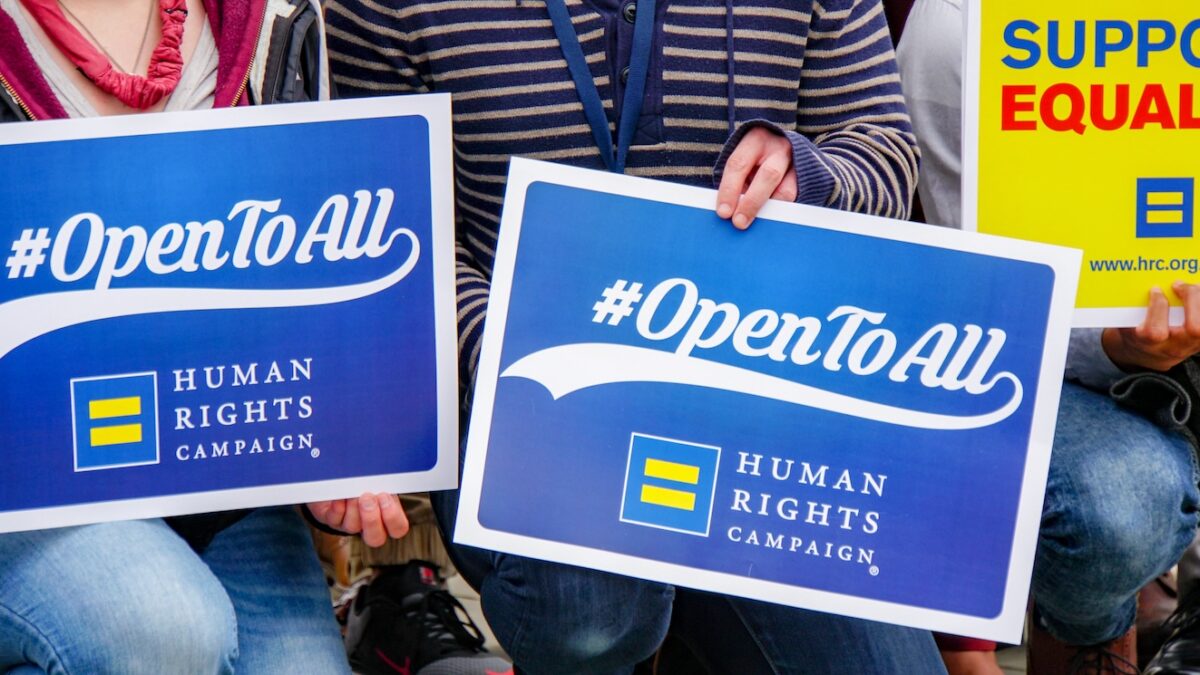
For years, corporate America has fallen all over itself to be applauded by activists like the Human Rights Campaign, falsely believing HRC’s approval meant they were doing something right and good for business. This year, hundreds of companies, realizing they’ve been led astray, marched the other way.
Participation in the Human Rights Campaign’s Corporate Equality Index (CEI) was once treated as all but mandatory for Fortune 500 companies. But 2026 marks a cataclysmic collapse for that assumption.
In 2026, HRC saw a dramatic 65 percent drop in Fortune 500 CEI participation from 2025. And the number of companies achieving the “perfect” 100 score dropped approximately 30 percent from roughly 750 to 534. That’s not a rounding error. It’s a rapid retreat. And it’s overdue. But why such a dramatic shift? Why now?
First launched in 2002, the CEI was sold for years as a simple “fairness” benchmark. In practice, it is a social credit scorecard designed to pressure companies into adopting a growing list of political and social positions that have little to do with running a business.
The CEI’s demands increasingly extended beyond “equal treatment” for HRC’s constituents. They now require active advancement of the most extreme ideological positions, including mandates that employers pay for controversial sex-denying drugs and surgeries for minors and adopt sweeping internal policies built around identity categories. And if a company donates to any cause not aligned with HRC, the company is punished by losing points on their CEI and with public shaming.
Yet for years, corporations complied because it was easier to check the boxes than to be harassed by professional agitators. Executives feared being publicly attacked and shamed for merely acting according to the supermajority values of the American public. No one wanted to be the first to say no.
Now many are saying “no” all at once, which doesn’t come as much of a surprise to 1792 Exchange. In numerous private meetings with corporate executives, alongside our partners at Bowyer Research, companies have been nearly unanimous in their decision to dump HRC. They’re tired of the perpetual arm-twisting and want to return their focus to shareholder returns and what’s good for all employees and customers.
HRC’s explanation for this mass exodus? They blame the current political climate. With a DEI-skeptical administration and regulators scrutinizing these programs, they say companies are pulling back from “transparency” and temporarily de-risking. That’s half-right.
Companies are thinking about the risks of associating with HRC. With the Supreme Court’s decision in Students for Fair Admission v. Harvard, which denounced identity-based admissions criteria, smart corporate lawyers saw this legal framework’s short step into the corporate world. Meeting HRC’s demands puts companies at risk of Equal Employment Opportunity Commission claims, lawsuits, lost business, and tarnished brands. The last thing these businesses need is for their CEI score to be “Exhibit A.”
But the real lesson is more fundamental: Corporations never should have been in the ideology business to begin with. Public companies exist to create value for customers, employees, and shareholders, not to be vehicles for social engineering or activists’ enforcement arms. The moment a company starts organizing its workforce around identity categories, political causes, or activist metrics, it stops focusing on its true purpose.
It also starts dividing its own people. Most employees don’t want to be “sorted” or told they are either privileged or marginalized based on traits that have nothing to do with job qualifications. They want fairness, a decent paycheck, and the chance to advance based on meritorious performance. Equal treatment is unifying. Group preferences are not.
The modern DEI-industrial complex, of which the CEI became a prominent part, corrodes something more important than quarterly earnings and brand capital. When corporations take sides in every cultural fight, they import the country’s political polarization into the workplace. Instead of being places where Americans of different backgrounds work together toward shared goals, companies become battlegrounds for the latest ideological crusade. That’s bad for business. It’s bad for employee morale. It’s bad for customers. And it’s bad for the country.
Walking away from activist scorecards is therefore more than a tactical retreat. It’s a chance for corporate America to rediscover an older, sturdier principle: Treat everyone well, follow the law, reward merit, and stay focused on the mission.
Companies that embrace this model won’t need an artificial index to prove their virtue. Their employees will know they’re judged fairly. Their customers will know the company is focused on serving them. Their shareholders will know management isn’t distracted by political theater and is acting in their best interest.
The collapse of support for HRC isn’t a step backward for “civil rights.” It’s one giant step forward toward sanity. Fortune 500 companies are waking up and understanding what time it is. It’s time for businesses to get back to business.