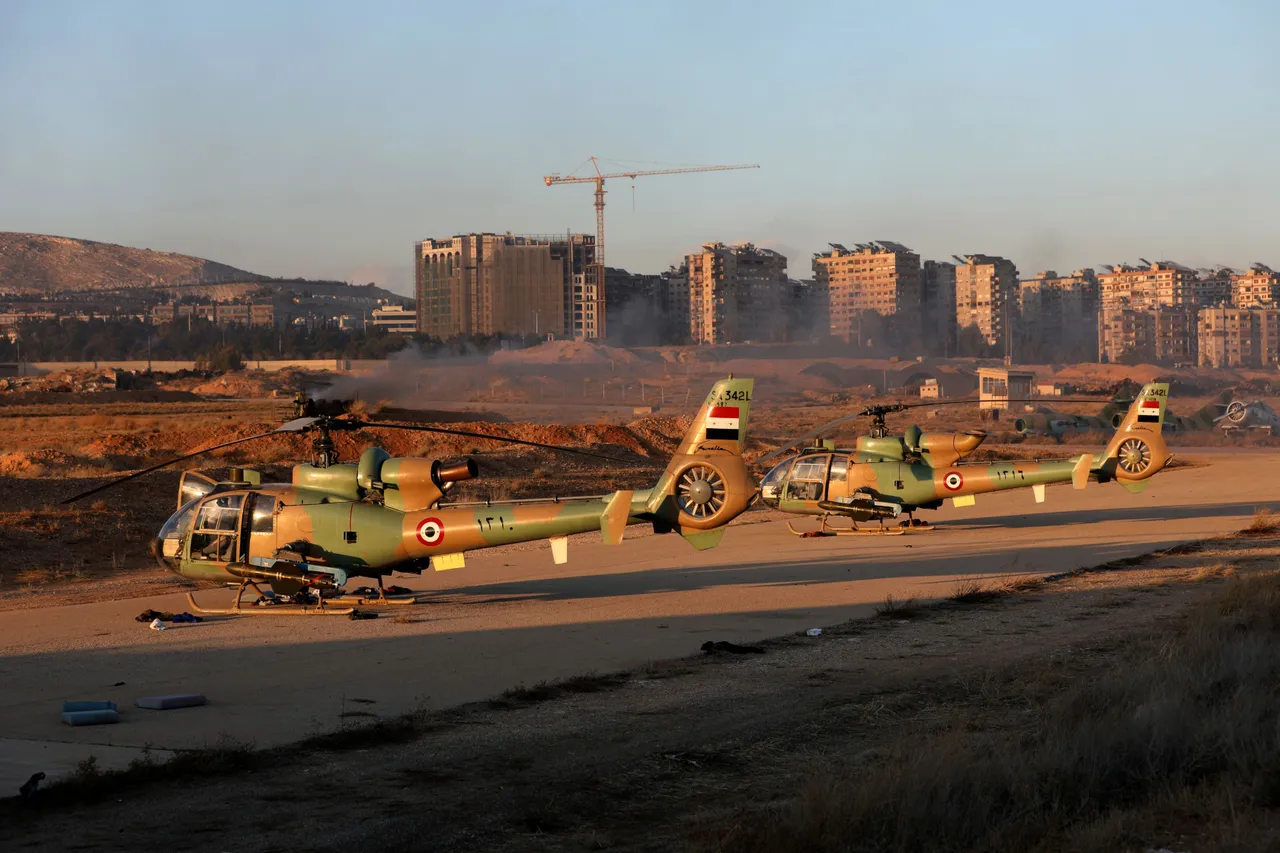
The U.S. military is preparing to establish a presence at an airbase near Damascus to help oversee a potential security agreement between Syria and Israel, Reuters reported Thursday, citing six sources familiar with the plans.
The proposed deployment would place American personnel near Syria's capital as President Donald Trump pushed for a security arrangement between the two longtime adversaries. However, Syrian officials disputed the reporting, according to the country's Foreign Ministry.
The facility would sit near portions of southern Syria expected to become a demilitarized zone under a possible nonaggression agreement with Israel, Reuters reported, citing Western and Syrian officials.
The White House did not respond to a request for comment. The Pentagon could not provide a comment before publication.

(Photo by Ali Haj Suleiman/Getty Images)
Trump first met Syrian President Ahmed al-Sharaa in Riyadh, Saudi Arabia, on May 14, 2025, shortly after announcing plans to lift American sanctions on Syria, according to a White House readout. (RELATED: Trump Moves To Legitimize Ex-Jihadist Leader's Regime)
During that meeting, Trump urged the Syrian president to join the Abraham Accords with Israel, expel foreign terrorists and help prevent an ISIS resurgence, according to the White House.
The meeting marked a dramatic reversal for al-Sharaa, a former al-Qaeda commander who previously led the Nusra Front, the terrorist network's Syrian affiliate, before breaking ties with al-Qaeda in 2016 and eventually leading Hay'at Tahrir al-Sham (HTS), according to the Center for Strategic and International Studies.
The State Department subsequently revoked the designation of HTS as a Foreign Terrorist Organization in July 2025, according to the Federal Register.
Trump later hosted al-Sharaa at the White House on Nov. 10, 2025, marking the first such visit by a Syrian president, according to official White House pool reports.
The two leaders met again on July 8, 2026, during the NATO summit in Ankara, Turkey, where Trump announced plans to remove Syria from Washington's list of state sponsors of terrorism, according to the State Department.
The Iran war has turned Syria into an alternative oil transportation corridor, allowing Iraq to move petroleum products overland to Mediterranean ports rather than through the Strait of Hormuz, according to the Syrian Petroleum Company.
Iraq initially contracted to transport approximately 650,000 metric tons of fuel oil monthly through Syria from April through June, Reuters reported, citing contracts awarded by Iraq's state oil marketer SOMO.
By late September, approximately 1,000 to 1,200 tanker trucks carrying Iraqi oil were crossing Syrian territory daily, according to the Syrian Petroleum Company. Syria had also begun moving imported gasoline in the opposite direction, delivering fuel from its Mediterranean coast to Iraq in exchange for transit fees.
The two countries have also agreed to pursue the reconstruction of the Kirkuk-Baniyas oil pipeline, potentially establishing a much larger export route between Iraq and the Mediterranean. The project would involve American energy company Chevron and other international firms, according to Syria's state-run SANA.
The Pentagon had accelerated preparations for the potential military presence during the preceding two months, conducting multiple reconnaissance missions to determine whether the installation could accommodate American aircraft, Reuters reported, citing a Western military official.
American C-130 military transport aircraft had already landed at the facility to assess runway conditions, while preliminary evaluations suggested the runway was ready for immediate use, Reuters reported, citing Syrian and Western officials.
The proposed mission would involve logistics, surveillance, aircraft refueling and humanitarian operations, according to two Syrian military sources cited by Reuters.
Syria would retain sovereignty over the installation, meaning American personnel would operate there without Washington assuming formal control of the facility, the sources told Reuters.
However, Damascus rejected the report following its publication. (RELATED: Dollar Signs Flash In Eyes Of Ex-Jihadist Leader's Regime As Iran War Forces Oil To Be Shipped By Land)
Claims about American military bases in Syria were "untrue," an unidentified Syrian Foreign Ministry official said, according to the state-run Syrian Arab News Agency.
The official nevertheless acknowledged that Damascus and Washington were expanding political, military and economic cooperation, while emphasizing Syria's sovereignty, according to the Foreign Ministry.
The Pentagon did not confirm the reported deployment, while an administration official declined to discuss specific military locations, Reuters reported.
The Trump administration initially hoped to announce an agreement during September's United Nations General Assembly, but negotiations encountered last-minute complications, Reuters reported.
Washington was also pressuring Damascus to reach an agreement before the end of 2025, potentially ahead of the Syrian president's visit to Washington, Reuters reported, citing a Syrian source.

(Photo by Ali Haj Suleiman/Getty Images)
U.S. Central Command Commander Adm. Brad Cooper and American envoy Thomas Barrack met with al-Sharaa in Damascus on Sept. 12 to discuss counterterrorism cooperation and regional stability, according to CENTCOM.
The discussions included combating ISIS and integrating Syrian armed factions into the country's military, although the American military's public statement did not mention Israel, CENTCOM said.
The potential Damascus deployment would also represent a departure from America's established military mission in northeastern Syria.
The Pentagon announced in April that it would reduce American troop levels in Syria to fewer than 1,000 personnel, citing progress against ISIS and a broader consolidation of its regional footprint, according to the Department of War.
Washington has maintained troops in Syria for years as part of operations against ISIS, including cooperation with Kurdish-led forces, according to Reuters.
The United Nations already maintains a peacekeeping mission along the Israeli-Syrian frontier under a disengagement agreement dating to 1974, according to UN Peacekeeping.
It remained unclear how many American troops would deploy, when they would arrive or whether the proposed arrangement would require a permanent U.S. presence, according to Reuters.
Source link