Propyl gallate's low profile does not mean the compound is unregulated. The U.S. Food and Drug Administration (FDA) maintains a list of substances "Generally Recognized as Safe" for use in food, according to NaturalNews.com [1].
The regulatory framework that governs it is the same framework that governs thousands of other direct and indirect food additives [2][3].
For shoppers, the practical question is not whether propyl gallate is authorized. It is whether the term belongs on a household avoid-list alongside BHA and BHT, two synthetic antioxidant preservatives that have drawn broader consumer attention [4].
What Propyl Gallate Is and Where It Appears
A NaturalNews.com report explains that propyl gallate is a type of ester formed by condensing gallic acid and propanol, appears as a white to light beige crystalline powder, and has a bitter taste that may be faintly odorous or completely odorless [5].
The compound does not dissolve in water but reacts with oxidizing agents, and it is incompatible with strong acids, bases, and reducing agents [5].
Its technical function is to slow fat oxidation, a chemical process that can cause off flavors, off odors, and shorter shelf life in foods containing oils or other fats [6]. The mechanism is well established in food science; propyl gallate is an antioxidant that protects against oxidation by hydrogen peroxide and oxygen free radicals [7].
Food science texts describe the broader problem the additive addresses: fatty foods and foods such as cakes and biscuits, which contain fat, are particularly prone to spoilage and become rancid or tallowy on keeping, a process caused by oxidation of the unsaturated fatty acid radicals in the triglycerides of which fat is composed [8].
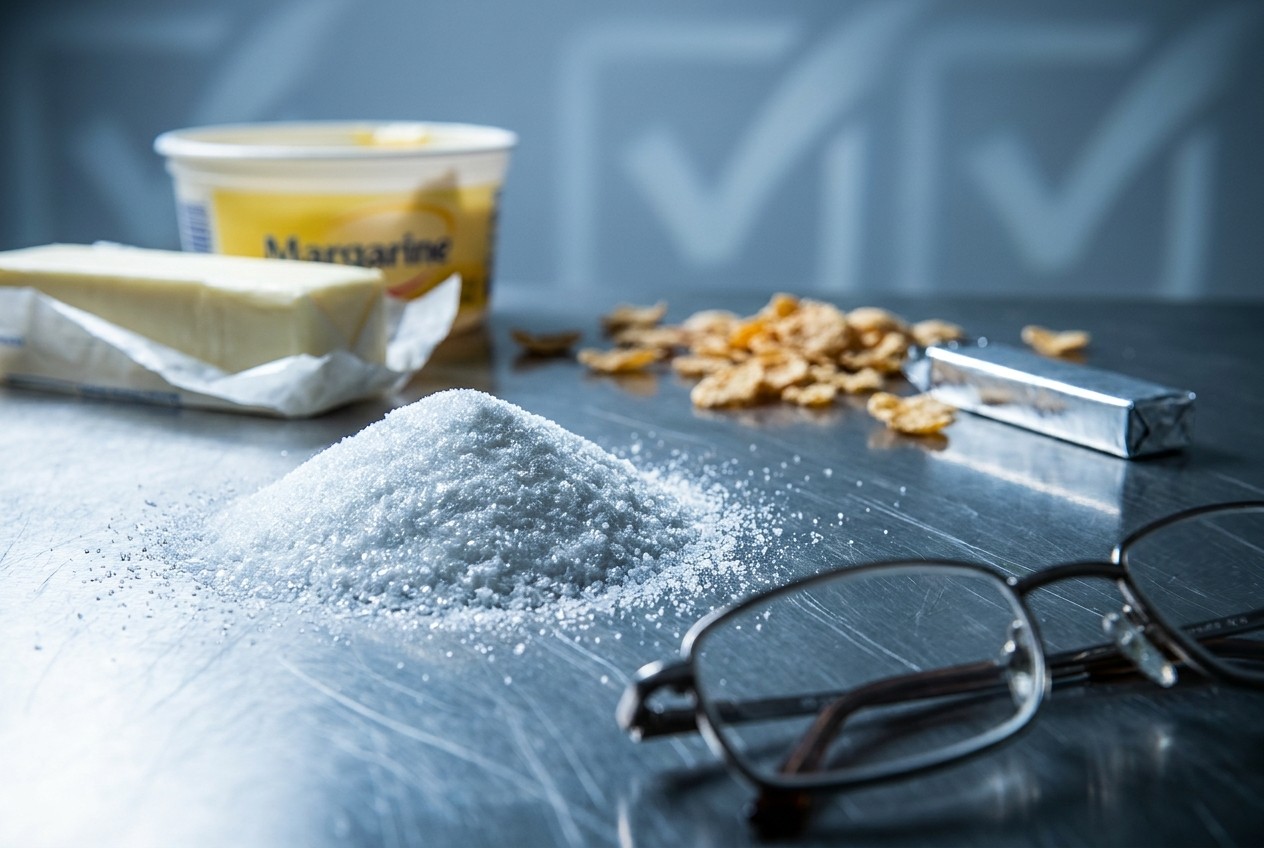
Author Deanna M. Minich lists oils, meat products, chicken soup base, butter, margarine, breakfast cereals, desserts, and chewing gum as products that may contain propyl gallate. She adds that the additive is commonly used in conjunction with BHA and BHT [9].
FDA Allowance and JECFA Review
A toxicology review on propyl gallate states that the compound is a synthetic preservative commonly used in food, cosmetics, and pharmacies as an antioxidant [10]. A separate 2025 paper in PubMed notes that propyl gallate is a common antioxidant used to keep fatty foods fresh and reports that it can trigger cancer cell death [11].
The wider regulatory context matters as well. The FDA maintains a list of substances generally recognized as safe, and public-interest reporting has examined how the GRAS framework operates [1].
NaturalNews.com has reported that more than 10,000 additives are allowed in food when direct additives and packaging migrants are counted together, a figure that underscores how difficult it is for consumers to track every compound individually [3].
Why It Is Overlooked and How It Differs From Other Antioxidants
The pattern is familiar to anyone who reads labels: some additives become shorthand for a category while others remain in the background.
Public-interest reporting has treated BHA and BHT as well-known antioxidant preservatives added to foods like cereal and gum, and a Mercola.com article on additives to avoid listed both compounds among a dozen terms worth subtracting from a diet [4][12].
That grouping reflects function more than identity.
Practical Label Checks and Conclusion
Those findings do not change the additive's legal status; they add context for consumers who want to know why the compound keeps drawing fresh scrutiny.
The broader takeaway is that propyl gallate rewards a specific kind of attention. It is a low-recognition ingredient that can be found with a scanner, or a careful read of the end of an ingredient list.
The compound is authorized, assessed, and regulated, and it remains one more term for shoppers to locate, understand, and decide about on their own terms.
References
- RFK Jr to axe FDA's GRAS loophole forcing scientific studies on a range of harmful food additives including these 43 additives - NaturalNews.com, March 13, 2025.
- EWG Releases Dirty Dozen Guide to Food Additi - Mercola.com, November 26, 2014.
- Analysis Confirms Chemicals in Food Are More - Mercola.com, June 10, 2015.
- 12 Food Additives to Avoid - Mercola.com, June 24, 2008.
- Propyl gallate sources health risks - NaturalNews.com, October 10, 2017.
- Propyl Gallate: Antioxidant Preservative on Food Labels. https://www.ingredicheck.app/blog/propyl-gallate-the-antioxidant-preservative-nobody-talks-about
- propyl gallate, 121-79-9. https://www.thegoodscentscompany.com/data/rw1034121.html
- Food science, nutrition and health. Fox, Brian A. (Brian Anthony)
- An A Z Guide to Food Additives: Never Eat What You Can't Pronounce. Deanna M Minich
- Pharmacokinetic and toxicological overview of propyl gallate food .... https://www.sciencedirect.com/science/article/pii/S0308814622031818
- Propyl Gallate's Evolving Story as a Metabolic Precursor .... https://pubmed.ncbi.nlm.nih.gov/41307530/
- 12 Food Additives to Remove From Your Diet - Mercola.com, July 14, 2009.
Source link