The woman in the photograph is beaming at the camera as though she has just got away with something.
She is propped up in a hospital bed with a newborn swaddled beside her and a masked nurse leaning in on either side, and she looks less like a patient than a woman who has won the raffle.
The newspaper cutting identifies her as Mrs Bernadette Dunne of Lissadel Road, Crumlin.
The baby is Louise Egan, the first child born in the new Coombe Hospital in 1967. A local business leader, Paddy Whelan, sent a Pedigree pram to mark the occasion.
The corridors still smelled new, and everyone on the ward wanted a hold of the first arrival.
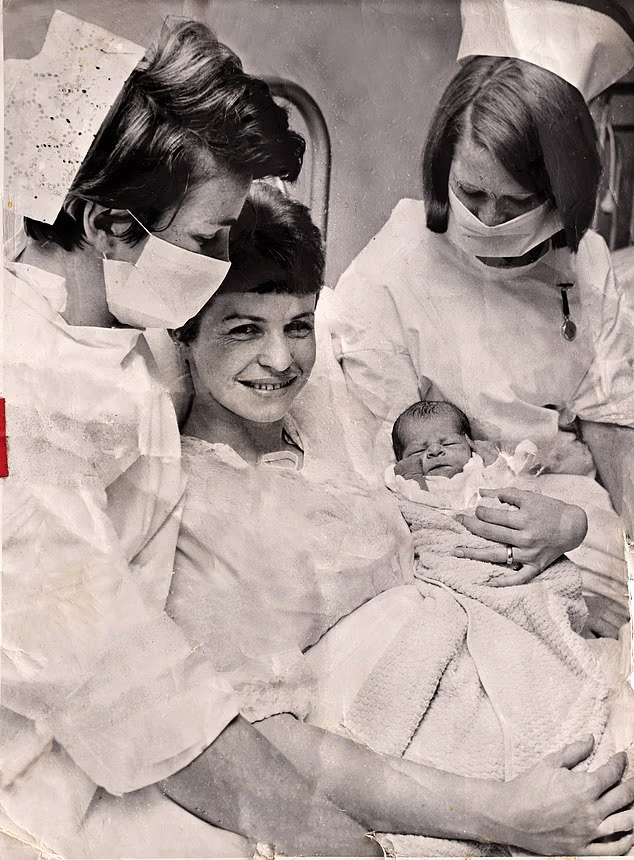
Bernadette Dunne with her baby Louise, the first baby born in the Coombe's new home in 1967
There is a remarkable amount of detail in the photograph and the accompanying report: the mother, the baby, the nurses, the address, even the man who donated the pram.
Yet go back 142 years before, to a snowstorm in Dublin, and the story begins with two women whose names were never written down.
In 1825, the Rotunda, on the northside of the city, was Dublin's only maternity hospital.
For a woman in labour in the Liberties, getting there could mean a long and dangerous journey, and many stayed at home rather than attempt it.
'There were two women from the Liberties going across to the Rotunda during a snowstorm,' says Professor Michael O'Connell, now Master of the Coombe. 'Both died.'
The hospital's own history is more cautious. One account records that a mother and baby perished together in the snow.
Whoever they were, nobody thought to write the names down.
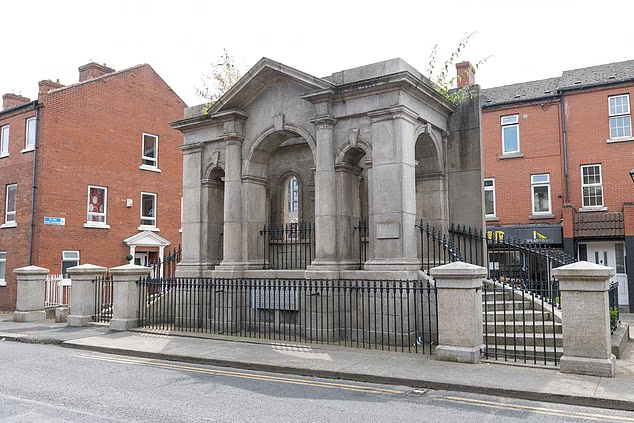
The Coombe portico from the hospital on its original site
There was a public outcry and a widow called Margaret Boyle decided something could be done.
Her late husband had been a Baggot Street merchant and she belonged to a very different world from the women who lived in the crowded streets of the Liberties.
Little else is known about her and no portrait has ever been found.
Mrs Boyle's 1831 will left the rents from two Merrion Square houses plus some debentures to the Coombe Lying-in Hospital, which was established 200 years ago, in 1826 – she had already given £100 toward its founding while she was alive.
The bequest was ongoing financial support so it could continue caring for poor women in labour in the Liberties.
The rents provided a steady income stream for the hospital for a number of years after her death and her name was carved above its original door.
Mrs Boyle's intention, O'Connell says, was to make sure women received 'some bit of dignity and respect'.
Last month, that hospital marked more than 743,000 deliveries in the 200 years since it was founded.
For most poor women in Dublin, however, childbirth remained much as it had been for generations.
They delivered at home, often on a birthing stool with a crescent-shaped opening cut into the seat.
Straw or rushes were spread underneath to absorb the mess and thrown out afterwards.
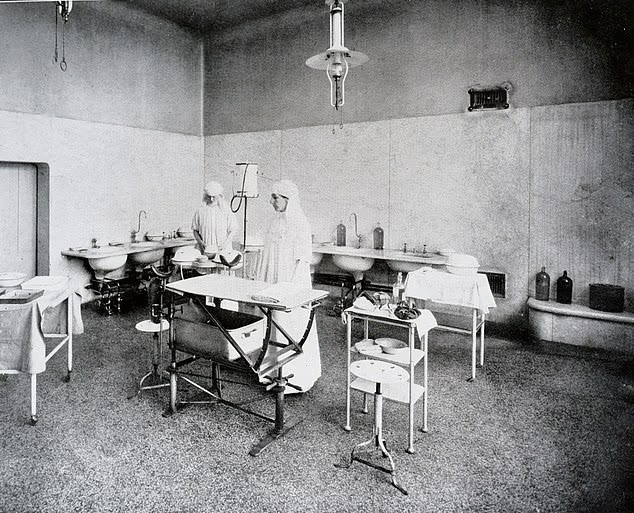
A sparsely supplied gynaecological theatre in 1926
A midwife's supplies might amount to vinegar, a flannel cap, scissors and thick thread.
In 1904, a young Scottish medical student spending a month at the Coombe recorded a mother lying on straw in a corner.
A police officer who had just broken up a fight was called upon to carry in the boiling water.
There was little in the way of pain relief and plenty of remedies rooted in superstition.
In 1849, William Wilde, Oscar's father, recorded the belief that everything in the house should be opened or undone to help the baby out.
Locks were unlocked, knots untied, doors and windows thrown open and cows released from their byres.
The practice was explained by 'occult sympathy' – what happened to the house would happen to the womb.
Women wore labour girdles and the cord of St Francis.
The knots in the umbilical cord were said to predict how many more children a woman would have.
During a contraction, nine articles of clothing, preferably belonging to a man, might be counted over her.
A few drops of opium offered some relief. Many women were also taught that their suffering was the punishment handed down to Eve.
That began to change when Queen Victoria took chloroform during the birth of Prince Leopold in 1853.
Its use became more acceptable, and women who experienced it were delighted.
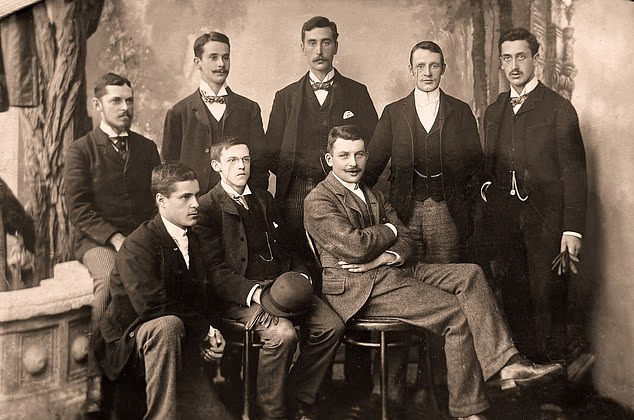
The Coombe's resident medical staff in 1891
More than a century later, the Coombe was still sending new mothers home with a small bottle of Guinness 'for the iron'.
Some old habits died harder than others.
For many women in Dublin, help arrived on a bicycle. In the small hours, a pebble might strike Bridget Minch's window, or somebody would shout from the street: 'Mrs Minch, she's in labour!'
Originally from Mayo, Ms Minch had lived in Philadelphia before returning to Ireland with three children after her husband died of tuberculosis.
She trained as a midwife at the Coombe and travelled around Dublin on a high-handled woman's bicycle, wearing a blue linen dress, white apron and navy cape.
Her Gladstone bag hung from the handlebars.
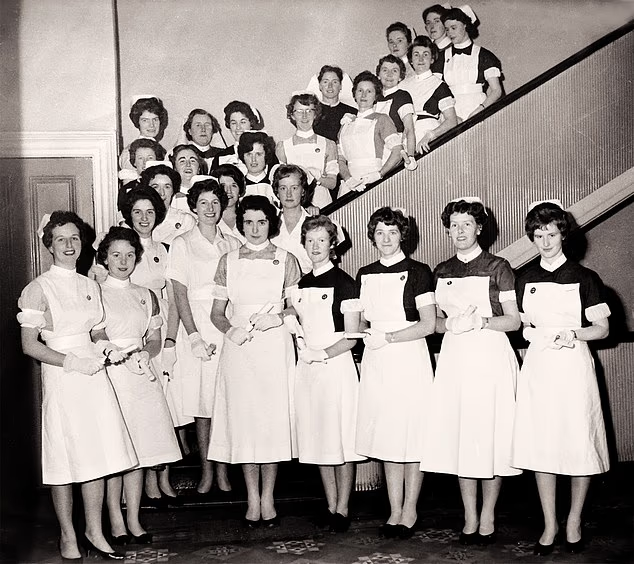
Staff nurses at the Coombe in the 1960s
The hospital's history records that she never lost a mother or a baby. On Sundays she stood as godmother at baptisms, still wearing her cape.
She belonged as much to the neighbourhood as she did to the hospital, summoned by a pebble at the window and trusted to arrive whenever she was needed.
Not every woman was so fortunate. Infection was one of the biggest killers, Professor O'Connell says.
Between 1928 and 1935, roughly one mother in every 181 who gave birth at the Coombe died. Eclampsia, which could bring on sudden and violent convulsions, was known as 'lightning'.
The Coombe's own figure for 2020 to 2023 was one maternal death in 31,063 births.
The arrival of penicillin in the early 1940s transformed the picture. According to the hospital's history, deaths from childbed fever were roughly halved.
'The graph is just stunningly amazing how quickly it comes down,' Professor O'Connell says.

Professor Michael O'Connell, Master of the Coombe. Photo: Patrick Bolger
During Covid, Professor O'Connell spent time going through the annual reports and found himself looking across the boardroom table at a portrait of the Master who had run the Coombe during the Spanish flu epidemic of 1918.
'I thought it's bad for us with Covid,' he says, 'but he had tenements, no vaccines, no good air conditioning.'
The reports mentioned that two or three members of staff had died of influenza, they said nothing about patients. 'I'm sure there were loads,' Professor O'Connell says.
The casebooks also recorded the extraordinary number of children some women bore.
In 1941, a 45-year-old gave birth to her 20th child at the Coombe, while a 38-year-old delivered her 14th.
Large families were commonplace, Professor O'Connell says, and the hospital's history describes the old 'Coombe Grande Multipara', for whom a home birth was a matter of pride and social obligation, as a figure now almost extinct.
The pressure on the hospital was immense. In 1965, with the wards full and stretcher beds in use, the Master refused to send women who had borne many children home early.
They needed, he wrote, 'a much longer well-earned rest'.
Four years later, a woman died during her 19th pregnancy. Her name, age and address were not recorded in the surviving account.
The hospital's history links her death to the growing case for family planning.
Contraception could not legally be bought over the counter in Ireland, despite the reality of women's lives.
In 1971, journalist Nell McCafferty travelled to Belfast by train with about 40 women to buy contraceptives.
They returned with condoms, contraceptive jelly and aspirin, which they presented as the Pill.
When customs officials tried to seize the goods, the women refused to surrender them. A crowd gathered, chanting 'Let them go!' They were allowed to leave.
By 1973, the Coombe had a family planning clinic.
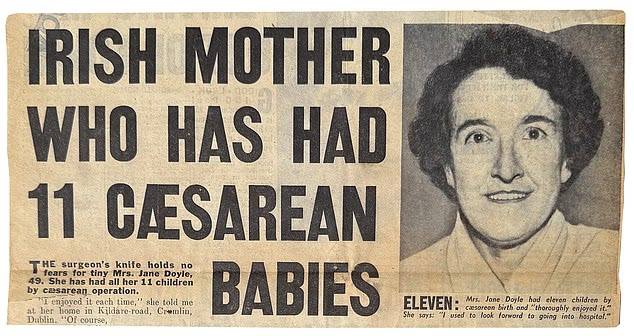
A newspaper report of a woman who had 11 children by C-section The arguments continued for years.
Professor O'Connell remembers a family planning clinic opening in Cork in the late 1980s, with protesters outside.
When he qualified as a doctor, a woman seeking sterilisation needed an ethics committee to approve it.
'It's very much now someone's choice, which is what it should be,' he says.
For some women, the difficulty was more immediate than having control over whether to become pregnant.
They arrived at the Coombe with almost nothing for the baby. In the early 1960s, a newspaper appeal carried the headline 'Wanted: 2,600 Layettes'.
Volunteers were needed to make baby clothes for mothers who had nothing ready for their newborns.
The hospital's records show that 51 unmarried mothers attended in 1960, with an average age of 22.
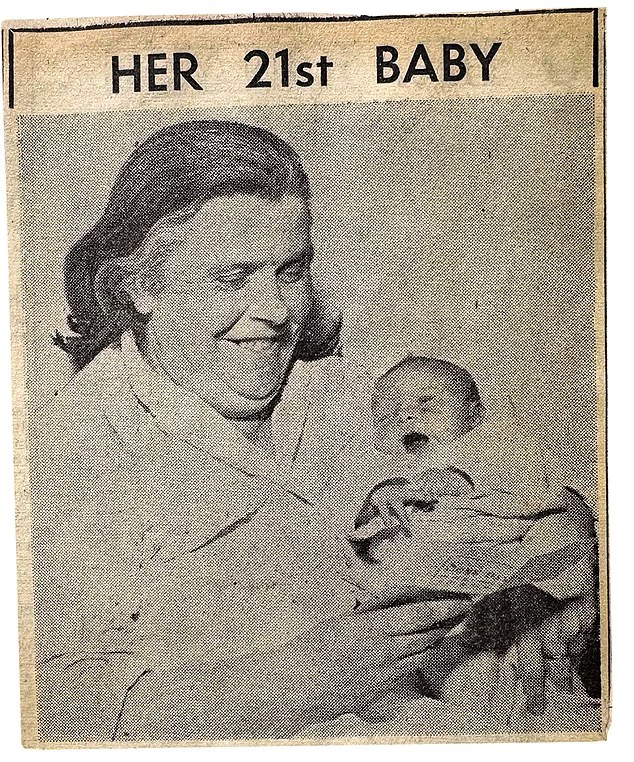
An unnamed mother with her 21st baby in the Coombe
Fathers were another matter. They were expected to wait elsewhere, usually in a pub.
'Go down to the pub next door and have a pint, and we'll call you when you need to come,' is how Professor O'Connell remembers the instruction.
He thinks it was the 1980s before fathers were allowed to stay with their partners.
By 2000, women born in 90 different countries were giving birth at the Coombe.
Some asylum- seekers assumed their older children could stay on the ward with them and were shocked to find they couldn't.
The housing crisis brought a different set of problems.
The hospital's 2014 annual report described families living in hostels and bed-and-breakfast accommodation without cooking facilities, travelling long distances so their children could continue attending school.
By 2016, some pregnant women and new mothers were sleeping in their cars and had nowhere suitable to take a newborn home to.
When Professor O'Connell began working as an obstetrician, a baby born at 26 weeks, perhaps 25, was at the limits of what doctors could save.
When Ollie Gomez arrived at 22 weeks and four days, weighing just 426g. His parents, a Brazilian couple living in Kildare, had buried a baby born at almost exactly the same stage the year before.
'He had a 5 per cent chance of survival and he survived,' says Daryl Hendley Rooney, a curator at the Little Museum of Dublin, which is marking the Coombe's bicentenary.
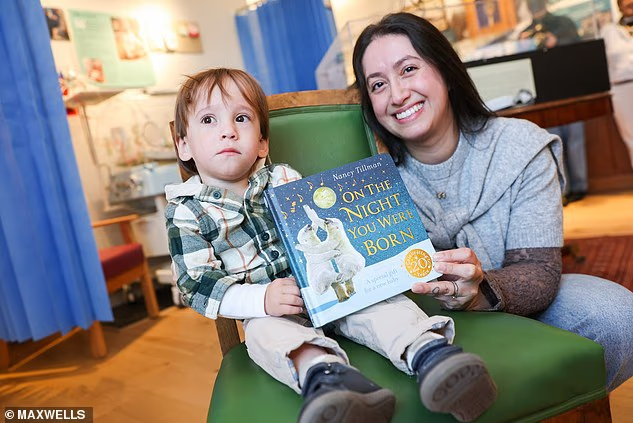
Ollie Gomez, who was born at 22 weeks and four days, and his mother Stefany
Ollie's father's response was characteristically simple: 'All he needs is a chance at life.'
In August, the baby who was never supposed to make it celebrated his second birthday.
Rooney knows the hospital from the other side of the story, too.
He was born at The Coombe, as were his three siblings, two of them prematurely.
He remembers visiting his baby brother in the neonatal unit in 2000 and seeing him in the isolette, tiny as he was.
Birth stories, Rooney says, 'can be profoundly heartbreaking as well'.
Around 6,500 babies are born at the Coombe each year.
Some families return generation after generation, sisters deliver their babies there, and children grow up knowing they were Coombe babies.
In 2017, Louise Egan returned to the hospital, 50 years after her birth, to raise the flag for its anniversary. Her mother Bernadette stood beside her.
In the old photograph, Bernadette has a nurse on either side of her bed and a pram waiting for her daughter.
The two women who set out for the Rotunda in 1825 but never made it inspired the setting up of the Coombe as we know it today.
We know the name of the man who gave Bernadette's baby her pram, we still do not know theirs.
Source link