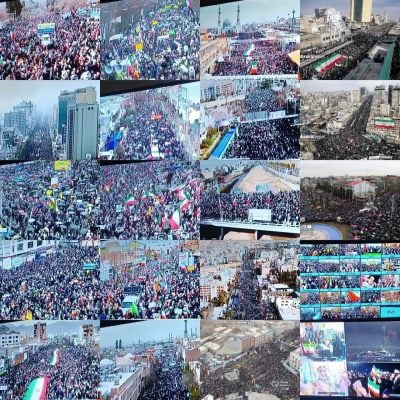
Millions take to the streets across Iran to celebrate the 47th anniversary of the Islamic Revolution and reject the ongoing threats of military intervention.
To read this article in the following languages, click the Translate Website button below the author’s name.
Farsi, Español, Русский, 中文, Portugues, Français, عربي, Hebrew, Deutsch, Italiano, 日本語, 한국어, Türkçe, Српски. And 40 more languages.
🇮🇷—Aerial views show the unique presence of people in Isfahan pic.twitter.com/Ws7t6qUq2C
— Sprinter Press (@SprinterPress) February 11, 2026
The gigantic turnout is a striking display of unity and defiance, in the face of the increasing threats of military action by Israel and the United States.
.
.
To understand the anniversary’s significance, it is necessary to revisit what led up to the revolution 47 years ago.
The Islamic Revolution was a response to the tyrannical and corrupt, Western-backed Imperial State of Iran, led by Shah Pahlavi, whose rule banned trade unions, opposition parties and independent media, and whose brutal “secret police force created with CIA assistance and trained by Mossad,” — known as SAVAK — had:
tortured thousands of political prisoners using methods including whipping, electric shocks, nail-pulling, mock executions, and sexual violence. A former SAVAK torturer testified in court that he had personally tortured hundreds, describing routine use of whips, electric prods, and forced confessions under extreme duress. Amnesty International’s 1976 report catalogued widespread use of the bastinado, boiling-water enemas, and acid drips, confirming systematic state terror designed to crush any opposition.
In the year leading up to the dictatorship’s collapse, Iran was gripped by protests and months-long strikes, where an estimated 10,000 people were killed.
During this time, in January 1979, Pahlavi reportedly left Iran for “medical treatment” in the U.S. and appointed Shapour Bakhtiar to head a provisional government in his absence. Days after he left, The Washington Post published a report claiming Pahlavi left the country with a staggering $20 billion of the nation’s wealth.
Long before Pahlavi’s departure, Islamic scholar and teacher, Ruhollah Khomeini, was a longtime critic of the Shah, who opposed his foreign-dominated rule, reform policies, corruption, and “capitulation” to U.S. dictates, such as the signing of a Status of Forces Agreement (SOFA), which granted U.S. military personnel diplomatic immunity in Iran.
Khomeini’s outspoken opposition led to his arrest, detention and eventual exile to Turkey, Iraq, and later, France. From abroad, Khomeini continued to urge for strikes, mass protests and the overthrow of the monarchy.
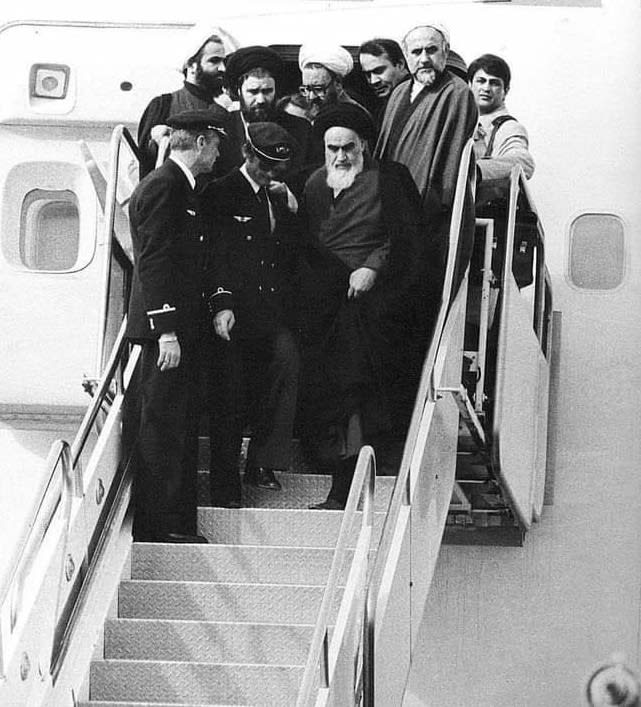
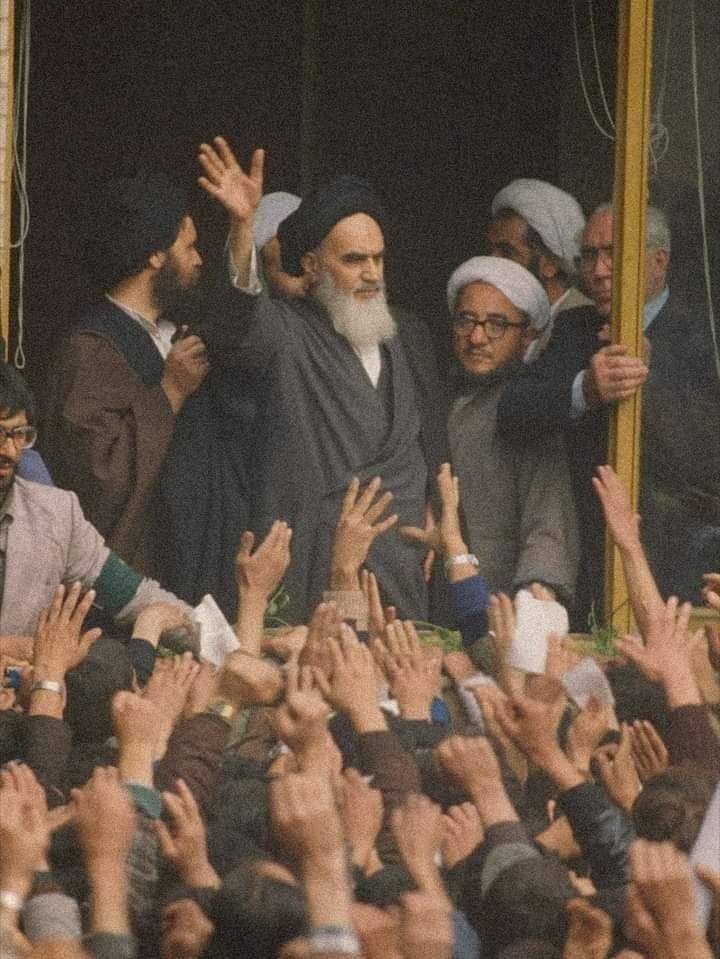
As soon as Pahlavi’s left, Khomeini supporters in Iran urged for his return and he arrived home two weeks later to crowds numbering in the millions.
.
.
Khomeini’s movement quickly gained momentum and resulted in the collapse of Bakhtiar’s interim government.
On February 11, 1979, Khomeini declared the formation of a provisional government and at the end of March, a referendum was held on whether to replace the monarchy with an Islamic Republic.
Over 90% of Iranians voted in its favour and Khomeini was later appointed the country’s Supreme Leader. He would lead Iran for the next decade, until his death, from cancer.
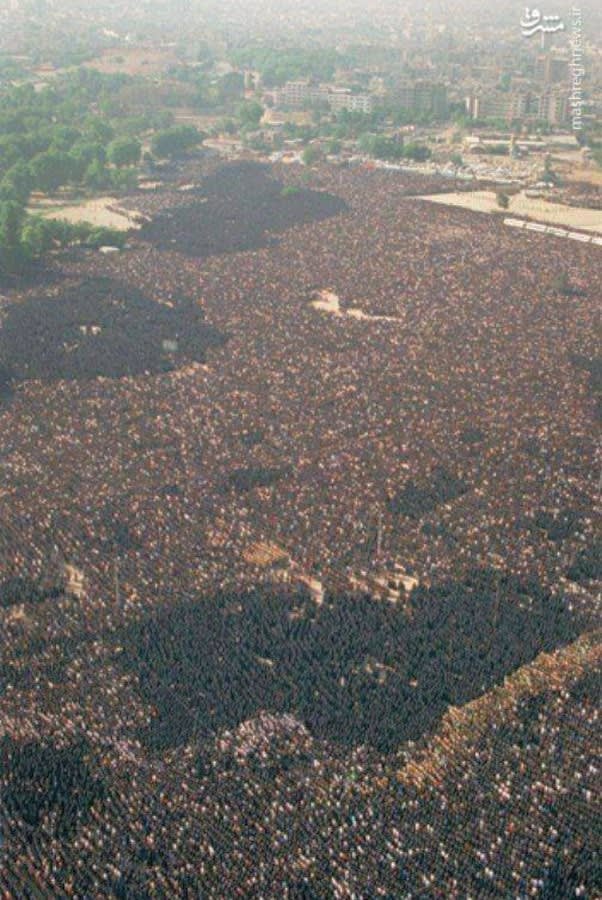
Khomeini’s popularity drew over 10 million mourners to his funeral — one sixth of Iran’s population at the time — and earned a place in the Guinness World Records for having the largest percentage of a population in attendance:
.
.
Today, almost five decades later, Khomeini’s legacy and revolution continues to mobilise millions onto the streets to assert and defend their sovereignty.
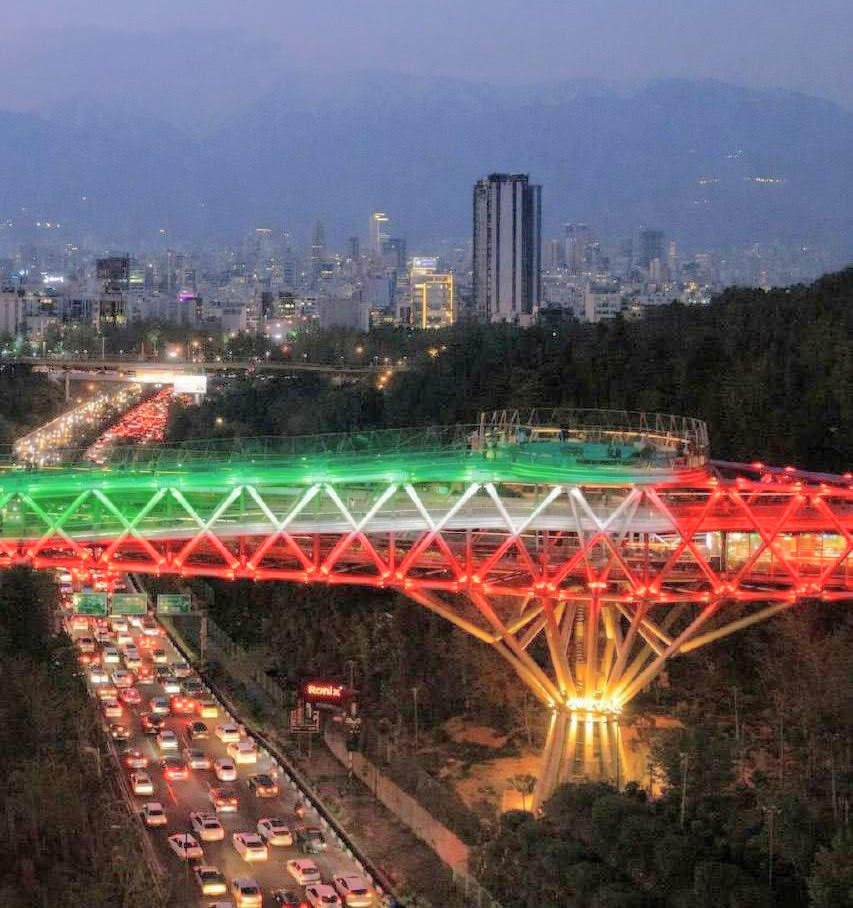
Azadi tower in #Tehran lit up in the colors of the Iranian flag on eve of anniversary of Islamic Revolution victory. pic.twitter.com/zjgZNKFl7u
— Hamdan News (@HamdanWahe57839) February 11, 2026
.
.
"National power is more related to the will and resilience of nations than to its missiles"
— Press TV 🔻 (@PressTV) February 9, 2026
In a message ahead of victory anniversary of Islamic Revolution, Ayatollah Khamenei said the Iranian nation will disappoint its enemies through a massive street presence on February 11th. pic.twitter.com/puBTlG0UK6
Khamenei called on Iranians to “disappoint the enemy” through solidarity, during a critical moment for Iranians, following last month’s Western-backed riots in the country (which were met with millions-strong counter-protests.)
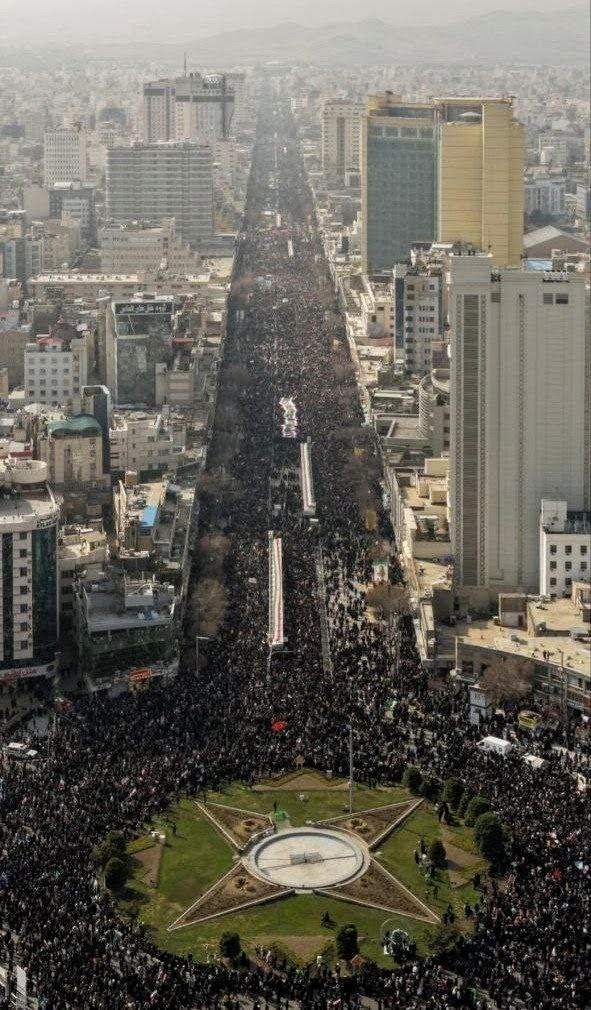
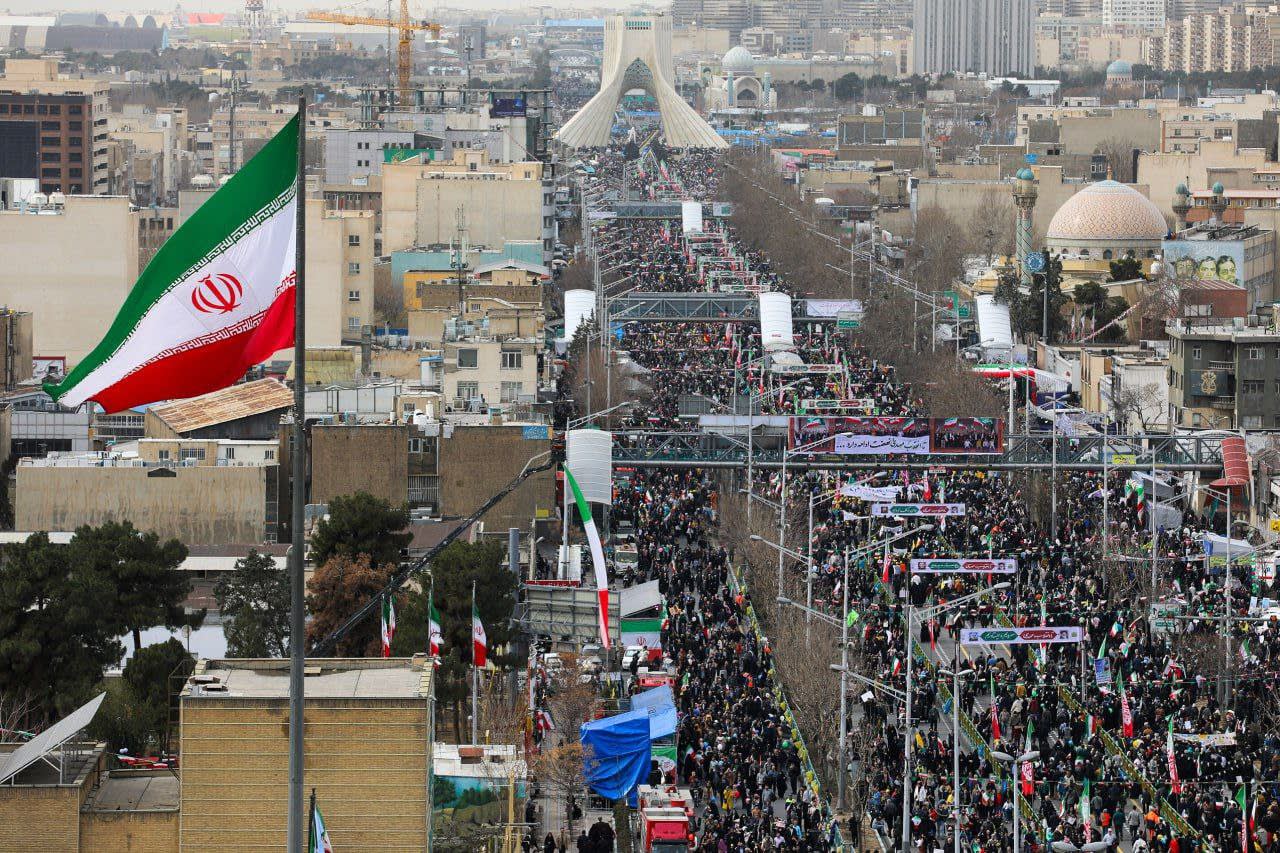
🇮🇷 Aerial view of Enghelab Street in Tehran massive crowds fill the capital as Iranians mark the 47th anniversary of the Islamic Revolution (22 Bahman).
— Abebe Samson (@AbebeSamson1) February 11, 2026
Reports claim around 4 million people took part in today’s events in Tehran alone. pic.twitter.com/aXGdffugjj
.
.
Protests were composed of people from all sectors of society, including workers, farmers, families, students and academics.
VIDEO | "As long as people like me in Iran exist they can't even dream of coming to Iran."
— The Cradle (@TheCradleMedia) February 12, 2026
An Iranian lawyer and social worker attending yesterday's massive gathering in Tehran, celebrating the anniversary of the Islamic Revolution, explains why, despite being critical of the… pic.twitter.com/J1ScmJCVsK
This is Iran👇🏻 This is what the Islamic Revolution taught the proud Iranian people:
— Marwa Osman || مروة عثمان (@Marwa__Osman) February 12, 2026
"We are all struggling. We are all burdened with debt, with rent to pay... yes, we are all struggling. But let everyone know this: despite all the economic hardships we live under, we do not… pic.twitter.com/BFsZOCyLwn
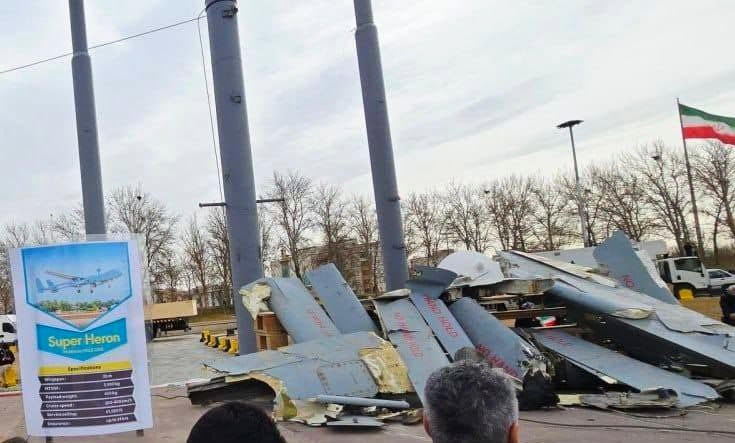
In Tehran’s Azadi Square, military hardware was on display, making visible some of Iran’s deterrence against attacks. This included tanks, armoured personnel carriers, satellites, ballistic and cruise missiles and UAV drones.
The remnants of Israeli drones — downed by Iran during attacks on the country last year — were also on display.
.
.
President Masoud Pezeshkian, along with senior politicians, military commanders and generals, marked the anniversary with speeches defending the revolution and its legacy. Pezeshkian said, “Iran will not back down to their injustices and aggressions.”
🇮🇷⚡️- Chants of Death to America and Israel in Tehran's Azadi Square. pic.twitter.com/sTSvrmKhmG
— Monitor𝕏 (@MonitorX99800) February 11, 2026
One participant at the demonstrations, speaking about the potential of another hot war with Israel said, “Definitely this time, all their bases must be hit. This time, a stronger response must be given so that they will not dare to come near and act against our country again.”
Yes, I walked the entire rally in Tehran without a hijab and guess what happened? Absolutely nothing. There is evidently more of a relaxed tone around hijab- I experienced it for myself. pic.twitter.com/YdhEVr3LwY
— Bushra Shaikh (@Bushra1Shaikh) February 12, 2026
Speaking about the demonstrations, Henningsen added:
If this was the story, it would transform Western public opinion and would force politicians to reevaluate the stereotypes of the Islamic Republic of Iran, but they will never do that because that has geopolitical implications and it goes against the regime change plans. All of that hinges on narratives.
Laith Marouf of @TVFreePalestine recounts what he observed firsthand at the mass rallies marking the anniversary of Islamic Revolution.#IR47
— Press TV 🔻 (@PressTV) February 12, 2026
Follow: https://t.co/B3zXG74hnU pic.twitter.com/3veSCH7IC7
*
Click the share button below to email/forward this article. Follow us on Instagram and X and subscribe to our Telegram Channel. Feel free to repost Global Research articles with proper attribution.
Our thanks to CRG Research Associate Mark Taliano for bringing this article by Naila to our attention.
All images in this article are from the author
Global Research is a reader-funded media. We do not accept any funding from corporations or governments. Help us stay afloat. Click the image below to make a one-time or recurring donation.