Protesters have been banned from using instruments or banging objects to make noise at an upcoming march to the Iranian Embassy, police have said.
Conditions have been posed on Saturday's demonstration in central London to 'prevent serious disruption' and 'limit disturbance' to local residents, according to the Metropolitan Police.
In a post on social media on Friday evening, the force said demonstrators were due to march from Whitehall to the Iranian Embassy in Westminster on Saturday afternoon.
No 'amplified noise equipment' for speeches or music, instruments may be used and banging 'other objects' to 'create noise' has been banned, according to the force.
It comes after police said it would 'intervene decisively' to stop criminal behaviour at the embassy where protests have been held for weeks.
Demonstrators have repeatedly scaled the building, toppling its flagpole, and officers have faced violence, Scotland Yard said in January.
The protests started after an uprising in Iran against Supreme Leader Ayatollah Ali Khamenei's rule was brutally suppressed, with hundreds of people killed and thousands detained.
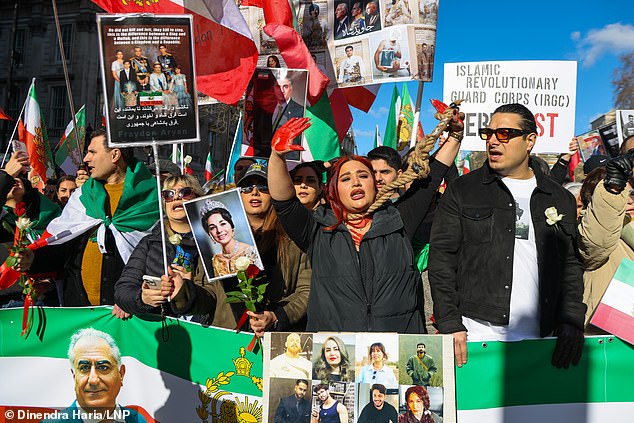
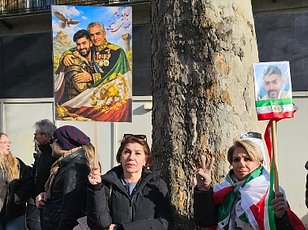
Droves of demonstrators on February 14 who gathered in central London to march to the Iranian embassy and protest against the regime
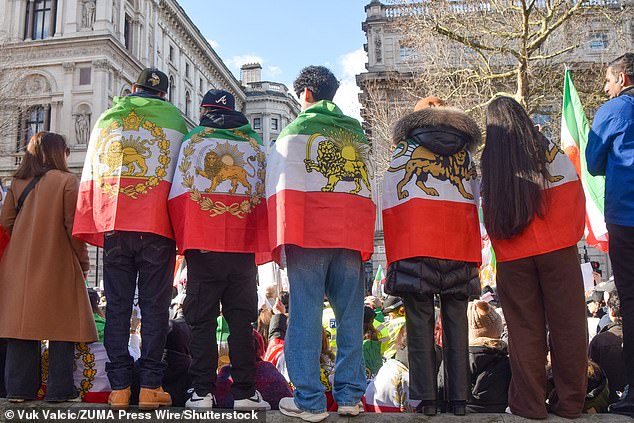
Many demonstrators were seen carrying Union Jacks, Israeli flags, and the Shahist flag of Iran , containing a lion holding a sword as they gathered at Whitehall. Pictured: February 14, 2026
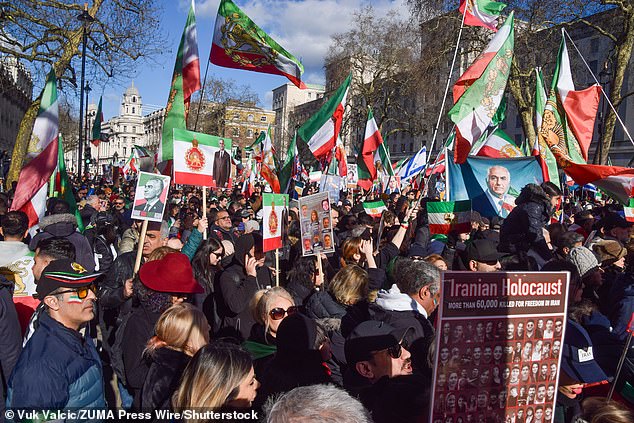
According to US-based Human Rights Activists News Agency, at least 7,008 people, mostly protesters, were killed in the crackdown, though rights groups warn the toll is likely far higher. Pictured: February 14, 2026
The Met said: 'A protest against the Government in Iran will take place tomorrow afternoon, marching from Whitehall to the Iranian Embassy.
'We've imposed Public Order Act conditions to prevent serious disruption.'
'The post-march rally must finish by 5.30pm with everyone dispersed by 6pm,' the force added.
'No amplified noise equipment can be used for music or speeches.
'Instruments may not be used and other objects must not be banged to create noise.
'This is to limit the disturbance to people living nearby.'
As part of the conditions, participants must remain on a defined route stretching from near Downing Street, down Pall Mall and along Piccadilly.
Last month, police violently clashed with protesters outside the Iranian embassy in London after an activist climbed the building and took down the Islamic Republic's flag.
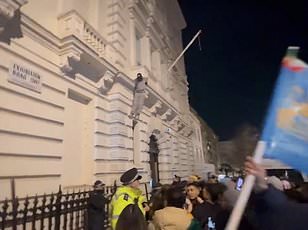
Dramatic footage showed a man perched on the balcony of the embassy while fellow protesters chanted slogans and wave flags on the ground below.
The man suddenly jumped off the ledge, prompting baton-wielding officers to surround him when he reached the ground.
In response, protesters appeared to lunge towards a group of cops, unleashing a violent clash as police used their clubs to fend off demonstrators.
Some activists were seen being crushed among the chaos, while others are toppled to the ground.
Two police officers were then seen dragging the man away from the scene, while protesters continued to pounce on cops.
Amidst the chaos, the two officers were pulled onto the ground, with one cop seen falling on top of the man.
Protesters continued to shout at officers, while some members of the police told them to 'get back'.
A spokesperson for the police force said at the time: 'During the ongoing protest at the Iranian Embassy this evening, a protester illegally accessed private property and climbed across multiple balconies onto the roof of the Embassy and removed a flag.
'He has since been arrested by officers on suspicion of criminal damage, trespass on diplomatic property and assaulting police.
'A section 35 order has been imposed as a result of ongoing disorder, including missiles being thrown at officers. Several officers have suffered injuries.'
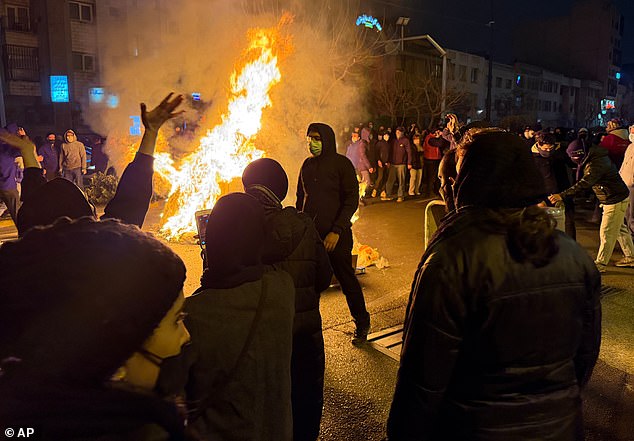
More than 3,400 people have been killed by Iranian security forces since the outbreak of protests last month. Pictured: Iranians attend an anti-government protest in Tehran, January 9, 2026
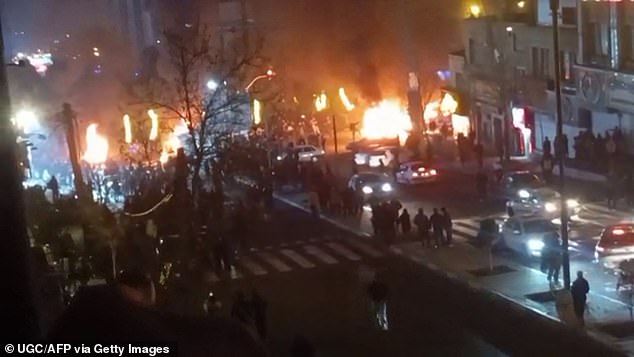
This video grab taken on January 14, 2026 from UGC images posted on social media on January 9, 2026 shows cars set on fire during a protest on Saadat Abad Square in Tehran
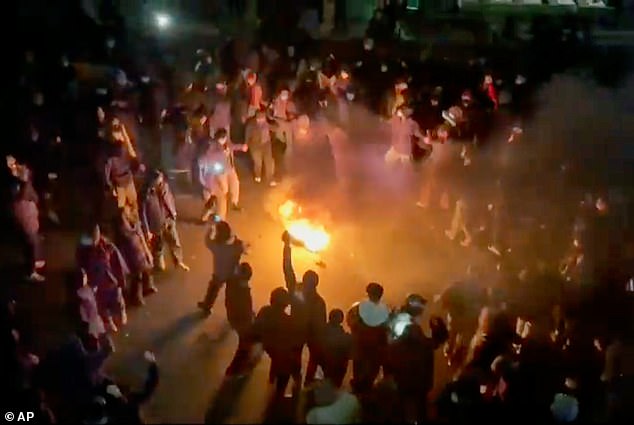
Pictured: Protesters dancing and cheering around a bonfire as they take to the streets to protest against the Islamic Republic
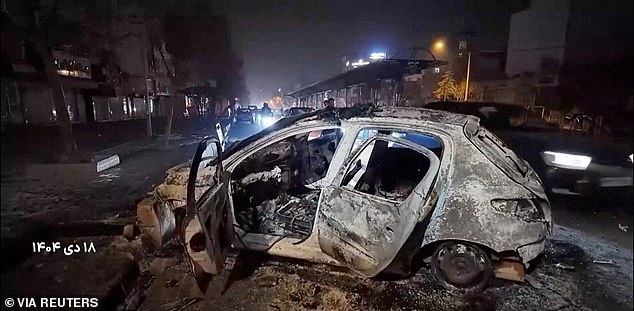
A burnt car lies on the road following unrest sparked by dire economic conditions, in a place given as Tehran, Iran, January 10, 2026
More than 3,400 people have been killed by Iranian security forces since the outbreak of protests in December, according to the human rights organisation Iran Human Rights (IHRNGO).
The unrest, sparked by dire economic conditions, posed the biggest internal challenge to Iran's rulers for at least three years and has come at a time of intensifying international pressure after Israeli and US strikes last year.
The protests began on December 28 over the fall in value of the currency and have grown into wider demonstrations and calls for the fall of the clerical establishment.
Iran's authorities took a dual approach, cracking down while also calling protests over economic problems legitimate.
So far, there are no signs of fracture in the security elite that could bring down the clerical system in power since the 1979 Islamic Revolution.
Britain, France, Germany and Italy all summoned Iranian ambassadors in protest over the crackdown.
US president Donald Trump is weighing fresh military action against the Islamic Republic, with a second US warship moving into the region and warnings that he could go ahead if no deal on its nuclear programme is reached.
This week, the Times reported Mr Trump had withdrawn is backing for Sir Keir Starmer's Chagos Islands deal because he has not received UK approval to use its military bases for a US strike on Iran.
The Iranian embassy in west London was the site of a famous siege in 1980 when six armed men took 26 people hostage.
The hostage-takers were Iranian-Arabs campaigning for the sovereignty of Khuzestan, a province in the south west of the country.
SAS soldiers stormed the embassy in 17 minutes on day six of the siege.
They rescued all but one of the hostages, killing five of the six hostage-takers in the process.