A convicted child rapist has failed in a bid to escape paying more than $700,000 to the man he abused as a child after a judge ruled his extraordinary argument about a model train set had virtually no prospect of overturning the award.
John Paul Garay, who was jailed in 2022 over the sexual abuse of Artem Kovalenko (a pseudonym) in the 1980s, argued key parts of his victim's account could not be true because a train set described in the evidence didn't exist at the time of the abuse.
But Justice David Mossop dismissed the appeal attempt, finding Garay's prospects of success were 'negligible' and ordering that his application be thrown out - with costs.
The dispute centred on two abuse incidents recalled by Mr Kovalenko, who told the court he had watched Garay working on a train set in the garage of his Canberra home before being sexually assaulted.
Garay argued photographs, diary entries, business records and film negatives showed the train set was not built until 1989 or 1990, years after the alleged abuse.
He claimed this proved his victim had fabricated the account and argued the entire $704,836 damages award should be overturned.
In submissions to the court, Garay argued Mr Kovalenko would have needed a 'time machine' to have seen the train set when he claimed he did.
The Supreme Court of the ACT was unconvinced.
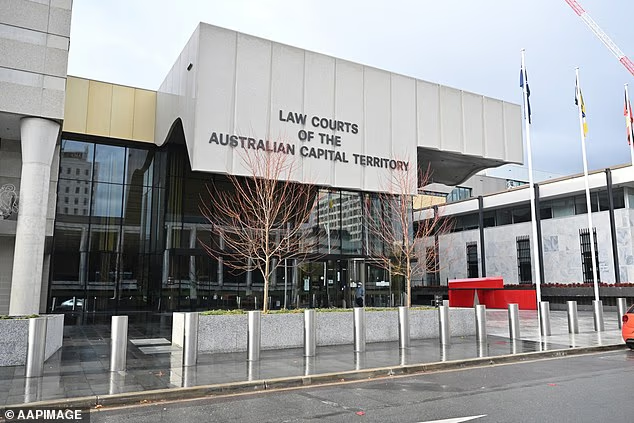
A convicted child rapist has failed in a bid to escape paying more than $700,000 to the man he abused as a child after a judge ruled his extraordinary argument about a model train set had virtually no prospect of overturning the award. (Above: a view of the ACT Supreme Court)

John Paul Garay, who was jailed in 2022 over the sexual abuse of a boy in the 1980s, argued key parts of his victim's account could not be true because a train set described in the evidence didn't exist at the time of the abuse. The Supreme Court of the ACT was unconvinced, however. (Stock image posed by model)
Justice Mossop noted the train set argument had already been examined during Garay's failed criminal appeal and said Garay's reasoning faced a critical problem: even if he could prove the train set timeline, it would not necessarily undermine the abuse findings.
The judge said the train set was just one detail in a much larger account of years of grooming and sexual abuse and was not central to the allegations themselves.
'The train set was significant for the applicant's case at trial,' Justice Mossop wrote.
'[However] having observed the applicant working on a train set at a particular time was a detail of the evidence in relation to two particular incidents.'
He found the alleged sighting of the train set was simply a 'temporal marker' within the broader pattern of abuse.
The judge also endorsed findings by Justice Belinda Baker, who had accepted Mr Kovalenko as a 'credible and reliable witness' while rejecting Garay's evidence as unreliable.
Justice Mossop said even if the train-set evidence turned out to be inaccurate, arguments based on it had 'negligible prospects' of overturning the detailed credibility findings made in favour of the abuse victim.
'An erroneous, or even false, statement about an event adjacent to two out of 15 occasions of abuse over a nine-year period has, in this case, negligible prospects of requiring the detailed assessment of the credibility of the respondent to be overturned,' he wrote.
In a particularly damaging finding for Garay, Justice Mossop said the appeal effectively depended on persuading a higher court to completely reverse the trial judge's assessment of both men.
'That is a high bar for the applicant on an appeal,' he said.
Mr Kovalenko successfully sued Garay after alleging he was sexually, physically and emotionally abused between 1979 and 1988, when he was aged between six and 15 and Garay was an adult family friend.
The abuse occurred in Sydney and Canberra, although the civil claim related to conduct in the ACT.
In 2021, Garay was found guilty of six counts of committing acts of indecency in the presence of a child and two counts of sexual intercourse with a child aged between 10 and 16. He was sentenced the following year to five years' jail with a three-year non-parole period.
His criminal appeal was dismissed by a majority of the ACT Court of Appeal and the High Court later refused special leave.
In the civil proceedings, Justice Baker awarded Mr Kovalenko $704,836 after finding Garay's abuse had caused lasting psychiatric injuries, including complex post-traumatic stress disorder.
Justice Mossop ultimately ruled Garay's latest challenge had no reasonable prospects of success, dismissing the application and ordering him to pay costs.
Source link