JD Vance is walking the narrowest tightrope in recent political history.
The heir apparent suffered a brutal setback on Tuesday night as America rejected Donald Trump's brand of conservatism, handing Democrats the House and the Senate.
Vance saw his odds crater on prediction markets. The longtime favorite to win the White House in 2028 now trails newly re-elected Georgia Senator Jon Ossoff.
The vice president wasted no time, blaming the Iran war in a lengthy statement posted to X on Wednesday morning. Trump launched the conflict in February despite his deputy's private misgivings.
The carefully worded statement all but laid the midterm defeat at Trump's feet.
Every word of this is 💯💯💯 https://t.co/EigF8EQYXU
— Donald Trump Jr. (@DonaldJTrumpJr) November 4, 2026
Trump, confronted with the post at the White House hours later, broadly agreed with Vance's diagnosis but refused to concede the war was a mistake.
'I think it's largely true because it drove the gasoline up ... but at the same time if I had it to do again, I'd have to do it again,' he said.
A detailed line-by-line analysis reveals the dangerous game Vance is now playing as recriminations erupt inside a White House ruled by an isolated, lame-duck president notoriously quick to throw aides overboard.
The vice president's words are italicized below.
One of the things the data analysts on our side obsessed over was "composition"—whether the electorate looked close enough to 2024 for Republicans to win. And despite polls that showed a Democrat blowout, the data kept on telling us the same story: in some states turnout was…
— JD Vance (@JDVance) November 4, 2026
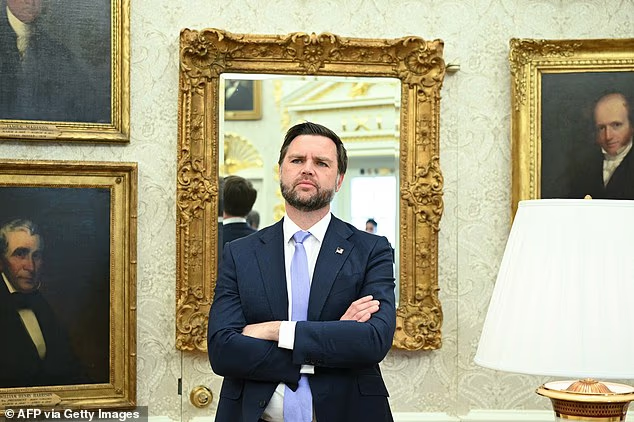
JD Vance listens to President Trump as he hosts Stephen Hubbard in the Oval Office on October 30
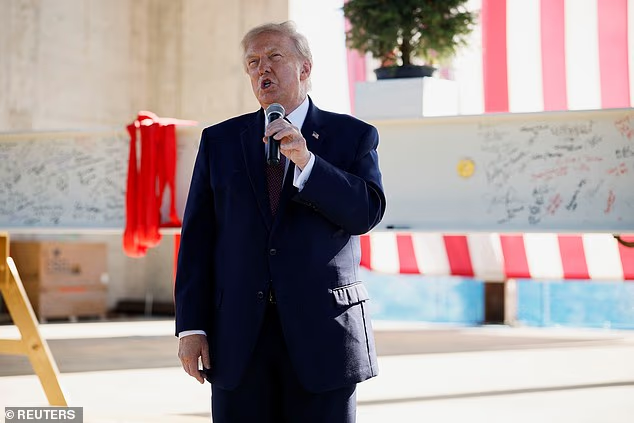
Trump speaks on the day the final steel beam goes into the ballroom at the White House on Wednesday
What JD Vance's statement means
What Vance says: One of the things the data analysts on our side obsessed over was 'composition' - whether the electorate looked close enough to 2024 for Republicans to win. And despite polls that showed a Democrat blowout, the data kept on telling us the same story: in some states turnout was merely OK, in other states it was downright amazing, and in no state was it catastrophic. There was a genuine sense of optimism on our team: our people were showing up.
What he means: Vance opens by acknowledging that the Republican Party machine underestimated the anger among ordinary Americans, particularly in deep red states that powered the president in his three White House runs.
That machine was run to great effect in 2024 by Susie Wiles, now White House chief of staff, and her ally Chris LaCivita.
Wiles repeatedly promised Trump a midterm win, sources told the Daily Mail, even as his approval rating sank to 32 percent. Vance is saying the 'genuine sense of optimism' came from her team.
What Vance says: So, I asked the smartest data guy I know, does that mean we're going to shock the world? 'No,' he told me. 'We might do better than the polls suggest. But the data is telling us that a lot of Trump/Vance 2024 voters are pissed and planning to vote for the other guys. Our voters are turning out, but they may not vote for us.'
Well, that looks prophetic now. Our voters did show up. In Florida, for example, the electorate was 9 points more Republican than Democrat, just a couple points worse than 2024. Undoubtedly there were places we could have done better on turnout. But the main problem is not turnout. The main problem is that many people who voted for Trump/Vance in 2024 voted for Democrats in 2026.
What he means: Vance stamps his own name on the 2024 coalition, twice invoking 'Trump/Vance' while dodging responsibility for his own role since entering government.
At the same time, he pointedly concedes that some of the operative class saw the wave coming, and that the warning went unheeded.
Notably, when those same voters are 'angry' and defecting in the next section, they become simply 'Trump 2024 voters.'
What Vance says: There will be a lot of infighting and arguing over what happened and why that is. One of the pollsters I really respect told me that our economic messaging wasn't sharp enough down the stretch. I'm sure that's true.
But the real reason we lost is obvious to almost everyone.
What he means: Vance is getting his shield up as the daggers start flying. He predicts 'a lot of infighting and arguing', casting himself above the fray on the morning leaks began gushing from the White House.
He doesn't dare say the economy itself is bad, so he blames the messaging instead.
What Vance says: Another pollster - one of the smartest people I know in politics, told me yesterday we'd lose the generic ballot by 13 points. I felt negative going into Tuesday, but even I was shocked by this. In his polling, he saw that a lot of Trump 2024 voters were angry and planning to vote for Democrats. He asked those voters who had abandoned us what would cause them to come back on our team. The top four answers, accounting for nearly all of the responses were:
1) End the war
2) Focus on cost of living/inflation
3) Put America First
4) Change our relationship to Israel
What he means: This is Vance's 2028 manifesto in a nutshell: a gentle departure from MAGA as Trump defines it, and a pivot toward America First.
Every item is a rebuke of the administration Vance serves, and each comes from the mouth of this conveniently anonymous pollster.
The list noticeably ignores the appearance of government corruption, which national exit polling suggests may have been the single biggest factor for voters.
Vance also leaves out his own central role in trying to end the war. He led peace talks with Iran in Islamabad in April.
Trump joked at the time: 'So, if it doesn't happen, I'm blaming JD Vance.'
Seven months on, Vance says that war, not his failed negotiations, cost his party Congress.
What Vance says: Our voters showed up. And the above four reasons are why many of them voted for Democrats. This is according to a pollster who nailed the results. While many spent Monday attacking Rachel Campos Duffy for calling for a diplomatic resolution to the conflict, it turns out her political advice was sound. (She's also a great person.)
What he means: The passage amounts to a pointed criticism of the administration's record: Vance argues that Trump voters did not simply stay home but turned out and backed Democrats instead.
Early exit polls lend support to that argument, although turnout also appears to have helped Democrats.
Vance's nod to Rachel Campos Duffy, the Fox News host wife of Transportation Secretary Sean Duffy, is no throwaway line.
She has fended off accusations of antisemitism over her objections to the Iran war, hitting back at conservatives accusing her of crossing over to 'the dark side.'
Not only does Vance again mark out the gap between himself and Trump on Israel, but he makes it personal, calling her 'a great person,' and invoking the allegations he himself has faced for his anti-war position.
What Vance says: In the next few months, there's going to be a lot of gaslighting. Expect to hear any number of establishment politicians say the solution to our woes is amnesty. I'm open to the idea that we should change enforcement - by focusing more on businesses that hire illegal labor, for instance. But anyone pushing amnesty is lying to you.
What he means: Vance's warning of 'gaslighting' is aimed at the 'establishment politicians' he expects to push amnesty as the fix.
By branding his anticipated critics the establishment, Vance is trying to insulate himself from Republicans who may seek to carve out a more moderate approach.
Yet he also signals a softer line. His suggestion of shifting enforcement toward 'businesses that hire illegal labor' reads as a tacit admission that the ICE raids went too far, while making clear he remains vigilant.
What Vance says: The reason we lost is the war. The president himself said so last night.
What he means: This is the statement's sharpest passage and a clever sleight of hand. By making the bold claim that Trump agrees with him, Vance closes the gap with the president even as he widens it.
Trump acknowledged on election night that 'Iran was a piece of it,' but stopped short of identifying the war as the decisive reason for the Republican defeat.
He told Fox News: 'I don't think it's the war... I think it's the gasoline price.' He gave the Wall Street Journal another culprit: 'The biggest issue is that I wasn't on the ballot.'
Vance presents his own much blunter assessment as common ground with Trump rather than a break with him, claiming the president had already endorsed it.
What Vance says: If you'd like to argue it was worth it, that losing the Senate for the next 6 years was worth it, then do so. Argue it was a worthwhile cost to pay. Agree or disagree, that's at least honest.
But everyone knows why we lost. And any honest conversation about where we go from here must start there.
What he means: Vance dares his critics to argue the war was worth it – and Trump answered his challenge just hours later.
Asked whether the war was worth it, Trump replied: 'I do, yeah ... I would have done nothing differently.'
Trump said he had known Vance's position from the start. 'I know how he feels about it,' he said, and called the post 'good.'
But Trump was pointedly cooler on Vance's future. 'Maybe he won't run, I don't know who's gonna run,' Trump told reporters.
What Vance says: I remain hopeful about our country. To the people who are pissed off and want to say, 'I told you so': you're right, you did tell us so. Take that energy into electing Republicans who share your worldview. To the people who are just pissed at the results, you should be. Let's take that anger and get back to the work of saving our country.
What he means: This is the 'I feel your pain' section of the statement, Vance's acknowledgment that he has heard the voters' message as he nears a decision on 2028.
He offers the administration's critics an unusually direct concession: 'you're right, you did tell us so.'
The subtext is that the administration did not listen, but the next Republican in the White House would.
His instruction to voters is not to abandon the Republican Party, but turn their anger toward a discussion about its future.
Vance's plans are now inextricably tied to whether Trump heeds the same lessons in his final two years or casts them aside. Either way, the tension between the president and his would-be successor has only grown.
Source link