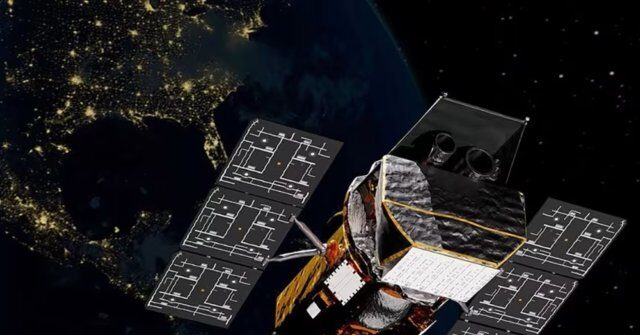
NASA’s Swift Observatory, a gamma-ray-hunting telescope that spent two decades watching the universe’s most violent explosions, is expected to fall from orbit within hours.
The Daily Mail reports that the 3,200-pound spacecraft is predicted to reenter Earth’s atmosphere on Wednesday mid morning, according to NASA tracking. The agency’s map of possible reentry paths spans Central and South America, Africa, South and Southeast Asia, northern Australia, and stretches of the Pacific, Atlantic and Indian oceans. Any surviving fragments would likely land somewhere within a broad equatorial band covering Latin America, Africa, southern Asia and northern Australia. The United States and Europe sit outside that zone.
We’re tracking the upcoming reentry of the Swift space telescope📡
— The Aerospace Corporation (@AerospaceCorp) November 2, 2026
The NASA Neil Gehrels Swift Observatory, launched in 2004 to study space objects and events, is now on its return to Earth.
Aerospace's Center for Orbital and Reentry Debris Studies has just released an updated… pic.twitter.com/mmq09B1FZ7
“Re-entry locations of any surviving components can vary from hemisphere to hemisphere and depend on when it re-enters,” NASA said in a statement.
Swift launched in 2004 with a prime mission meant to last just two years. It ended up running for 21, scanning the sky for gamma-ray bursts and other short-lived cosmic events, until increased solar activity started dragging its low Earth orbit down faster than expected.
“We’ve known this day would come since before Swift was launched,” said John Nousek, a Pennsylvania State University astronomer who worked on the mission. “At least in low-Earth orbit, what goes up must come down. And that end is catastrophic.”
NASA tried to buy Swift more time in August, sending a rescue spacecraft called Link, which had launched in early July. The $30 million effort failed after Link went into an uncontrollable spin a few weeks after liftoff. Flight controllers managed to slow the tumble, but the craft never regained reliable pointing and positioning, and the rescue was called off.
“This is not the outcome we were working toward, but it does not change why this mission was worth attempting,” NASA Administrator Jared Isaacman said at the time.
Swift kept working after the failed rescue, picking up more gamma-ray bursts and ultrahigh-energy events before its orbit finally dropped too low to hold steady for observations. Its systems were shut down in late October.
Over its lifetime, Swift logged more than 2,000 gamma-ray bursts and 1,400 exploding stars, along with comets, asteroids and black holes caught shredding nearby stars. It could swing around quickly toward sudden eruptions in the sky, which let it act as a kind of first responder, flagging targets for larger instruments like the Hubble and Webb space telescopes to study in detail. Scientists are now working out how to cover the gap its absence leaves in that early-warning role.
“Our fervent hope is that the lessons learned by the successes of Swift can be applied to new generations of space missions to accelerate our discoveries about the universe,” Nousek said.
Read more at the Daily Mail here.
Lucas Nolan is a reporter for Breitbart News covering issues of AI, free speech, and online censorship.
Source link