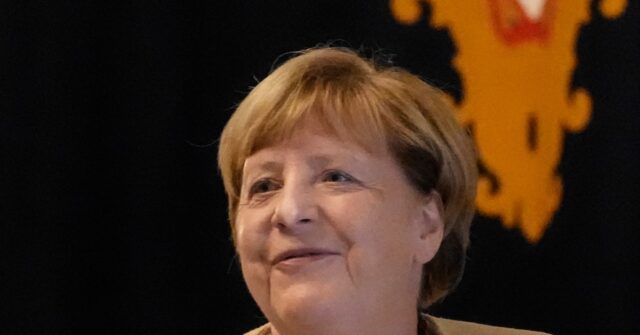
Former German Chancellor Angela Merkel has argued that migrants from countries like Syria should be viewed as equally German as Germans who grew up in the former East Germany.
In remarks delivered at the International Mendelssohn Prize ceremony in Leipzig, Germany, former Chancellor Merkel doubled down on the open-borders ideology which came to define her political career.
Merkel, Germany’s only female leader and the only citizen from the formerly Soviet-controlled East Germany to ascend to office after reunification, lamented the rise of “populist parties” allegedly seeking to divide the country.
She invoked the concept of the “Volk”, a national collective of a people, and a term which comes loaded with some historical undertones due to its use by the Nazi regime.
According to Die Welt, the former Chancellor said that in Germany, all power flows from the Volk, but argued that “the Volk are all German citizens.”
Denying any distinction for the ethnic Germans, Merkel remarked: "And no one asks: 'Did you come later from East Germany, or did you perhaps arrive as a Syrian only three years ago?' All German citizens are the Volk."
However, she complained that some were seeking to stoke “divisions” by recognising a difference between “those who have only recently become citizens, and then there are those who have been citizens for a bit longer.
“They try to create divisions, they try to incite hatred, they try to differentiate and thereby provoke envy,” Merkel said.
The argument over who qualifies as German has become a hot-button issue in recent years, particularly amid the demographic insecurity caused in large part by the decision in 2015 by then-Chancellor Merkel to open the gates to millions of migrants from the Middle East and Africa, sparking the European Migrant Crisis.
However, discussion in Germany of such topics can also be fraught with peril, given that there are literal legal limits imposed on the acceptable bounds of political discourse.
Merkel Blasted for Calling on Migrants to Vote Against Populist AfD Partyhttps://t.co/K1uOxuuuuy
— Breitbart London (@BreitbartLondon) March 15, 2026
The anti-mass-migration Alternative for Germany (AfD) party has said it favours a national identity that affords all citizens the same rights, regardless of heritage. However, it has also argued that protecting German ethnicity, the German language, and the traditions associated with both is a legitimate aim.
“For us, there is no such thing as first- and second-class citizens. At the same time, the party commits itself to preserving a German people distinct from the people of the state,” the party said in 2021.
AfD leader Alice Weidel has argued that it is not unconstitutional to accept that the German people are a distinct ethnic group, rather than a civic identity, a category which some have branded as “passport Germans”.
Weidel previously noted that although the concept has fallen out of fashion with liberal elites in Berlin, the phrase “To the German People (Volk)” is inscribed over the main entrance of the West side of the Reichstag building. According to the Bundestag Parliament, housed in the building, a Berlin Jewish family foundry produced and installed the letters in 1916.
The debate over civic and ethnic identity has also come to the forefront of British politics in recent months, with some questioning Conservative Party leader Kemi Badenoch’s assertion that she is English because she was born in London. Yet if she were born several years later, she would not automatically have received citizenship by virtue of being born in the country, as the British Nationality Act of 1981 abolished birthright citizenship.
Opponents have noted she was born to two Nigerian parents and was raised in the African country for much of her early life and therefore does not meet the standard of an ethnic or cultural Englishness. Badenoch has also demanded that her children be recognised as English, even though she is of Nigerian heritage and her husband is Scottish.
In contrast, former Home Secretary Suella Braverman, who was born and raised in England, has said she does not consider herself English because both her parents are ethnically Indian. Braverman and others have argued that the term “British” could be used as a civic national identity that could encompass people with migrant backgrounds such as herself, while terms like English, Welsh, or Scottish should be reserved for ethnic categories.
“There have been English people for centuries and we need to recognise this more if we are to start taking a more muscular approach to citizenship and nationality. And no, it's not racist to say this,” Braverman said in September.
“Other countries have no qualms in limiting who can be part of their citizenry and use ethnicity and culture as criteria. Here, the dogma of multiculturalism has been so corrosive that some people don't actually know who we are anymore.”
Now You Say! German Chancellor Admits Immigration and Failed Assimilation Caused French Riotshttps://t.co/ASVbM3E9ow
— Breitbart London (@BreitbartLondon) October 21, 2026
Source link