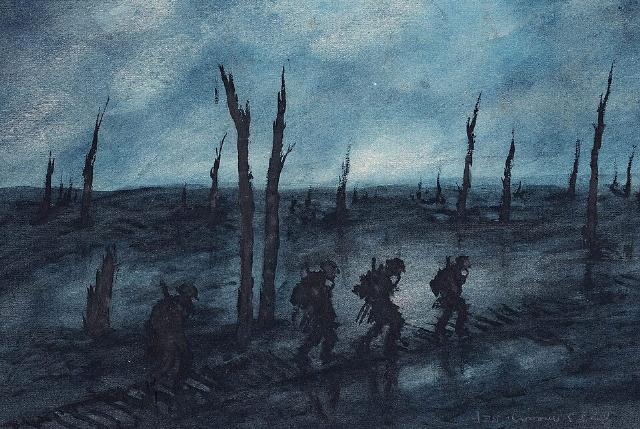
From Wikimedia Commons: WWI battlefield at night (F. J. Mears, unknown date)
The West has long cherished a consoling fiction: that history's bloodier chapters closed with the twentieth century's great catastrophes, leaving behind a
socially matured civilization capable of resolving conflict through markets, dialogue, and the redistribution of resources. This conviction—equal parts progressive teleology and liberal complacency—treated human nature as an infinitely malleable artifact rather than a fixed and flawed constant.
The wars of the former Yugoslavia and the Russian invasion of Ukraine have exposed the fiction with brutal clarity. What remains is the necessity of "forced realism"—an unsparing recognition that envy, hatred, tribal loyalty, and the will to dominate endure unchanged, and that any polity ignoring them courts catastrophe.
The outbreak of the Yugoslav wars in the early 1990s arrived as an almost metaphysical affront. The Cold War had ended; the ideological struggle that had structured European politics for decades had dissolved. In the prevailing Western imagination, war itself had become anachronistic, a relic of primitive passions that enlightened institutions and rising prosperity had supposedly outgrown.
Yet within months, the successor states of Yugoslavia descended into campaigns of ethnic slaughter whose methods and intensity recalled WWII. Serbian nationalist forces, in particular, orchestrated systematic ethnic cleansing, the establishment of detention camps at sites such as Omarska, Keraterm, and Trnopolje, and the calculated use of rape as an instrument of terror. The siege of Sarajevo subjected a European capital to years of artillery and sniper fire.
Most starkly, in July 1995, Bosnian Serb units under Ratko Mladi?? executed more than eight thousand Bosniak men and boys at Srebrenica—an act later adjudicated as "genocide" by both the International Criminal Tribunal for the former Yugoslavia and the International Court of Justice. Cultural monuments—mosques, churches, libraries—were deliberately erased to extinguish the material memory of rival communities. Approximately 130,000 to 140,000 people died during the wider Yugoslav wars, with more than four million being displaced.
Nothing in the preceding half-century had altered the underlying capacities that made these crimes possible. The West had simply chosen to believe that the material abundance and institutional sophistication of the postwar order had rewritten the human script. That belief rested on a shallow anthropology: the assumption that interpersonal and intergroup conflict is primarily a function of scarcity or misrecognition, both of which can be remedied by economic transfers and deliberative procedures. Once scarcity is alleviated and recognition extended, the argument ran, residual antagonisms will dissolve into the solvent of mutual interest.
The Yugoslav tragedy demonstrated the poverty of this reasoning. The combatants were not starving primitives; they were Europeans inheriting the technological and administrative apparatus of a modern state, and they turned that apparatus to the service of ancient hatreds with terrifying efficiency.
The Russian assault on Ukraine in February 2022 repeated the pattern on a larger scale and with greater strategic consequence. Once again, Western capitals expressed astonishment that a power would choose conquest over negotiation, as though the language of civilized discourse possessed some inherent compulsory force.
Russian columns advanced towards Kyiv under the expectation of rapid collapse; when that expectation failed, the conflict settled into a grinding contest of attrition whose tactical features evoke WWI more than any recent conventional war. Extensive trench networks, dense minefields, and belts of obstacles have constrained maneuver. Artillery has reasserted its primacy as the principal killer. Large armored thrusts have frequently given way to small infantry assault groups operating under continuous fire, a distant echo of the German stormtrooper tactics of 1918.
Territorial advances are measured in hundreds of meters rather than tens of kilometers. The war has already outlasted the duration of WWI itself. Its logic is industrial and demographic: a test of which side can sustain the greater expenditure of men, munitions, and political will.
These two shocks—Yugoslavia and Ukraine—have forced upon the West a recognition it had labored to avoid. Constrained and recalcitrant by nature, human beings continue to hate, to envy, and to mistreat those they regard as alien or threatening. Love and loyalty bind communities; the same passions, inverted, license their destruction. No quantity of redistributive policy dissolves these facts. The belief that conflict is ultimately economic in origin has functioned less as an empirical claim than as a moral alibi, permitting elites to treat military preparedness and the hard realities of power as residual embarrassments of an earlier age.
The practical consequences of that alibi are now visible across Western Europe. Since the end of the Cold War, most European states reduced their armed forces to levels that left them dependent on American military power and American production capacity. Rearmament, when it has occurred at all, has proceeded with agonizing deliberation.
Simultaneously, climate policy framed in the language of existential urgency has accelerated the dismantling of heavy industry, further eroding the material foundations of strategic autonomy. The result is a civilization that lectures the world on normative evolution while remaining unable to defend its own frontiers without external patronage. War has returned Europe to a reality that is raw and merciless: geography, demography, industrial capacity, and the willingness to kill still decide outcomes.
Philosophically speaking, the failure is deeper than mere policy error. It reflects a sustained refusal to confront the permanence of the tragic. Classical political thought, from Thucydides to Hobbes, understood politics as the management of ineradicable human passions under conditions of scarcity and fear. Modern liberal internationalism inverted that understanding, treating the passions themselves as historical residues destined for transcendence. The result has been a peculiar combination of moral vanity and strategic fragility. When mass graves appear in Europe or Russian armor crosses an internationally recognized border, the response is first astonishment and only later, reluctantly, the rediscovery of power.
Forced realism consists precisely in abandoning the astonishment. It requires the West to recover a self-understanding grounded in the continuity of human nature rather than in progressive myths of irreversible civilizational maturation. Economic redistribution may alleviate certain forms of misery; it does not extinguish the capacity for organized cruelty. Dialogue may postpone conflict; it does not abolish the interests that generate it. Only institutions that take those interests seriously—armed forces capable of deterrence, industries capable of sustaining them, and political cultures capable of acknowledging tribal loyalty without romanticizing it—offer any prospect of durability.
The alternative is continued oscillation between utopian expectation and traumatic disillusionment. Each new eruption of violence will again be met with the claim that "this time" the perpetrators have violated some newly achieved civilizational standard, as though the standard itself possessed causal force. In truth, the standard is an aspiration, not a description.
The massacres of Srebrenica and the attrition of the Ukrainian front demonstrate that the older description retains greater explanatory power. A realistic West would cease treating that demonstration as a temporary aberration and begin treating it as a permanent constraint.
According to Thomas Sowell, human nature is fixed, flawed, and driven by self-interest; it cannot be re-engineered to achieve moral perfection. Nor is civilization a malleable project for utopianism, but a fragile repository of evolved traditions, laws, and social mechanisms designed to manage these permanent flaws.
Source link