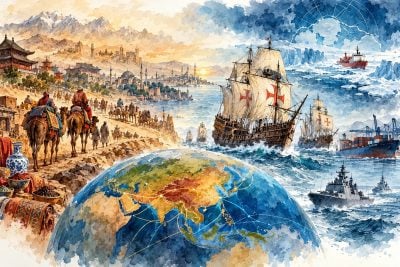
Five centuries ago, west's wind defeated the Asian caravan.
Later steam replaced sail, oil displaced coal.
Today, Asian industry, energy, technology, and algorithms challenge Atlantic hegemony.
***
Five hundred years ago, the center of gravity of the world economy was in Asia. The historical process set in motion by Europe's expansion into the oceans would eventually give rise to a new global order that integrated sea power, production, capital, and technology. China and India were among the world's principal centers of wealth, not merely because of their large populations, but also because of their agricultural output, sophisticated craftsmanship, extensive trade networks, scientific knowledge, and thriving urban economies. At a time when Europe had yet to emerge as a global center of power, a substantial proportion of the world's most valuable, traded commodities originated in Asia. The wealth of the East aroused both admiration and an appetite for riches in the West. Silk, spices, porcelain, cotton textiles, precious stones, and advanced metal products were tangible manifestations of Asia's productive capacity and economic supremacy.
This supremacy was not merely commercial; it rested on profound demographic and economic realities. According to historical population estimates, the world's population around 1500 stood at approximately 450–500 million, of whom nearly 60 percent lived in Asia. China and India each accounted for close to one-quarter of the global population. Based on Angus Maddison's historical estimates of economic output, China and India together accounted for nearly 50 percent of world production in 1500. At the dawn of the modern era, the center of the world economy was not the Atlantic but Asia.
Asia's wealth reached the Mediterranean and Europe through vast, interconnected trading networks. The Silk Road, stretching from China across Central Asia, Persia, Anatolia, and onward to Mediterranean ports, was not a single route but an extensive economic and cultural system comprising overland caravan routes that had developed over centuries. These routes carried not only silk and precious commodities but also scientific knowledge, religions, technologies, and cultural influences across continents. The Spice Route, extending from India and Southeast Asia toward the Persian Gulf, the Red Sea, and the Mediterranean, constituted another major trading network combining maritime and overland routes. Black pepper, cinnamon, cloves, nutmeg, and other valuable commodities commanded high prices in European markets. Although coastal navigation played an important role in this maritime trade, seafarers also undertook open-ocean passages across the Indian Ocean, taking advantage of the seasonal monsoon winds.
One of the most striking characteristics of this trading system was Europe's long-standing position as a dependent purchaser of Asian goods. Commodities originating in the production centers of the East reached Western markets through the seafaring communities of the Indian Ocean, Arab and Persian merchants, Central Asian caravans, and the maritime trading cities of the Mediterranean. Although maritime republics such as Venice and Genoa accumulated considerable wealth from this commerce, the principal centers of production remained outside Europe. Europe sought access to the riches of the East but lacked direct control over both the centers that produced them and the trade networks through which they were transported.
In the late thirteenth century, the journeys of the Venetian merchant Marco Polo to Asia, particularly his accounts of China under the Yuan Dynasty, intensified European interest in the East. His travel narratives introduced European readers to China's great cities, sophisticated commercial networks, use of paper currency, and the economic capacity of its imperial administration. The East was no longer merely a distant geographical realm; it had become a vast world of wealth that Europe aspired to reach.
One of the fundamental economic motivations behind Europe's expansion into the oceans was precisely the desire to gain direct access to this wealth without relying on intermediaries. Securing a greater share of the silk and spice trades, establishing direct maritime access to Asia's centers of production, and reducing dependence on traditional trade networks were among the principal objectives driving Portuguese and Spanish voyages of exploration. In other words, Europe's initial ambition was not so much to seize Asia's wealth as to discover direct routes to it.
At the same time, the Ottoman conquest of Istanbul placed a strategically vital crossroads of Eurasian commerce under the control of the Muslim world, with which Christian Europe had been engaged in intense rivalry since the Crusades. The Ottoman Empire's position along major commercial arteries connecting East and West further reinforced Europe's determination to circumvent established trading networks and seek alternative maritime routes to the riches of Asia.A new sea route had to be found.
The Shift of Global Dominance from Asia to the Atlantic
Christopher Columbus's crossing of the Atlantic and arrival in the Americas in 1492, followed by Vasco da Gama's voyage to India via the Cape of Good Hope in 1498, marked two major turning points in world history. Europe gained access to new oceanic sea routes that enabled it to bypass traditional overland trade routes and Mediterranean-centered intermediary trading networks. Thus began the historical process through which the center of gravity of the world economy would gradually shift from Asia to the Atlantic.
Europeans integrated shipbuilding, cartography, the magnetic compass, astronomy, naval gunnery, and financial resources into a formidable maritime system. Large ocean-going sailing vessels enabled not only the transportation of commercial goods but also the projection of military power across vast distances. Wind was no longer merely a source of propulsion; it had become a strategic instrument of global dominance. Yet the West was not the first civilization to harness the power of wind at sea. The Chinese, Arabs, and seafaring societies of the Indian Ocean had maintained sophisticated maritime trading networks for centuries. The great expeditions of the Chinese Admiral Zheng He during the fifteenth century were compelling evidence of this maritime capability. What distinguished the West was its transformation of seafaring capacity into a global system of domination through armed commerce, colonial expansion, state sponsorship, and capital accumulation.
While the Portuguese established strategic maritime strongholds throughout the Indian Ocean, the Spanish channeled the wealth of the Americas into the emerging Atlantic economy. They were followed by the Dutch and the English, who integrated chartered trading companies, banking, marine insurance, and naval power into increasingly sophisticated systems of maritime expansion. Seaborne trade accelerated capital accumulation; capital financed stronger fleets; and those fleets secured control over new markets. Sea power thus became not merely the protector of wealth but also an instrument for its creation.
Overland trade did not disappear, nor did Asia's productive superiority come to an immediate end. Nevertheless, oceanic shipping, colonial expansion, and naval military power gradually shifted the center of the world economy toward the Atlantic. What increasingly mattered was not simply who produced the goods, but who controlled the sea lines of communication, maritime transportation, and the financial mechanisms underpinning international trade.
This is why the great transformation of the fifteenth and sixteenth centuries can be summarized in a single sentence: ''The wind defeated the caravan.'' Yet it was not sail power alone that defeated the caravan. Behind the sails stood naval artillery, capital, state organization, and the determination to establish overseas dominion. These were the foundations upon which five centuries of Atlantic supremacy were built.
Today, however, one of history's great ironies is unfolding. Five hundred years ago, the West rose to prominence by reaching Asia's wealth across the oceans. Today, China's industrial production, merchant fleet, shipyards, ports, and technological capabilities are challenging the economic foundations of the Atlantic-centered order. The West, which once ventured across the oceans in pursuit of the riches of the East, now finds itself confronting Asia's resurgence within the very global system it created. Today, industrial production, technological capability, and maritime trade are challenging the historical privileges of Atlantic hegemony.
Practice Outpaced Theory (16th–18th Centuries)
The foundations of humanity's scientific and technological knowledge were laid to a considerable extent by the ancient civilizations of the East. Mathematics and astronomy flourished in Mesopotamia; geometry and engineering advanced in Egypt; China made major contributions to the development of the compass, gunpowder, paper, and mechanical technologies; while Islamic civilization achieved remarkable progress in algebra, optics, astronomy, medicine, and engineering. Within the Islamic scientific tradition, in which Turkic and Persian intellectual and cultural circles played prominent roles, the mechanical inventions of Al-Jazari, the pioneering work of Al-Khwarizmi in algebra and mathematics, Al-Biruni's research in astronomy and geography, Ibn Sina's contributions to medicine, and the achievements of Ulugh Beg, Ali Qushji, and Qadi Zada al-Rumi in astronomy and mathematics became integral parts of humanity's shared scientific heritage. Europe's scientific ascent also benefited substantially from this accumulated knowledge, particularly through its translation into Latin during the Middle Ages, its subsequent development, and its integration with new methods of observation, experimentation, and scientific inquiry.
The decisive historical turning point, however, lay not so much in the production of knowledge as in its transformation into economic and military power. Although China and the Islamic world possessed sophisticated engineering capabilities, major infrastructure projects, and advanced manufacturing techniques, these achievements did not evolve into a continuously expanding system of mechanized production on the scale that would later characterize Europe's Industrial Revolution. From the sixteenth century onward, Europe increasingly began to apply scientific knowledge in a more systematic manner to navigation, naval gunnery, shipbuilding, commerce, and finance.
Maritime affairs became the field in which theoretical knowledge was most directly converted into strategic power. Astronomy improved the safety and accuracy of navigation; mathematics and geometry advanced cartography and hydrographic surveying; metallurgy enhanced naval artillery; and mechanical engineering contributed to ship design and construction. Capital generated through maritime commerce financed technological innovation, while the military requirements of competing states accelerated scientific research and technical development. A mutually reinforcing relationship emerged among science, production, capital, and sea power. By the eighteenth century, this process, combined with the increasing application of steam power and mechanization, had laid the foundations for the Industrial Revolution.
Why, then, did Eastern societies, which possessed substantial scientific knowledge during the same period, fail to undergo a comparable transformation? The answer must be sought not only in differences in technology or capital accumulation but also in the intellectual and institutional structures that shaped the production, questioning, and practical application of knowledge.
In Europe, reason, observation, experimentation, and critical inquiry increasingly moved to the center of scientific progress. Meanwhile, in certain influential educational and intellectual institutions of the Islamic world, the emphasis placed on the knowledge transmitted through established traditions and inherited authority tended to narrow the scope for independent inquiry. This distinction was, of course, neither absolute nor universal. Rational thought and experimentation never disappeared from the East, just as the influence of religious authority did not vanish entirely from Europe.
Over the longer term, however, the decisive difference lay in the strengthening of institutions that encouraged knowledge to be continuously tested, refined, expanded, and translated into productive capabilities, rather than merely preserved and transmitted. Ultimately, historical supremacy was determined not simply by which civilization possessed the greatest body of knowledge, but by which societies were capable of critically reassessing that knowledge, renewing it, and converting it into economic, technological, and military power. At its most fundamental level, the issue concerned the relationship between reason and transmitted authority.
The essential distinction, therefore, was not that the East produced only theory while the West produced only practical applications. Both civilizational spheres possessed sophisticated scientific traditions and advanced engineering capabilities. The decisive difference was that, in Europe, scientific advances became increasingly integrated with capital accumulation, institutional transformation, commercial competition, and military requirements, creating a continuously expanding system of production and power.
This historical transformation can be summarized in a single proposition: The East pioneered the development of much of humanity's scientific and technological knowledge. The West, in turn, integrated this accumulated heritage from different civilizations with sea power, capital, and increasingly mechanized production, transforming it into global dominance.
Thus, the decisive determinant of global supremacy was no longer merely the possession of knowledge, but the capacity to convert knowledge into productive capability, economic wealth, and military superiority.
Mercantilism Evolved into Capitalism, and Capitalism into Imperialism
The oceanic voyages of exploration that began in the late fifteenth century did more than reshape the geography of world trade. They initiated a historical process that fundamentally transformed Europe's economic, political, and social structures. The expansion of maritime commerce, colonial expansion, capital accumulation, and scientific advances reinforced one another, establishing the economic foundations of Western global supremacy. This transformation unfolded in three major stages.
In the first stage, during the fifteenth and sixteenth centuries, European states established new trading networks connecting Asia, Africa, and the Americas through oceanic exploration and the expansion of overseas commerce. Between the sixteenth and eighteenth centuries, mercantilism emerged as the dominant economic doctrine, seeking to strengthen state power through favorable balances of trade, the accumulation of precious metals, colonial possessions, and protectionist policies. Powerful merchant fleets and naval forces were indispensable instruments of this system. Control of maritime trade routes, the enrichment of state treasuries, and the restriction of rival powers' commerce were interconnected elements of the same strategic objective.
In the second stage, spanning the seventeenth to nineteenth centuries, the Scientific Revolution, Enlightenment thought, the development of financial institutions, and ultimately the Industrial Revolution accelerated the transformation of accumulated commercial capital into industrial productive capacity. Steam power, mechanization, iron and steel production, and railway networks became the new engines of economic growth. During the nineteenth century, industrial capitalism, driven by its growing demand for raw materials, cheap labor, new markets, and secure lines of transportation and communication, fueled the expansion of modern imperialism. Sea power now became essential not only to the protection of maritime commerce but also to the maintenance of industrial production and supply chains on a global scale.
In the third stage, during the twentieth and twenty-first centuries, this historical process evolved into a global system of financial, technological, and military dominance. Particularly after the Second World War, the United States emerged as the principal power of the Atlantic-centered order through its dollar-based international financial system, global economic institutions, advanced technological capabilities, worldwide network of military bases, and naval forces deployed across the world's oceans. The supremacy once secured through colonial ports and merchant fleets thus evolved into a multilayered system of power sustained by financial markets, energy transportation routes, technological standards, and military alliances.
Capitalism's emergence, of course, cannot be explained solely through colonialism. Europe's internal agricultural transformation, evolving property relations, urbanization, commercial institutions, legal systems, and technological developments also played decisive roles. Nevertheless, colonial exploitation, enslaved labor, coercive trading arrangements, and the transfer of overseas resources substantially accelerated capital accumulation, particularly within the Atlantic economy. An increasingly powerful relationship of mutual dependence emerged between economic expansion and military strength. Religion also played an important role as an instrument of legitimacy and political organization throughout this process. The early colonial expansion of Spain and Portugal was supported by the missionary objectives of Catholic Christianity and religious narratives that sought to legitimize overseas conquest. With the rise of Protestantism, states such as the Netherlands and England developed a different economic synthesis in which commercial entrepreneurship, financial institutions, overseas chartered companies, and evolving work cultures became increasingly interconnected.
Ultimately, mercantilism, capitalism, and imperialism were not rigidly successive systems that mechanically replaced one another. Rather, they were historically intertwined economic and political orders whose development frequently overlapped. Their common characteristic was the conversion of economic wealth into political and military power, and the subsequent use of that power to secure new economic privileges.
Within this mutually reinforcing relationship, sea power became one of the principal strategic instruments underpinning five centuries of Western ascendancy. By venturing into the oceans, Europe transformed maritime commerce into capital, capital into industrial capacity, and industrial capacity into military superiority, thereby shifting the center of global dominance toward the Atlantic.
The Age of Energy and Sea Power
Throughout history, the evolution of sea power has been inseparable from transformations in energy. Every major revolution in energy and propulsion has altered the operational capabilities of fleets, the geography of maritime commerce, and ultimately the global balance of power. Yet the decisive factor has never been energy alone. Maritime supremacy has belonged to those powers capable of integrating energy resources, propulsion technologies, industrial production, naval capabilities, and logistical infrastructure into a comprehensive system of strategic power. From the age of sail to the era of nuclear propulsion and autonomous maritime systems, control of the seas has depended increasingly on the capacity to transform energy and technology into sustained maritime and military superiority.
In the late fifteenth century, ocean-going sailing ships harnessing wind power became the principal instruments of Europe's overseas expansion and global maritime supremacy. During the eighteenth century, the development of precision marine chronometers, capable of maintaining accurate timekeeping despite a ship's motion and rolling, made it possible to determine longitude reliably, marking a breakthrough in ocean navigation. In the nineteenth century, the widespread adoption of coal-fired steam engines and, particularly, screw-propeller propulsion systems substantially reduced ships' dependence on prevailing winds and seasonal conditions. As a result, maritime transportation became faster, more reliable, and more predictable. The expansion of scheduled ocean services accelerated the growth of international trade.
The transition from sail to steam represented far more than a technological improvement in ship propulsion. It fundamentally changed the strategic requirements of maritime supremacy. While sailing fleets depended primarily on winds, seamanship, and access to suitable ports, steam-powered fleets increasingly required secure coal supplies, coaling stations, repair facilities, and an extensive network of overseas naval bases. Consequently, the ability to sustain naval operations across the world's oceans became inseparable from industrial capacity and global logistical infrastructure.
The new energy system, integrating steam-powered warships, industrial production, and railway networks, further consolidated Britain's global naval supremacy. During the twentieth century, petroleum and internal combustion engines transformed the mobility, speed, and operational range of naval and air power. Access to oil reserves, refineries, replenishment facilities, and maritime lines of communication became a central strategic priority for the great powers. Following the Second World War, nuclear propulsion systems provided submarines with the capability to remain submerged for extended periods and conduct sustained operations on a global scale. Energy security and command of the sea thus became inseparable components of economic and military superiority.
The strategic significance of these transformations extended beyond the performance of individual ships or weapons systems. Each new energy regime reshaped the infrastructure required to sustain maritime power. Coal made overseas coaling stations indispensable; petroleum elevated oil-producing regions, tanker routes, refineries, and strategic maritime chokepoints to critical geopolitical importance; and nuclear propulsion introduced new requirements in reactor technology, specialized shipbuilding, nuclear fuel infrastructure, and highly skilled personnel. ''The history of sea power is therefore also the history of competition to control the energy systems and industrial networks upon which maritime supremacy depends.''
The twenty-first century is witnessing another major technological transformation. Advances in electricity generation and energy storage technologies, nuclear energy, artificial intelligence, autonomous maritime systems, satellite networks, and digital infrastructure are fundamentally reshaping the character of sea power. Maritime supremacy can no longer be measured solely by the possession of major surface combatants, aircraft carriers, or powerful naval fleets. The shipyards capable of building and maintaining these platforms, advanced semiconductors, critical minerals, energy infrastructure, software capabilities, and uninterrupted logistical support have all become integral components of the strategic power equation.
This transformation does not render the traditional elements of sea power obsolete; rather, it integrates them with emerging technologies. Nuclear-powered submarines, unmanned surface vessels (USVs), unmanned underwater vehicles (UUVs), artificial intelligence-enabled command-and-control systems, and space-based intelligence, surveillance, and reconnaissance (ISR) networks are expanding the speed, operational reach, and effectiveness of naval operations. At the same time, access to energy resources, the security of strategic maritime chokepoints, and the uninterrupted functioning of global supply chains remain essential to the economic and military resilience of states.
The implications for the emerging global balance of power are profound. In previous centuries, the Atlantic powers consolidated their supremacy by combining advances in maritime propulsion with industrial production, overseas bases, and control of international trade routes. Today, the growing importance of shipbuilding capacity, advanced manufacturing, energy technologies, digital infrastructure, and maritime logistics is introducing new dimensions into the competition for global maritime supremacy. In this context, the expanding industrial and maritime capabilities of Asian powers, particularly China, challenge the historical concentration of these capabilities within the Atlantic-centered order. Ultimately, the central lesson of five centuries of maritime history is that command of the sea cannot be separated from command of the industrial, technological, energy, and logistical systems that sustain it. The transition from wind to coal, from coal to petroleum, and from petroleum to nuclear propulsion and increasingly autonomous systems has repeatedly transformed the foundations of naval power. The dominant maritime powers have been those capable of adapting to these transformations and integrating them into comprehensive national power.
The emerging struggle for maritime supremacy in the twenty-first century will therefore be determined not simply by the number of warships, aircraft carriers, or submarines a nation deploys, but by its ability to design, build, power, maintain, replenish, and replace them while sustaining the commercial and industrial networks upon which national power ultimately rests. Energy transforms propulsion. Propulsion transforms maritime reach. But it is the integration of energy, industry, technology, and logistics that transforms sea power into global power.
Conclusion: The Turning Point of a Five-Hundred-Year Historical Cycle
World history is marked by great transformations in which economic wealth, productive capacity, and military supremacy shift from one geographical center to another. Five hundred years ago, such a transformation unfolded from Asia toward the Atlantic. By venturing into the oceans, Europe integrated the scientific knowledge of the East with sea power, capital, and military organization, gradually shifting the center of the world economy. Mercantilism, industrial capitalism, and imperialism constituted mutually reinforcing stages of this ascent. Western supremacy rested not merely on powerful navies, but on the ability to integrate production, commerce, finance, and military power into a coherent strategic system.
Yet no hegemony can endure indefinitely when its underlying economic and technological foundations begin to erode. The decline of the British Empire demonstrated that naval supremacy, when no longer adequately supported by productive economic capacity, can eventually become a costly strategic burden. Today, although the United States retains its global military reach, the financial privileges of the dollar, and its strengths in advanced technology, China's expanding industrial production, shipbuilding capacity, and maritime commerce are challenging the economic foundations of the Atlantic-centered order. Conflicts in the Strait of Hormuz, the Bab el-Mandeb Strait, and the Red Sea have also demonstrated that military superiority alone cannot guarantee the security of sea lines of communication. The Arctic Revolution adds another geopolitical dimension to this transformation by opening new maritime routes and energy connections across the northern reaches of Eurasia.
The fundamental issue is therefore not simply China's rise or America's relative decline. It is the restructuring of the relationship among production, capital, technology, and sea power that has sustained Atlantic supremacy for five centuries. In the emerging global struggle for power, the decisive factor will not merely be the ability to deploy warships across the oceans, but the possession of the industrial capacity to build them, the energy resources to sustain their operations, the merchant fleets to maintain international trade, and the economic resilience to finance the entire system.
For Türkiye, this historical transformation offers important strategic lessons. The true strategic value of the Blue Homeland (Mavi Vatan) doctrine extends beyond the protection of maritime jurisdiction areas. It must be integrated with a strong merchant marine, a competitive shipbuilding industry, modern port infrastructure, energy security, advanced maritime technologies, and an independent industrial base. Naval superiority unsupported by productive economic strength cannot be transformed into enduring geopolitical power.
Five hundred years ago, despite its immense productive capacity and accumulated wealth, the East lost control of the expanding oceanic trading system to the West. Today, while the West continues to retain substantial naval and military superiority, it faces the growing industrial and technological power of Asia. History is not repeating itself in precisely the same form, but the economic foundations of global power are once again shifting.
Five hundred years ago, the wind defeated the caravan. Steam displaced sail and oil supplanted coal as the dominant source of maritime propulsion. Today, industrial production, energy, technology, and algorithms are challenging the foundations of Atlantic hegemony. History now confronts us with a fundamental question: ''Can the West, which rose to global supremacy by gaining maritime access to Asia's wealth five centuries ago, preserve its privileged position within the international order it created in the face of Asia's resurgent productive power?'' Sea power can protect wealth, secure maritime trade routes, and establish military superiority. But over the long term, it cannot substitute for the economic and industrial foundations that sustain it. Five hundred years ago, the wind defeated the caravan. Today, history is approaching another turning point: ''Will the power of production ultimately overcome the supremacy of the Atlantic?''
*
Click the share button below to email/forward this article. Follow us on Instagram and X and subscribe to our Telegram Channel. Feel free to repost Global Research articles with proper attribution.
This article was originally published on Mavi Vatan.
Ret Admiral Cem Gürdeniz, Writer, Geopolitical Expert, Theorist and creator of the Turkish Bluehomeland (Mavi Vatan) doctrine. He served as the Chief of Strategy Department and then the head of Plans and Policy Division in Turkish Naval Forces Headquarters. As his combat duties, he has served as the commander of Amphibious Ships Group and Mine Fleet between 2007 and 2009. He retired in 2012. He established Hamit Naci Blue Homeland Foundation in 2021. He has published numerous books on geopolitics, maritime strategy, maritime history and maritime culture. He is also a honorary member of ATASAM.
He is a Research Associate of the Centre for Research on Globalization (CRG).
Featured image is from the author
Global Research is a reader-funded media. We do not accept any funding from corporations or governments. Help us stay afloat. Click the image below to make a one-time or recurring donation.

Comment on Global Research Articles on our Facebook page Become a Member of Global Research
Source link