
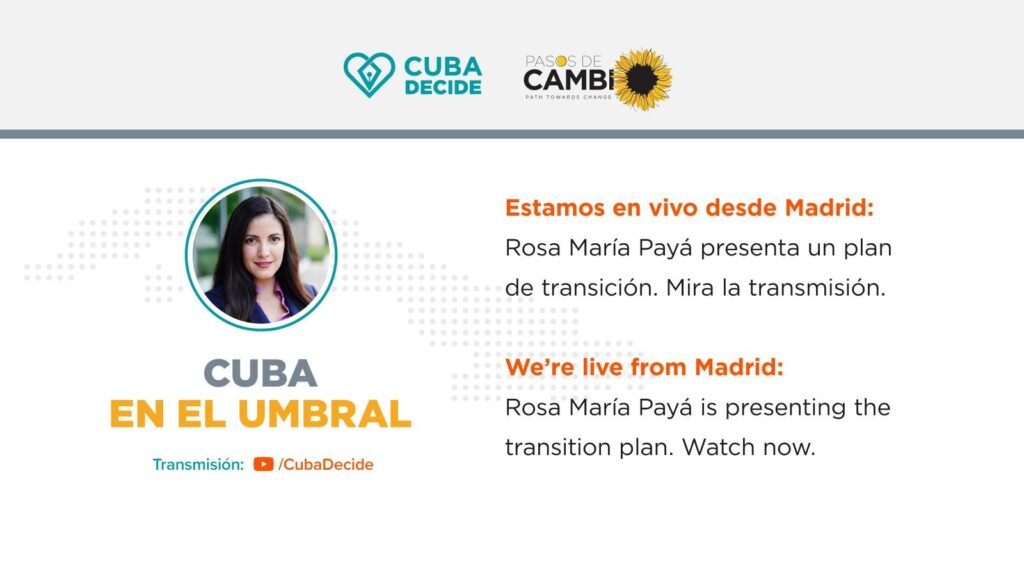
Rosa María Payá's Madrid presentation put Cuba's democratic transition back on the international agenda.
As new discussions are expected to take place in Seville next week, the focus is shifting from ending Communist rule to answering a much bigger question: How does Cuba rebuild after nearly seven decades of dictatorship?
For nearly seven decades, Cuba has been governed by a one-party Communist system that has eliminated political competition, restricted fundamental freedoms, weakened private enterprise, and driven millions of its citizens into exile.
The consequences are impossible to ignore: economic collapse, widespread poverty, deteriorating hospitals, shortages of food and medicine, an unreliable electrical grid, and the systematic persecution of political opponents.
But condemning the dictatorship is no longer enough. The international community and the Cuban opposition must also address what comes next.
That was the central message emerging from Madrid, where Cuban opposition leader Rosa María Payá presented Cuba en el Umbral, a roadmap for democratic transition developed around the Acuerdo de Liberación.
The initiative represents an important evolution in the Cuban opposition's strategy. Rather than focusing exclusively on denouncing repression and demanding political change, it seeks to prepare the institutional, economic, humanitarian, and security structures necessary to rebuild the country.
THE DAY AFTER THE DICTATORSHIP: WHO WILL REBUILD CUBA?
One of the most important lessons from the collapse of authoritarian regimes around the world is that the fall of a dictatorship does not automatically produce democracy.
Countries can move from one authoritarian structure to another if there is no institutional reform, accountability, protection of individual rights, and genuine political competition.
Cuba must avoid that outcome.
The Madrid proposal addresses four fundamental stages: liberation, stabilization, reconstruction, and democratization.
The first priority must be ending political repression and securing the release of political prisoners. There can be no credible democratic transition while political opponents remain behind bars and citizens continue to face persecution for exercising their fundamental rights.
The second challenge is humanitarian stabilization.
During the Madrid presentation, the team outlined an emergency response plan for the first 180 days of a transition. It includes delivering food, drinking water, medicine, and essential sanitary products, with immediate assistance intended to begin within the first 72 hours.
The scale of the humanitarian challenge is enormous. The organizers cited estimates that 94% of Cuban households live in extreme poverty and that eight out of ten Cubans regularly sacrifice one or more meals a day.
The assistance must reach ordinary families without political discrimination. Food, medicine, and humanitarian relief cannot become instruments of political control.
ECONOMIC FREEDOM: CUBA NEEDS MORE THAN FINANCIAL ASSISTANCE
Perhaps the most important long-term challenge is economic reconstruction.
Cuba cannot recover through temporary financial assistance while maintaining the same economic model that contributed to its collapse.
The country needs to restore private property rights, encourage entrepreneurship, attract international investment, establish legal certainty, and dismantle the structures that have placed enormous economic power in the hands of the military and the Communist establishment.
A functioning economy requires more than foreign currency. It requires confidence, independent businesses, competitive markets, access to capital, and institutions that protect investors and citizens alike.
The transition must also address monetary instability, inflation, the collapse of productive capacity, and the destruction of incentives for Cuban workers and entrepreneurs.
For the millions of Cubans living abroad, this represents an enormous opportunity to contribute to national reconstruction.
The Cuban diaspora possesses capital, professional expertise, business networks, international relationships, and experience in free-market economies. Those resources could become essential to rebuilding the island.
But exiles must be able to return, invest, own property, establish businesses, and participate freely in the country's future.
FROM A STATE SECURITY SYSTEM TO THE RULE OF LAW
Another fundamental question is what happens to Cuba's security and military institutions.
A democratic transition cannot simply change the people in government while leaving the machinery of political repression intact.
The Madrid roadmap addresses the need to reform security institutions, establish civilian control over the armed forces, dismantle structures responsible for political persecution, and ensure that law enforcement operates under constitutional guarantees.
The objective must be to transform Cuba from a police state into a country governed by the rule of law.
Justice must also be part of the process. Human rights violations, political persecution, and the misuse of public resources cannot simply be ignored.
At the same time, a credible transition will require legal safeguards, due process, institutional accountability, and protections against arbitrary retaliation.
The lesson from other post-Communist transitions is clear: removing an authoritarian leadership is only the beginning. Democratic institutions must be built to ensure that authoritarianism cannot return under a different name.
THE ROLE OF THE UNITED STATES, EUROPE, AND THE CUBAN EXILE COMMUNITY
Cuba's future will ultimately be decided by Cubans. However, the international community has an important role to play.
The United States, Spain, the European Union, and governments throughout Ibero-America should make democratic freedoms, political pluralism, and respect for human rights central to their policies toward Havana.
Diplomatic engagement should not become an excuse to legitimize political repression or preserve the existing power structure.
International cooperation will also be essential in mobilizing humanitarian assistance, supporting economic reconstruction, protecting investors, and ensuring credible electoral processes.
The Cuban exile community must have a place in this conversation. Generations of Cubans who were forced to leave their homeland should not be treated merely as observers of the country's future. Their knowledge, experience, and resources can help rebuild it.
FROM MADRID TO SEVILLE: THE CONVERSATION CONTINUES
The debate taking place in Madrid will continue in Seville on November 11, when several activists and economists will gather to discuss the impact of socialism in Cuba and throughout the region.
The discussions will examine not only the Cuban experience but also the broader political, economic, and institutional consequences of socialist policies across Ibero-America.
Cuba provides one of the clearest historical examples of what happens when political power, economic decision-making, and control over civil society become concentrated in the hands of a single party.
The experience of Venezuela offers another warning about the consequences of institutional deterioration, political authoritarianism, economic mismanagement, and the destruction of productive capacity.
The central question is whether other countries in the region will learn from these experiences or repeat the same mistakes.
Spain, with its historical, cultural, and family ties to Cuba, has a particular responsibility to encourage an honest discussion about the island's future.
The question is not simply whether Cuba can change. It is whether the international community is prepared to support a genuine transition that places freedom, human dignity, and economic opportunity above political interests.
THE FINAL MESSAGE: CUBA MUST BE READY FOR FREEDOM
The opportunity for change must be accompanied by preparation, international cooperation, and a commitment to ensuring that the next chapter of Cuban history is fundamentally different from the last seven decades.
When that historic opportunity arrives, the Cuban people must be ready to choose their leaders, rebuild their country, welcome home their exiles, and reclaim their national sovereignty.
CUBA DOES NOT NEED ANOTHER REVOLUTION. IT NEEDS FREEDOM. CUBA'S FUTURE MUST BE A FREE REPUBLIC.
About The Author
Source link


